Collecting lucky charms, finding parking spots, acting as a tour guide... A pair of smart glasses is unlocking the "life mode" of AI.
Written by | Xu Jiajing
Edited by | Ba Rui
Cover image source | AI-generated
Collecting the Five Blessings has become a must - have New Year activity. Somehow, over the years, this "blessing ritual" has evolved into a standardized process. Before Chinese New Year's Eve, people hold up their phones, aiming at the Chinese character "Fu" at home or various forms of "Fu" characters found online, repeatedly focusing, scanning, and identifying them one by one. However, the eagerness for the much - sought - after "Dedication Blessing" seems to have gradually diminished over the years of repetitive operations.
But this year, the scene of collecting the Five Blessings has started to change. Alipay is introducing a new way to collect the blessings, a lighter, more futuristic, and tech - savvy approach — scanning the "Fu" with AI glasses. Of course, you need to own a pair of advanced Rokid or Quark AI glasses first.
If you have a pair, you can show off. For example, when walking on a festive street and seeing a special "Fu" character, you can stop, rest one hand on the stylish and multi - functional temple of the glasses, strike a pose if you like, point the glasses at the character, press the shooting button, and say "Scan the Fu". The "Fu" character in your field of vision will be slowly circled, and at the same time, your phone in your pocket will vibrate slightly, indicating that a blessing card has been received.

How about it? Isn't it quite futuristic?
You don't need to deliberately look for blessings anymore. Wherever your eyes land, you can effortlessly complete the "unconscious" process of collecting the Five Blessings. Moreover, when looking at the world through AI glasses, there are hidden Easter eggs everywhere. This year, collecting the Five Blessings is no longer limited to scanning the "Fu" character. You might even unexpectedly get a blessing card when your sight passes by the character "Ma" or a horse - shaped pattern.
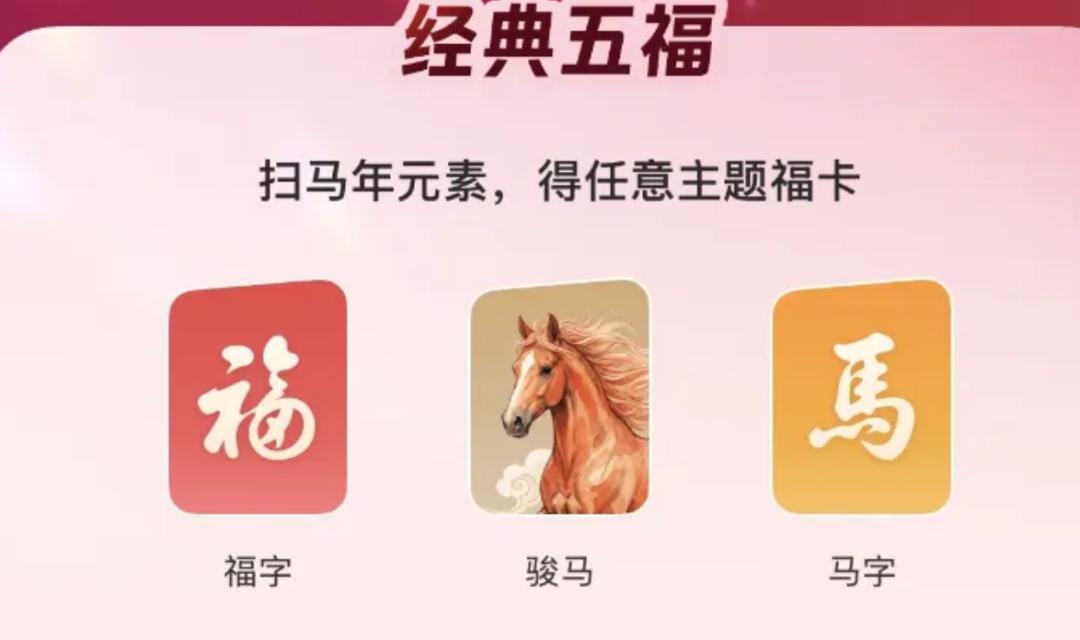
Even popular domestic IPs like "Honor of Kings" and "Country Love" have joined the activity of collecting the Five Blessings. When you see the character images related to them, you might suddenly find several Easter - egg blessing cards in your Alipay account. The real world has directly turned into a large - scale open - world game of collecting the Five Blessings.
Behind this smooth experience is the collaborative support of Ant Group's GPASS intelligent terminal trusted connection technology framework and Agent intelligent agent architecture.
It can be said that this is a very interesting new attempt of AI glasses that we've seen recently — using the Five Blessings as an entry point, it's a signal that AI glasses are being integrated into daily life. Before we know it, AI glasses, still in the process of ramping up production, have begun to penetrate into various life scenarios, unleashing greater imagination.
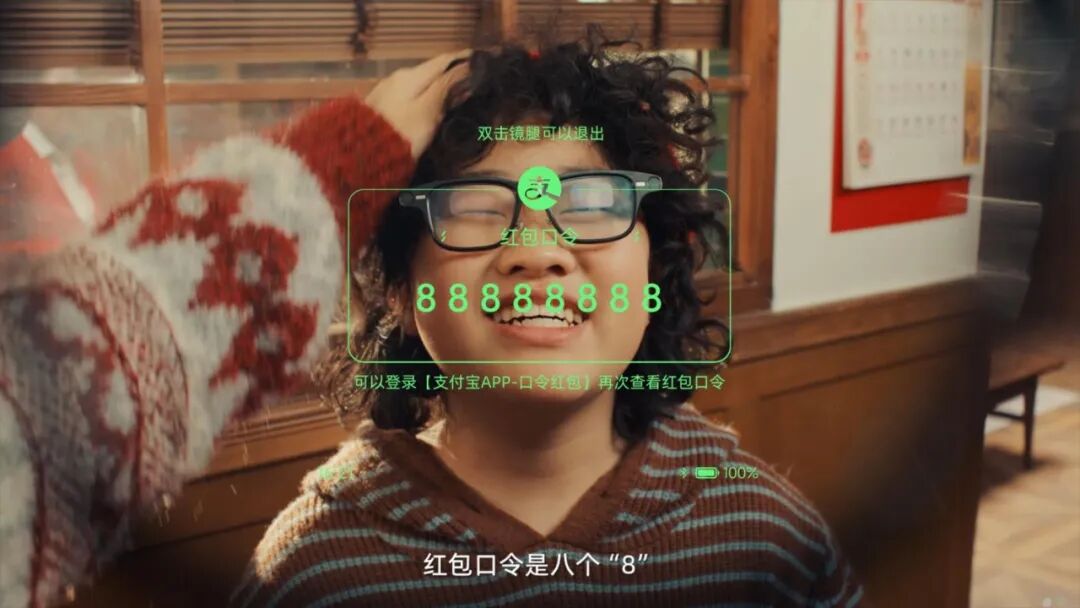
Issue a red - envelope password using AI glasses
The imagination of "services at your side" has come true
The penetration of AI glasses into daily life often starts with small things. Although it may seem like just a tiny step, looking at the covered scenarios, the upgrade of the service experience of AI glasses has actually taken a big step forward without our notice.
Let's take a simple example — paying for parking.
We probably all have a similar experience. When leaving a parking lot, we often have to queue up. Every car owner stopped in front of the barrier gate may experience a bit of a "fuss". First, they switch between apps to find the payment interface, then enter the license - plate number to pay, or roll down the window and stretch their arms to reach the QR - code scanning machine. Until they leave the parking lot, they can't help but feel annoyed.
But now, if you wear a pair of smart glasses connected to Ant's GPASS, the experience can be completely changed. As soon as your vehicle enters the parking lot, you'll hear a voice prompt saying "Timing starts". When you're about to leave, just say "XX, pay the parking fee", and the AI assistant will automatically query the bill and give a voice report. All you need to do is say "Confirm", and the payment will be completed, eliminating the cumbersome intermediate steps.
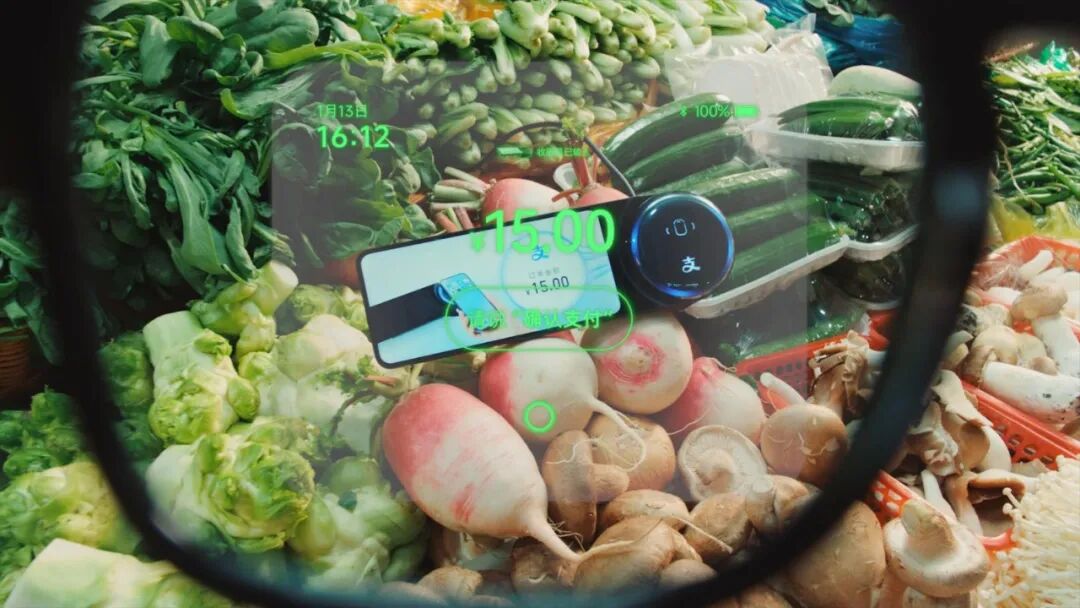
For users who are already used to using Alipay's "Look to Pay" function, this function can also be directly transferred to AI glasses. Just turn your head and look at the parking QR code, and the glasses will automatically scan the code and complete the payment for you. The barrier gate will be raised and let you pass before you even take out your phone.

You might say that this little thing doesn't take much time anyway. Why bother with high - tech? But this is just the beginning of the services carried by AI glasses. Gradually, technology will empower various general life fields, achieving "services at your side".
For example, the field of health care has become an experimental ground for GPASS smart terminals.
In the past, to query health information, you had to take out your phone, type in keywords to search, and manually filter the results. Now, by connecting the AI health assistant "Ant Afu" to smart glasses, this interaction logic has changed. When you're walking, working, or resting while wearing the glasses, just voice your health concerns, from "I've been having trouble sleeping lately" to "What should I eat to reduce internal heat this season", and the AI glasses can answer you at any time in a natural conversation, like a health assistant always by your side.
Another area is culture and tourism, which is the most intuitive scenario suitable for AI glasses. During a journey, everyone dreams of simplifying the accessories they carry and traveling light. Lightweight AI glasses are just perfect for being a tour guide.
At last year's World Internet Conference Wuzhen Summit, AI glasses started their initial exploration in the culture and tourism field. Ant, in collaboration with Rokid's AI glasses and the GPASS technology, can wake up the built - in official intelligent agent "Tong Xiaowu" to provide 24 - hour online tour guidance.

AI glasses equipped with GPass technology enable the intelligent companion tour of the intelligent agent "Tong Xiaowu" at the Wuzhen Summit
When you're strolling on the bluestone - paved road and become curious about an ancient bridge, the glasses can automatically identify it and introduce its historical origin. More practically, what if you get lost outside? Just say "Navigate me to XXX", and the optimal route will be clearly marked on the lens, and at the same time, a brief introduction of the day's key activities will sound. When you're attracted by the aroma of Ding Sheng Cakes at a street stall, pick one up, look at the vendor's payment QR code, and say "Confirm payment", and the transaction will be completed silently.
These seemingly independent and scattered application scenarios all show an ambition: to free people's hands with AI glasses and achieve "services at your side". Moreover, this future blueprint is gradually taking shape.
From "you look for it" to "it looks for you", the service ecosystem of AI glasses has changed
From several application scenarios, we can see that the service logic of AI glasses is undergoing a fundamental transformation from "people looking for services" to "services looking for people" — this might be the decisive moment when "artificial stupidity" turns into "artificial intelligence".
When smart hardware first emerged, the imagination was always bold. However, it often came to a halt when applied to real - life scenarios.
Many devices were jokingly called "artificial stupidity". The root cause is that these so - called "smart devices" often only respond passively to people's instructions and lack the initiative for interactive communication. In the early stage when the infrastructure was not perfect, smart devices couldn't understand specific scenarios and users' real needs, so they had to follow rigid program instructions and give limited feedback.
The "unconscious" experience supported by Ant's GPASS has the opposite underlying logic. Through cooperation with the agent intelligent agent, it transforms the model's capabilities into users' actual life experiences. It can act as a life assistant and complete a logical chain from "perceiving the environment - confirming potential needs - actively offering assistance - getting user confirmation - seamlessly executing and completing".
The essence of this chain lies in the first step — perception, and then intervention.
Recently, when using large - language models to support work, many users particularly appreciate a feature of Gemini: at the end of each response, there is an additional sentence "Do you still need me to help you with XXX", which anticipates users' advanced needs and keeps providing services. From the initial "Don't you know what to do if I don't tell you?" to anticipating needs in advance, users can really feel that the AI agent saves them a lot of trouble.
So how does GPASS improve this chain in AI glasses services? Three key elements: security, interaction, and connection.
When it comes to the application of AI glasses in life scenarios, security is definitely the top concern for everyone. People are very cautious about opening payment permissions and uploading personal information to the cloud. Just like when people switched from using cash to mobile online payment, trust was gradually built up.
GPASS relies on Ant's security system, which has been verified in a large number of financial scenarios, to dispel such doubts as much as possible. A set of biometric identification technology that incorporates voiceprint can ensure "uniqueness", making sure that every "look" and "speak" instruction comes from the user themselves.
Next, let's talk about interaction. The interaction revolution brought by GPASS is about trying to make smart devices learn to anticipate. In real - time scenarios, it can predict in advance the questions that users may have and offer timely assistance. Just like the cultural and tourism practice in Wuzhen, especially in an unfamiliar environment, this interaction mechanism can create a sense of surprise for users and build an immediate "presence" of a "smart life assistant" through natural conversations.
Finally, there is the immersive connection. The smoothness of services is often interrupted when switching between scenarios. Taking out and putting away the phone, switching between apps, all these will reduce the user experience. The connection built by GPASS aims to break this fragmentation. It can intelligently identify scenarios and connect to multiple intelligent agents at the same time. Users don't need to switch between multiple vertical applications, eliminating the step of "finding applications by themselves". At the same time, information can flow seamlessly among the glasses, the phone, and the cloud, and multi - terminal synchronization can reduce all the trouble of manual operations, making services follow the users.
So, you see, these small and gradually implemented scenarios actually represent a change in the underlying service logic of AI glasses. It doesn't bring sudden and extreme efficiency improvements, but a grand vision that "truth lies in the details".
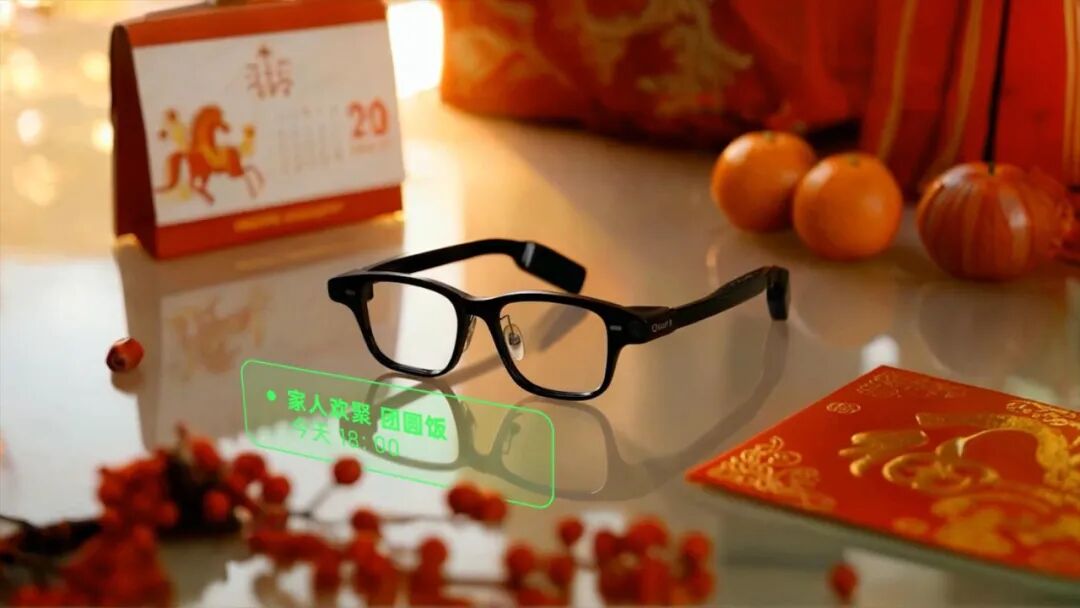
On the eve of the explosion of AI glasses, get this experience ticket first
At the Rokid new - product launch event last November, founder Zhu Mingming boldly predicted: "In three to five years, mobile phones will still exist, but glasses will be the main devices." In fact, as early as 2020, when he was interviewed, he mentioned that smart glasses would be popular and replace or squeeze the market share of mobile phones in five years — which is now.
Now, the entire industry is holding its breath, waiting for the "iPhone moment" of AI glasses to arrive. The industry consensus is that as the next - generation personal computing platform, the critical point for the large - scale explosion of AI glasses is approaching.
According to an IDC report, in the first half of 2025, the global shipments of smart glasses increased by more than 60%. Focusing on the category of AI smart glasses, the sales volume in the third quarter increased by 370% year - on - year, showing amazing market acceleration. Moreover, more than 80% of the global AI glasses supply - chain enterprises are concentrated in China. From the core optical modules and chips to the precise whole - machine manufacturing, Chinese factories have mastered the full - chain capabilities from "producing samples in three days" to large - scale delivery. What used to be an expensive geek toy is quickly entering the field of mass consumption.
Therefore, 2026 is widely predicted to be the "turning - point year" for AI glasses to move towards large - scale application. Now, on the eve of the explosion, everyone is making preparations in full swing.
On the one hand, the hardware production capacity is still ramping up, and manufacturers are accelerating to optimize the balance between cost and performance. On the other hand, the more crucial software and application ecosystem is the key to making AI glasses a real necessity in life. Beyond hardware parameters, experience and ecosystem are the real battlegrounds. Whoever can integrate AI capabilities into real scenarios faster and deeper will get the key ticket to the future blue ocean.
It's like we've built a fleet of ships, but what determines how far they can sail are the compass and the nautical chart. For AI glasses hardware partners like Rokid, Xiaomi, and TCL, they don't need to build a complex service framework and security system from scratch. They can reliably "introduce" the digital service ecosystem through GPASS.
Currently, the rapid implementation of multiple scenarios supported by GPASS is already warming up for the explosion of AI glasses. We also have reason to expect that a future of AI glasses with truly accompanying services and smooth interaction experiences is not far away.