A post-85s doctor who raised 400 million in financing: supplying goods to Huawei and earning tens of millions per month
If there were a new material that could fully charge your new energy vehicle in 15 minutes and increase its range, how much would you think it's worth?
This material is gallium oxide.
Recently, a future unicorn has emerged in this field: Mingjia Semiconductor.
It has just completed its fifth round of financing exceeding 100 million yuan, jointly invested by Pengcheng Venture Capital, Chengdu Science and Technology Innovation Investment Group, Tianying Capital, Henan Guoyu Fund, and Hongtai Fund. As of now, the cumulative financing is nearly 400 million yuan.
Currently, Mingjia Semiconductor's products have been mass - produced: 4 - inch gallium oxide wafers have been shipped, and 6 - inch wafers are stable. It has also reached cooperation with Huawei, BYD, and China Electronics Technology Group and other enterprises, with monthly revenue reaching tens of millions of yuan.
Chen Zhengwei, the founder of Mingjia Semiconductor, is a post - 1985 person, growing up in Anyang, Henan. He graduated from Tianjin Polytechnic University with a bachelor's degree and obtained a doctorate from Saga University in Japan.
Recently, Pencil News had an exchange with Chen Zhengwei about the commercialization opportunities of gallium oxide. The highlights are as follows:
1. What are the long - term pain points of gallium oxide?
The material is expensive and not easy to buy.
2. What are the difficulties in overcoming it?
It requires large material investment, has a long cycle, slow returns, and a high risk of failure.
3. What can it be used for?
It can reduce the electricity bills of household appliances, speed up the charging of new energy vehicles, and improve the industrial energy utilization rate, etc.
4. What are the long - term misunderstandings of investors?
They think that gallium oxide has neither market scale nor commercial imagination space.
5. What are the differences between China and foreign countries?
Japan started earlier, and consortiums lead the investment; China's advantages are a large market, fast response, and the engineer dividend.
6. What is the future trend?
It is estimated that by 2030, China will be on par with the world.
01 The "Ace" Material
The first time I saw "gallium oxide", I was shocked by its "toughness".
In 2011, I went to Saga University in Japan to pursue a doctorate in optoelectronic semiconductor materials. When researching wide - bandgap semiconductors, I tried to compare the key parameters of silicon carbide, gallium nitride, and gallium oxide.
The breakdown electric field strength of gallium oxide can reach over 8 MV/cm, while the most popular silicon carbide and gallium nitride at that time were only 3 MV/cm and 3.3 MV/cm respectively.
It's like ropes of the same thickness. Other materials can only lift 3 tons, while gallium oxide can stably lift 8 tons.
This means that devices can be made thinner, smaller, and more efficient. At that moment, I set my eyes on gallium oxide.
But things got a bit tricky.
Around 2012, gallium oxide was almost "invisible" in the industrial circle. I wanted to buy a gallium oxide substrate for experiments. It was not only outrageously expensive, but only a small department of Japan's Tamura Manufacturing Co., Ltd. (the predecessor of NCT) was promoting it.
The turning point came in 2014. The Japanese industrial circle became obviously agitated. A group of leading enterprises such as Mitsubishi Electric, Sony, and Toyota Central R & D Labs successively launched research and development related to gallium oxide.
You know, Japanese enterprises are always cautious and rarely follow blindly. Once they bet collectively, it means they have calculated the accounts thoroughly. At that time, Japanese peers directly deified gallium oxide, calling it "the material for Japan's semiconductor revival".
Gallium oxide was actually a "backup" at first.
It was initially studied to replace sapphire as an LED substrate. By chance, people found that it performs exceptionally well in the field of power devices: it has higher voltage resistance, lower power consumption, and better efficiency. Many indicators can be several times that of silicon carbide and gallium nitride, and there is even an order - of - magnitude gap in some dimensions.
What's charming about gallium oxide is that it is both powerful and "down - to - earth".
Among ultra - wide - bandgap materials, it is one of the few that can be expected to achieve "large size and low cost" at the same time. It just hits an extremely subtle but extremely important position between top - level performance and commercial implementation.
In 2015, the first Global Gallium Oxide Conference was held in Kyoto, Japan. Looking at the experts from various countries filling the venue, I suddenly had a strong sense of déjà vu - wasn't this exactly what it was like before the explosion of gallium nitride in the late 1990s?
At that moment, I realized that gallium oxide could step out of the laboratory and was very likely to be the "chosen one" for the next - generation power semiconductors.
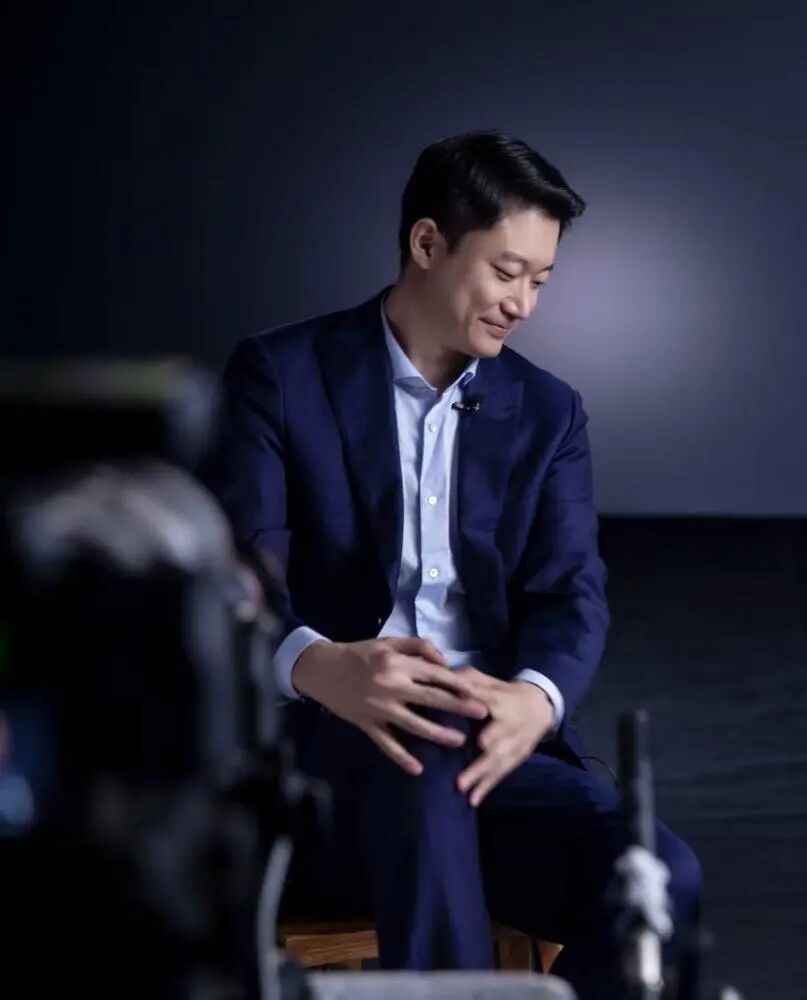
Chen Zhengwei, the founder of Mingjia Semiconductor, is 1.95 meters tall.
In 2016, I was about to graduate with a doctorate.
During that time, I repeatedly reviewed the development path of China's semiconductor materials. The more I looked, the more uncomfortable I felt. Whether it was electronic - grade silicon, gallium nitride, or silicon carbide, there was already a significant gap between us and the international advanced level.
The reason is quite painful.
In those years, global trade was smooth, and the industrial chain was highly open. You could buy ready - made materials with money. Who would be willing to tackle the hard task of self - research? Material research requires large investment, has a long cycle, slow returns, and a high risk of failure.
But from the perspective of material R & D, I did some calculations. If we wait until the market really explodes and then go back to make up for the material link, there will be at least a 5 - to 10 - year generation gap. By the time we realize that "we must do it ourselves", the window period has often passed.
This was also my biggest anxiety at that time. I didn't want to see China repeat the old path with the next - generation materials. I hoped that gallium oxide could start in the first echelon from the beginning.
In 2017, with this "unwillingness to admit defeat", I returned to China.
My idea at that time was very simple. Even if I took the academic route, I had to push gallium oxide one step forward from the papers and move in the direction of "self - research + industrialization".
After returning to China, we got project support from Beijing City and Shunyi District (20 million yuan in start - up funds from the Beijing Sanxin Entrepreneurship Achievement Transformation Investment Fund), and our goals were also very clear:
First, truly develop gallium oxide from scratch;
Second, never touch Japan's core patents (IP). Start from the very beginning on an independent route and build an independent patent pool.
For those few years, hardly any capital in China paid attention. Investors generally thought that gallium oxide had neither market scale nor a clear commercial imagination space. Even so, in 2019, our wafers and epitaxial wafers were successfully developed and put into mass production.
02 Don't Show Off High Parameters, Stabilize Cost - Effectiveness
The year 2020 was a watershed for industrialization.
In this year, STMicroelectronics provided silicon carbide power modules for Tesla Model 3, and the third - generation semiconductors could be commercially used on a large scale.
We decided to step out of the laboratory and start financing.
In 2021, Inno Angel Fund approached us and asked a series of questions: With silicon carbide so popular, what does gallium oxide rely on? What about its poor thermal conductivity, difficult P - type doping, and expensive crucibles?
My judgment at that time was that many "shortcomings" of gallium oxide only become problems when pursuing extreme performance. In reality, most applications do not need to push the performance to the limit.
I gave an example: It's like a house with a maximum ceiling height of 4 meters. Although we can only build it to 2 meters now. But for household appliances, industrial power supplies, and new energy vehicles, a height of 2 meters is already comfortable enough to live in.
The key point is not to "reach the limit" but to be stable, reliable, and cost - effective. So, wherever there is electricity, there is a place for gallium oxide.
What really impressed the investors was the cost - effectiveness.
In terms of the material growth method, gallium oxide can be grown by the melting method, which has a short cycle, low energy consumption, and a simpler raw material system. Compared with the growth cycle of silicon carbide, which can take several weeks, the advantages of gallium oxide in terms of time and manufacturing cost are very obvious.
Even considering the cost of the iridium crucible, after spreading it over large - size substrates, the overall cost structure is still more favorable.
Three months later, the investment agreement was signed.
Inno became our angel investor. Subsequently, well - known institutions such as Hongtai and Zhilu Capital also joined one after another.
One investment left me especially impressed. Zhilu Capital is a US - dollar fund supported by a powerful overseas industrial player. To verify the market, they traveled to Japan and the United States for demonstrations. In the end, that year, we were the only semiconductor project they invested in in China.
Getting the financing is just getting the entry ticket. The real suffering has just begun.
Research pursues "I can grow it", while the industry requires "the market can use it". The first crystal orientation we tackled was (100), and we grew it to 4 inches and 6 inches, with beautiful data. But after all the efforts, we found that the market didn't buy it at all - downstream device manufacturers need the (001) crystal orientation suitable for power devices.
With this change, we instantly went from being a "top student" back to being a "first - grader".
Throughout 2021, every time we opened the laboratory door, we were almost always greeted with failure: cracked crystals, uneven shoulders, and slow growth. The psychological gap of going from 150 millimeters back to 10 millimeters pushed the whole team to the verge of collapse.
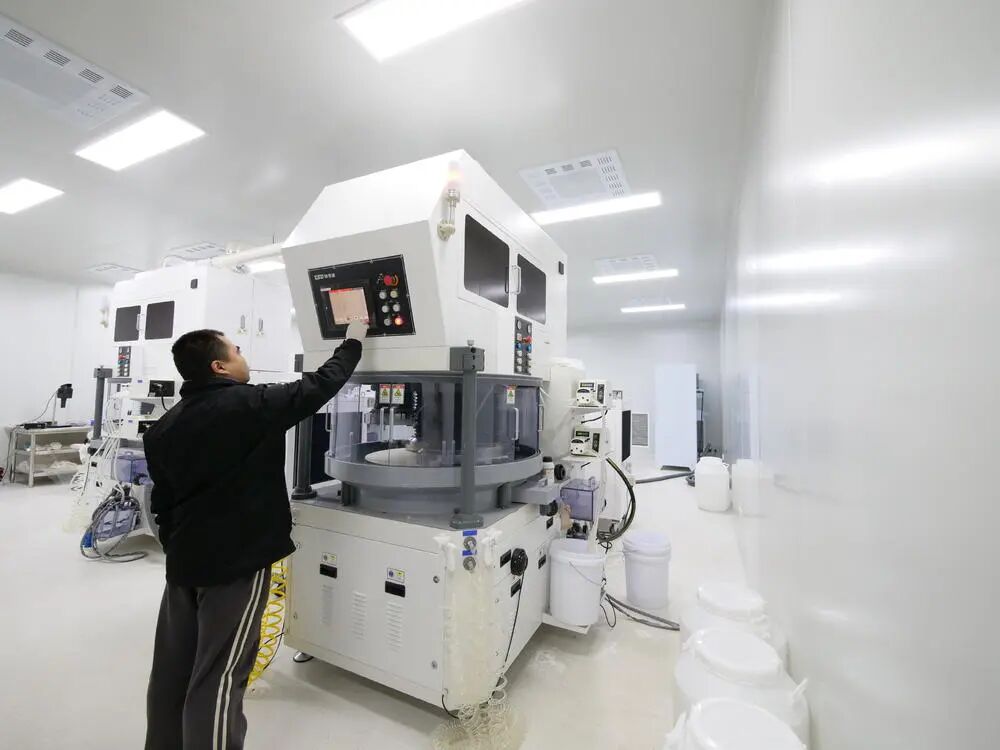
The staff of Mingjia Semiconductor is adjusting the parameter settings for wafer cleaning.
If we want to pursue the path of power devices, we must tackle this crystal orientation. There is no turning back.
It wasn't until March 2022 that the crystals of the (001) crystal orientation finally started to "look decent", growing from 10 millimeters to 1 inch and then 2 inches.
03 Behind Becoming a Supplier to Huawei
An enterprise can't just rely on financing to survive.
Since the end of 2023, the primary market has fallen into a deep freeze, and companies that rely on burning money have suddenly "frozen". We managed to survive because in 2021, we laid out a "two - leg support for one head" hematopoietic logic:
The first leg (survival): Indium phosphide materials and optical crystals. This business has extremely stable demand and contributes tens of millions of yuan in monthly revenue for us.
The second leg (future): Gallium oxide materials and epitaxy. This is the direction that Mingjia really wants to invest in in the long term and is also the core material for the next - generation power semiconductors that we believe in.
It may not be the most profitable in the short term, but it determines how far a company can go in the future and its position.
One head (full - chain): The industrial layout centered around gallium oxide, from materials to applications.
This logic ultimately needs to be verified by products. In 2022, we faced a "big test" - entering the supplier system of a well - known domestic large enterprise.
It took us two whole years to get into the supply chain of large enterprises. From sample verification to a hell - level in - depth factory inspection, we went through a lot of hardships to prove that our materials can not only be used but also be mass - produced with better performance.
In the semiconductor market, there is no "overtaking on a curve". There is only a "positive breakthrough" through the market's harsh tests.
For a material company, the lifeline is the process, and the process is inseparable from equipment. There is a saying in the semiconductor industry: If you don't master the equipment, you are handing your heart to others.
That's why we made a judgment early on: We either make the equipment ourselves or must be deeply bound to the equipment manufacturer and truly "work together".
Ultimately, we chose the latter and cooperated with a little - known growing equipment company.
We didn't choose large enterprises because large enterprises have their own rhythms. Promoting new directions within them has a long decision - making chain and complex processes. While small companies are also "fully equipped" and have a faster response. They can develop equipment that can iterate quickly with our process.
In the "pioneering period" of new materials, flexibility is far more important than scale.
We officially started the cooperation in 2019. They lacked funds, so we paid more advance payments. We lacked equipment, so they fully cooperated with the R & D. The relationship between the two sides is not simply a buyer - seller relationship but a joint effort to push forward based on the same process.
To date, our company's order volume has exceeded the total order volume of their other customers.
This incident is a microcosm of China's industrial chain: In the early stage of industrial development, rather than pursuing a "seemingly strong endorsement", it's better to find a partner who can resonate with you and accompany you through the early uncertainties.
Especially in the field of new materials, what really makes a difference is not who has a big name but who is willing to invest time and resources in the same process route in the long term.
04 Monthly Revenue in the Tens of Millions
Many people have asked me a question: Will gallium oxide replace silicon carbide? My answer has always been clear: No.
In the material world, there is no absolute replacement, only each material's "comfort zone".
Even in this era of "third - generation semiconductors", silicon materials still hold a dominant position, accounting for 70% to 80% of the market share. When gallium arsenide and gallium nitride emerged, silicon didn't disappear.
Silicon carbide is good at high - temperature and high - power - density applications; gallium oxide is more suitable for scenarios with high voltage resistance, low loss, and cost - sensitivity.
