2026: A Big Year for Autonomous Driving IPOs - Technology Builds Barriers, Capital Determines the Landscape
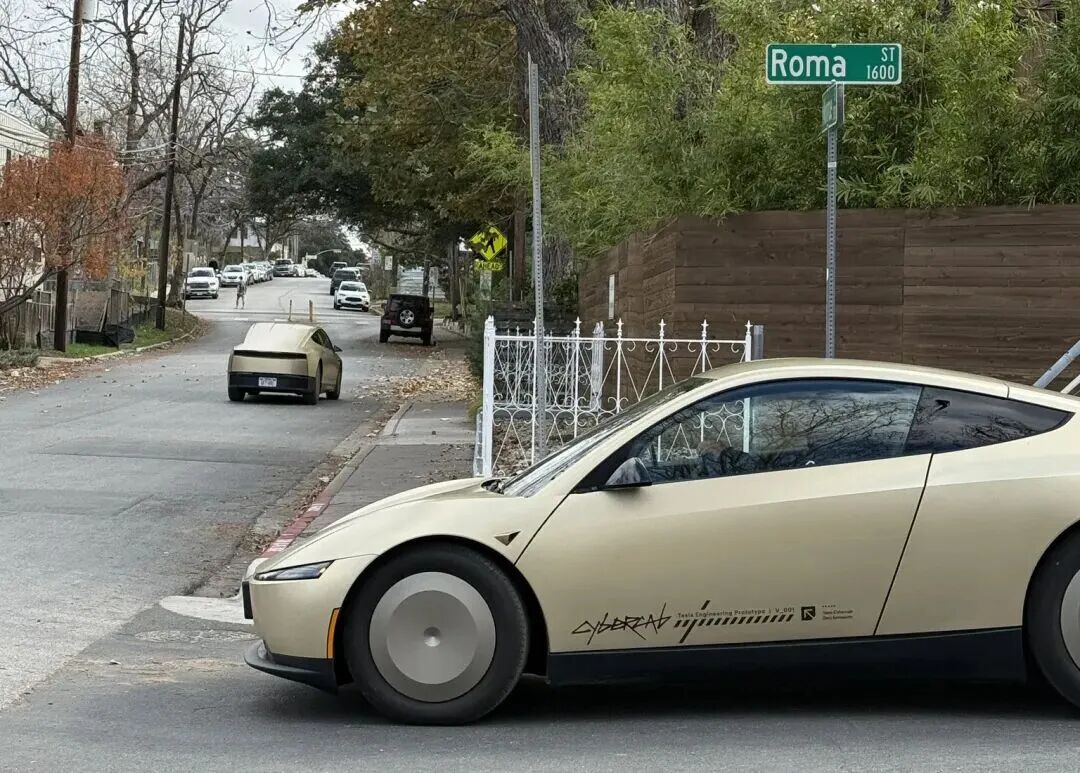
In 2026, the autonomous driving arena is witnessing an unprecedented wave of transformation. Tesla's fully driverless Robotaxi is speeding through the streets of Austin, and Waymo's driverless vehicle fleet has entered Miami Airport. Meanwhile, Chinese companies, represented by Pony.ai, WeRide, and Mobaxi, are making breakthroughs in the global market.
Meanwhile, the trend in the capital market is quietly changing. From the wave of listings on the Hong Kong Stock Exchange in 2025 to the IPO rushes of industry leaders in 2026, autonomous driving companies are moving from the stage of "telling technological stories" to the capital elimination round of "proving commercial viability." Behind this wave of listings lies a deep - seated competition in the three core technologies of algorithms, models, and data, as well as a life - and - death race for companies to cross the deep waters of commercialization.
Underlying Logic: Mutual Empowerment of Technology and Capital
In 2025, the intelligent driving industry chain witnessed a "big year for listings." Nine companies, including Saimu Technology and CIDI Intelligent Driving, flocked to the Hong Kong Stock Exchange, raising over HK$20 billion. This boom is not accidental but the result of the resonance of three factors: technological breakthroughs, policy relaxation, and rational capital investment.
Technologically, the core barrier in autonomous driving is shifting from "hardware stacking" to "soft - power competition in algorithms and models." The maturity of world models has become a key driving force for the implementation of high - level autonomous driving. These models are based on environmental dynamics and multi - agent interaction rules. Through temporal prediction and causal reasoning, they can achieve long - term prediction of the behavior trajectories of traffic participants (with a prediction window of 3 - 5 seconds), addressing the shortcomings of traditional rule - based systems in dealing with unexpected scenarios.
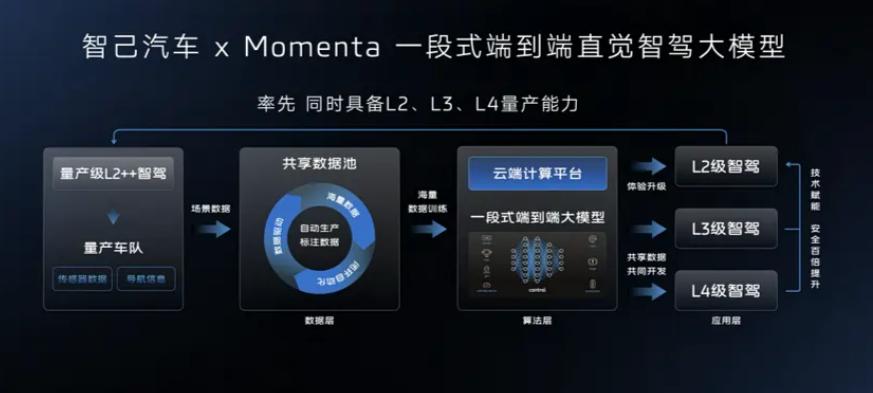
The mass production and application of end - to - end large models have further reshaped the technological paradigm of autonomous driving. The mass - produced end - to - end large model launched by Momenta abandons the traditional discrete architecture of perception, decision - making, and planning. It directly maps sensor inputs to vehicle control commands, simplifying system complexity and improving decision - making efficiency in extreme scenarios. This model has been installed in over 400,000 vehicles and has cooperated with BMW to develop a full - scenario intelligent driving system, demonstrating the commercial potential of end - to - end technology.
Policy relaxation has cleared the obstacles for technological implementation. China may approve the implementation of FSD in February 2026, and the "Model - Speed - Intelligence - Driving" action plan released by Shanghai clearly aims to achieve large - scale application of L4 - level autonomous driving by 2027. Europe is also accelerating the unification of regulatory frameworks. The global policy relaxation provides a compliance basis for the commercial operation of autonomous driving.
The change in the logic of capital investment is the core driving force behind the wave of listings. In the past, investors were willing to pay for "algorithm demonstration videos." Now, the market only recognizes "commercial closed - loops." The continuous losses of companies like WeRide and Pony.ai have made capital shift from "faith - based investment" to "value return." Companies with stable orders and the ability to form data closed - loops have become the favorites in the capital market. This change forces autonomous driving companies to shift from "technological R & D" to a dual - wheel drive of "technology + operation."
Core Technological Battle: Triple Barriers of Models, Algorithms, and Data
In the race for listings in the autonomous driving industry, technological strength is the core moat for companies. Models, algorithms, and data are the three main battlefields in this technological war.
World Models and VLA Reshape the Decision - Making Center of Autonomous Driving
The core challenge in high - level autonomous driving lies in enabling machines to understand complex traffic environments. The combination of world models and VLA (Vehicle - mounted Intelligent Agent) has evolved the autonomous driving system from "rule - based" to "cognition - based," enabling it to handle both known scenarios and long - tail scenarios that have never been seen before. This is the key to the implementation of L4 - level autonomous driving.
As the vehicle - end carrier of world models, VLA adopts a "native base model + MoE dynamic routing" architecture. It can adaptively call different expert networks according to the complexity of the scenario, optimizing computing power consumption while ensuring decision - making accuracy. Its core lies in achieving end - side integrated reasoning for perception, positioning, planning, and control. Through TensorRT INT8 quantization acceleration and heterogeneous computing scheduling, it can control model reasoning latency within 20 ms, meeting the real - time requirements of autonomous driving. Horizon's Journey 7 chip, based on the "Riemann" architecture, achieves a computing power density of 200 TOPS/W with a 6 - nm process. It is equipped with a dedicated NPU unit to support Transformer operator acceleration, providing a computing power base for the end - side deployment of VLA and large models, forming a collaborative closed - loop of "algorithm - computing power."
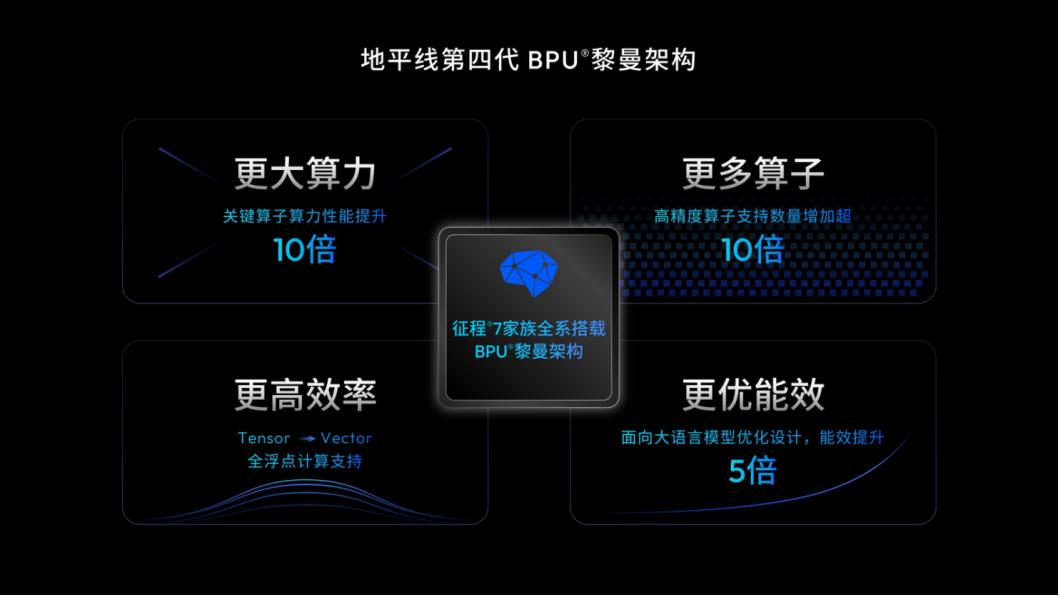
Horizon's Journey 7 chip, based on the "Riemann" architecture, provides powerful computing power support for VLA. Its computing power density has increased several times, meeting the real - time operation requirements of end - to - end large models and forming a collaborative empowerment of computing power and algorithms with large models like MogoMind.
Algorithm Iteration: A Paradigm Revolution from Discrete to End - to - End
The evolution of autonomous driving algorithms is undergoing a paradigm revolution from discrete to end - to - end. The traditional discrete architecture divides autonomous driving into five modules: perception, positioning, decision - making, planning, and control. Each module is optimized independently, which easily leads to the problem of "information gaps between modules."
The end - to - end algorithm breaks this barrier. It uses a Transformer Encoder - Decoder architecture to directly map multi - sensor raw data (image pixels, lidar point clouds, IMU inertial data) to vehicle control commands (steering angle, throttle/brake opening), avoiding the problem of error accumulation between modules in the discrete architecture. Its core advantage lies in fitting the driving decision - making function in complex scenarios through massive data training. Its generalization ability for long - tail scenarios such as rain, snow, and construction - occupied lanes is more than 40% higher than that of traditional algorithms. Mobaxi integrates the core cognitive capabilities of MogoMind into its self - developed MOGO AutoPilot end - to - end system and optimizes the dynamic control module according to the characteristics of bus models. At the same time, the BEV perception algorithm projects multi - view images and lidar point clouds into a unified 3D space through a spatial attention mechanism and a temporal fusion network, achieving accurate detection and trajectory tracking of targets within 400 m and solving the problems of occlusion and scale distortion in the traditional perspective view.
Data Closed - Loop Competes for the Right to Speak of Core Assets in Autonomous Driving
In the field of autonomous driving, data is a more important core asset than hardware. If algorithms are the "brain" of autonomous driving, then data is the "oil" needed for the "brain" to operate. Building an efficient data closed - loop has become the key for companies to gain an edge.
Mobaxi's practice is quite representative. Its autonomous driving buses have accumulated a total of 5 million kilometers in travel and served over 200,000 passengers. Relying on a perception solution of "vision - based + solid - state lidar," it has built the world's largest multi - modal bus dataset. This solution uses a 128 - line main solid - state lidar (point cloud frequency of 10 Hz, ranging accuracy of ±2 cm) paired with high - dynamic - range cameras. Through a spatio - temporal synchronization calibration algorithm (time synchronization error < 1 μs), it achieves data alignment and combines the BevFusion algorithm to improve the reliability of perception in complex scenarios. In terms of the data closed - loop, it uses edge computing devices to perform real - time data screening and difficult - case annotation on the vehicle end. Relying on a federated learning framework, it iterates the model across scenarios while ensuring data security, significantly shortening the technology iteration cycle.
Companies like Pony.ai and WeRide are also building their own data closed - loops. Pony.ai has accumulated a large amount of urban scenario data through its Robotaxi operations in Shenzhen and Saudi Arabia. WeRide obtains multi - vehicle model data through cooperation with automobile manufacturers. It is worth noting that the value of data lies not only in scale but also in quality. Through data cleaning, annotation, and desensitization techniques, companies can extract effective information from massive data. Mobaxi's edge computing devices can perform preliminary data screening on the vehicle end, significantly reducing the computing pressure on the cloud.
Competition in the Arena: IPO Rushes on Differentiated Tracks
In the wave of listings in 2026, different companies have chosen differentiated tracks. From Robotaxi to autonomous driving buses, from intelligent driving in passenger cars to logistics in commercial vehicles, companies are leveraging their respective technological advantages to rush into the capital market.
Robotaxi Field: Global Breakthroughs of Pony.ai and WeRide
Robotaxi is the most imaginative and technically challenging track in autonomous driving. Pony.ai and WeRide are the Chinese representatives on this track.
Pony.ai has achieved regular fully driverless operations in Qianhai, Shenzhen, and has joined forces with Uber to enter the Riyadh market in Saudi Arabia, becoming the first Chinese player to enter the Middle East. Its L4 - level autonomous driving system is based on the BEV perception algorithm and an end - to - end decision - making model, capable of handling complex urban road scenarios. In terms of capital, Pony.ai has completed multiple rounds of financing, and its IPO valuation is highly anticipated by the market.
WeRide has adopted a "two - front battle" strategy. On the one hand, its new - generation Robotaxi plans to enter the European and American markets in 2026, competing directly with Tesla and Waymo. On the other hand, WeRide has been deeply involved in the field of autonomous driving buses and has launched Robobus projects in multiple cities. Despite cumulative losses of over 6.5 billion yuan, WeRide's global layout and large - scale operation capabilities are still its core selling points to attract capital.
Autonomous Driving Bus Track: Mobaxi's Commercial Closed - Loop
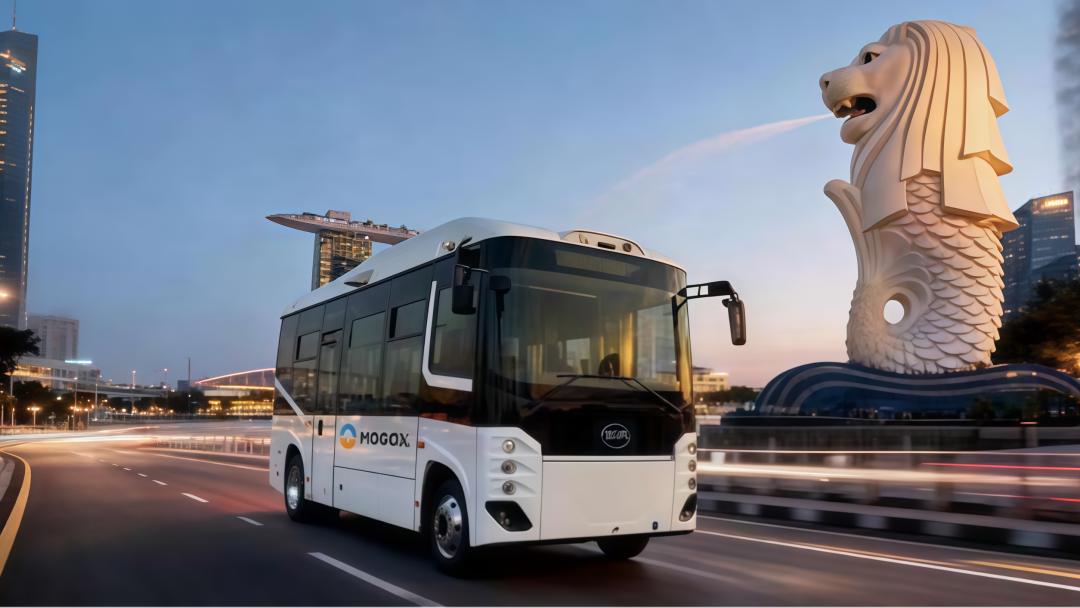
Compared with Robotaxi, the scenarios of autonomous driving buses are clearer, and the commercialization path is more definite. On this track, Mobaxi, empowered by the MogoMind large model and with a unique technological route, has taken a differentiated path of "front - loading mass production + data closed - loop + global implementation." Its winning of the first L4 - level autonomous driving bus project in Singapore has become a benchmark for Chinese technology going global.
Technologically, Mobaxi's core competitiveness starts with a forward - looking perception solution. Two years ago, when the industry still mainly used mechanical lidars, it resolutely switched to a fusion route of "vision - based + solid - state lidar," accurately avoiding the defects of mechanical radars, such as complex structure, high cost, and short lifespan. In the solution for the Singapore project, it uses a 128 - line main solid - state lidar paired with 4 high - beam blind - spot - compensation radars. The point cloud density has increased by 3 - 6 times, enabling it to accurately lock pedestrians and non - motor vehicles. Combining the BevFusion algorithm to achieve deep integration of image and point cloud data, the target perception distance has increased by over 50%, the miss/error detection rate has decreased by 70%, and the takeover rate has been significantly reduced by two orders of magnitude, perfectly meeting the strict requirements of Singapore's dense traffic flow and complex road conditions during peak hours. At the same time, solid - state lidars have strong anti - vibration and anti - impact capabilities, with a service life of 8 - 10 years. The cost of the entire solution is only 1/3 - 1/5 of the traditional mechanical radar solution, achieving a balance between high durability and low cost.
The front - loading mass production model provides the ultimate carrier for technological implementation. Its autonomous driving system is integrated into the vehicle's power, braking, and steering systems at the bottom layer. Through a hybrid architecture of CAN/LIN bus and Ethernet, it can achieve millisecond - level response of control commands, and the command execution accuracy is more than 3 times higher than that of retrofitted vehicles. To meet the local requirements of Singapore, such as right - hand drive and pedestrian priority, the system optimizes the avoidance strategy and parking logic through map adaptation and scenario rule embedding. The MOGOBUS B2 model has completed the filing with the Ministry of Industry and Information Technology and has the ability for large - scale delivery.
Commercial Vehicle Track: Cost - Reduction Battle of Mainline Technology and Inceptio Technology
Autonomous driving in commercial vehicles is one of the fastest - growing tracks for commercialization. Companies such as Mainline Technology and Inceptio Technology focus on the long - haul logistics scenario, achieving a commercial closed - loop by reducing labor costs and improving transportation efficiency.
Technologically, autonomous driving systems for commercial vehicles pay more attention to long - distance perception and platooning capabilities. Mainline Technology's autonomous heavy - duty trucks are equipped with long - range lidars and high - precision positioning systems, enabling them to drive for hundreds of kilometers on highways without takeover. Inceptio Technology has cooperated with FAW Jiefang and Manbang Group to build an integrated logistics ecosystem of "vehicle - cargo - road." In terms of capital, the profit model of commercial vehicle autonomous driving companies is clearer. They obtain stable order revenues through cooperation with logistics companies, and this "ToB" model is favored by the capital market.
2026: The Decisive Moment for Autonomous Driving
2026 is a decisive year for the autonomous driving industry. Technologically, the maturity of world models and end - to - end algorithms will accelerate the implementation of high - level autonomous driving. Capital - wise, the capital injection brought by the wave of listings will drive the industry from "burning money" to "making profits." In the market, global competition will become more intense.
It is worth noting that mainstream vehicle manufacturers such as Zhongtong, King Long, Geely, and Changan have long established a foundation for large - scale implementation through solid overseas layouts. Their demand for upgrading autonomous driving systems is creating precise cooperation opportunities for technology service providers. Zhongtong Bus has been deeply involved in the overseas market for many years. More than 80,000 new - energy buses are running around the world. It has won several "super large orders" in the past 3 years, such as 1,000 units in Kyrgyzstan, 1,022 units in Saudi Arabia, and 895 units in Chile. It has rich experience in meeting local requirements, such as adapting to narrow - body models in Singapore and chassis protection in the Middle East. King Long Bus has broken through with a model of "exporting technical standards + localizing the industrial chain." It has established 13 KD factories in Africa and Southeast Asia. The factory in Ethiopia has built the first new - energy KD project in East Africa, and the factory in Egypt has produced more than 6,000 light - duty buses, forming a mature global production capacity and service network. Geely and Changan have also promoted their commercial vehicle products to core markets in Europe, America, and Southeast Asia through their global R & D systems and local operation capabilities, building an operation matrix covering multiple road conditions and regulatory scenarios. The overseas operations of these vehicle manufacturers place extremely high requirements on the local adaptation