Alibaba enters the nuclear power industry, propelled by three major forces, and global nuclear power is experiencing a full-fledged renaissance.
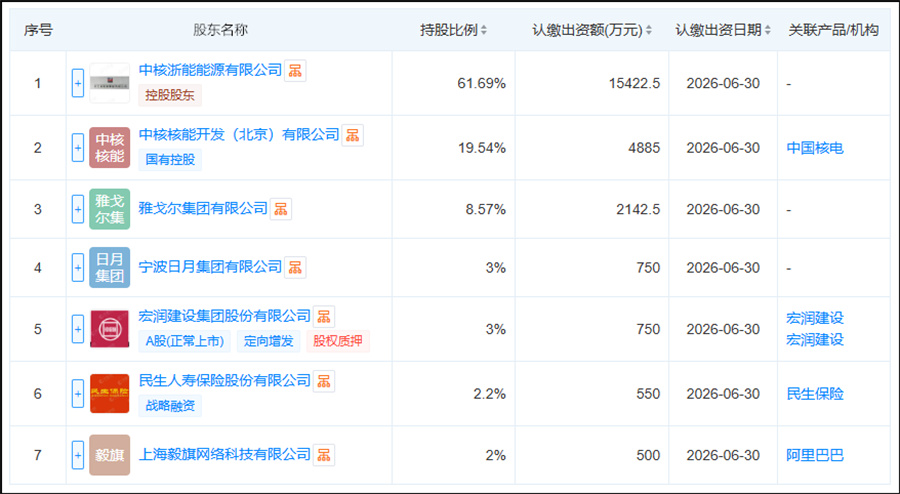
On January 20th, a company named "China National Nuclear (Xiangshan) Nuclear Energy Co., Ltd." (hereinafter referred to as "Xiangshan Nuclear Energy") quietly completed its industrial and commercial registration with a registered capital of 250 million yuan.
However, sharp - eyed media soon discovered that Shanghai Yiqi Network Technology Co., Ltd. (hereinafter referred to as "Yiqi Network"), a member company of the Alibaba Group, was listed in the shareholder roster. China Energy Net noticed that Yiqi Network has a registered capital of 10 million yuan and is 100% owned by Alibaba Cloud, a subsidiary of Alibaba.
Soon, the news that Alibaba had entered the nuclear power sector spread like wildfire. The media interpreted that the purpose of Alibaba and China National Nuclear Corporation to establish a nuclear energy joint - venture company was to provide strong power supply guarantees for artificial intelligence data centers in the future.
In fact, it's not just Alibaba. From Meta Platforms (formerly Facebook) to Microsoft, global technology giants are either investing in nuclear power companies or signing cooperation agreements with nuclear power enterprises, entering the nuclear power field in various ways to seize the high - ground of future energy.
Behind the rush of Internet giants to enter the nuclear power field is the full - scale revival of nuclear power globally. Driven by the three forces of governments around the world, technology giants, and nuclear fusion innovation, global nuclear power investment is reaching new heights.
The First Force: Many Countries are Turning to Embrace Nuclear Power
Affected by the Fukushima nuclear leakage incident in 2011, the global nuclear power industry experienced a trough period of more than a decade. The anti - nuclear voice dominated, and the development of nuclear energy declined in many countries.
The Russia - Ukraine war that started in 2022 gave a profound lesson to European countries - energy security is far from being solved, and nuclear power is one of the options to ensure energy security. The energy transformation practices around the world in recent years have made countries more clearly aware that although new energy is clean, its power supply is far from stable.
That is to say, against the backdrop of the energy security issue and the dilemma of energy transformation, nuclear power has once again come into the view of leaders around the world.
On February 27, 2022, just as the Russia - Ukraine war broke out, Robert Habeck, a member of the Green Party and the then German Minister of Economics, said that Germany was considering extending the operation time of the three nuclear power plants that were still generating electricity. This move means that Germany's policy of gradually phasing out nuclear energy, which had been implemented for nearly 30 years, began to change.
The German Green Party originated from the anti - nuclear protest movement against the deployment of US nuclear missiles in West Germany. In 1986, a large amount of radioactive fallout from the Chernobyl nuclear leakage spread to Western Europe, making the public aware of the danger of nuclear energy. In 2002, Germany proposed a nuclear energy phase - out plan. The Fukushima nuclear leakage incident in 2011 finally prompted then - German Chancellor Angela Merkel to make the major decision to abandon nuclear energy.
There are several reasons for Germany's shift in 2022. On the one hand, after the Russia - Ukraine war, the prices of coal, oil, and natural gas in Europe soared, and the energy supply in Europe was tight, plunging the whole of Europe into an "energy crisis." On the other hand, the legal draft published by the European Union classified nuclear power and natural gas as green energy, reaffirming the green power attribute of nuclear power.
After that, the German government began to attach importance to nuclear energy again. In May 2025, German Chancellor Friedrich Merz and French President Emmanuel Macron published a joint editorial in Le Figaro, promising that Germany would no longer oppose nuclear power from receiving equal policy treatment with renewable energy.
Once, Germany was at the forefront of the "anti - nuclear" movement in Europe. Therefore, its current change of attitude has a great impact on the whole of Europe. Previously, a number of European countries that opposed nuclear energy and nuclear power - including Austria, Belgium, Spain, Portugal, Denmark, etc. - have also reversed their attitudes and started to embrace nuclear power again.
China Energy Net noticed that in 2025, the Danish parliament voted to overturn a 40 - year - old nuclear power ban and will consider investing in new nuclear power technology, small modular reactors. The Belgian Federal Parliament passed a new bill by an overwhelming majority, officially abolishing the nuclear energy phase - out plan formulated in 2003. Spain and Portugal, which had experienced major power outages due to a high proportion of wind and photovoltaic power, are also reconsidering their plans to shut down nuclear reactors.
France and the UK, which have always supported nuclear power, are even more ambitious. France plans to add 25 million kilowatts of nuclear power installed capacity by 2050 and extend the service life of existing nuclear power units from 40 years to more than 50 years. The UK has clearly set the goal of "delivering 3 - 7 gigawatts of installed capacity every five years from 2030 to 2044 to achieve a nuclear power installed capacity of 24 gigawatts by 2050."
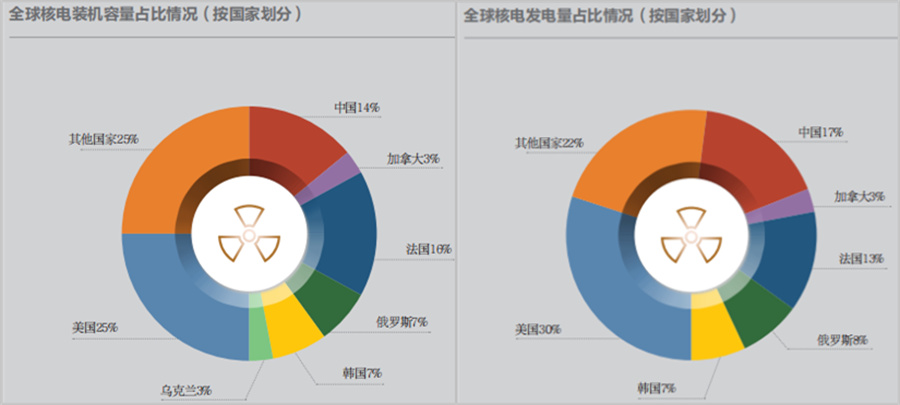
Nuclear power installed capacity and power generation proportion in major countries around the world (Data source: International Atomic Energy Agency)
Beyond Europe, more countries are vigorously promoting the development of nuclear power.
In April 2023, Japan proposed in the "Draft Direction and Action Guidelines for Future Nuclear Policy" that nuclear energy should be utilized to the maximum extent on the premise of ensuring safety. In February 2025, the Japanese government announced the latest revised "Basic Energy Plan," aiming to increase the proportion of nuclear energy in Japan's power source structure to 20% and the proportion in the energy structure to 8.5% by 2040.
In November 2024, the United States proposed a new nuclear power generation installed capacity target: to add 35 million kilowatts of new production capacity by 2035 and achieve an annual installed capacity increase of 15 million kilowatts by 2040.
India plans to add 18 nuclear power units by 2032, doubling its nuclear power installed capacity. Indian Prime Minister Narendra Modi said, "The role of nuclear power in power generation will continue to increase in the 21st century. India is at the forefront of this advanced technology, which makes us proud."
Since 2019, China has also been vigorously building nuclear power plants. From 2019 to 2023, the number of nuclear power units approved in China was 6, 4, 5, 10, and 10 respectively, showing an overall positive, safe, and orderly development trend. In 2024, China approved 5 nuclear power projects, a total of 11 nuclear power units. In 2025, China approved 5 nuclear power projects and 10 units at once. Roughly calculated, from 2019 to 2025, China approved a total of 56 nuclear power units, with an investment amount exceeding 1.1 trillion yuan.
The Second Force: Technology Companies are Keen on Investing in Nuclear Power
High - tech companies investing in and tying up with nuclear power has become a powerful current trend.
On January 9th local time, Mark Zuckerberg, the CEO of the well - known US high - tech company Meta, announced that it had reached cooperation with three nuclear power companies to add and maintain 6.6 gigawatts of nuclear power energy by 2035 to meet the energy needs of future data centers after they are put into operation.
Behind Meta's move is the fact that high - tech companies are competing to invest in data centers and artificial intelligence. Data centers and artificial intelligence are well - known "power - guzzling beasts" that require a stable power supply, and clean nuclear power can exactly meet all their expectations for stable power.
The US Energy Information Administration (EIA) predicted in its short - term energy outlook report released in December 2025 that mainly driven by the growth of data center demand, the US electricity demand will reach new highs in 2025 and 2026, increasing by 2.2% and 1.6% respectively to 419.9 million and 426.7 million kilowatt - hours, higher than the 411 million kilowatt - hours in 2024.
Daniel Yergin, the vice - chairman of S&P Global and a well - known energy expert, pointed out that a key reason for the strong global revival of nuclear power this time is the strong interest of the technology industry in nuclear energy. Based on this, Amazon led the investment in X - energy, a small modular reactor (SMR) company, and hopes to reduce costs through continuous investment and construction. Previously, large - scale technology companies had never considered energy issues and related capital investment.
In the view of Rafael Mariano Grossi, the Director - General of the International Atomic Energy Agency, the rise of artificial intelligence and the global transformation towards clean and reliable energy are reshaping the future picture of humanity at an unprecedented speed.
"The artificial intelligence revolution, with its scale and speed of development, is destined to choose nuclear energy as a partner. The only question is - when? Now we know the answer is - now," Grossi said. "Only nuclear energy can meet the five major requirements of low - carbon power generation, all - weather reliability, ultra - high power density, grid stability, and true scalability at the same time. Therefore, there is a structural alliance between nuclear energy and artificial intelligence, which I call the atomic - powered algorithm."
In the view of experts, the new picture of the future energy system is becoming clearer: nuclear energy is no longer just a traditional base - load power source, but an indispensable infrastructure in the era of artificial intelligence.
Currently, 441 reactors are operating in 31 countries around the world, and 71 new reactors are under construction in 14 countries, of which 13 will be put into operation in 2026. Driven by artificial intelligence, the revival of nuclear power is accelerating, and the nuclear power industry is making a stronger - than - expected comeback.
The Third Force: Nuclear Fusion May Trigger a New Revolution
Daniel Yergin, the vice - chairman of S&P Global and a well - known energy expert, pointed out that nuclear fusion, a technology that was once thought to take at least 50 years to achieve, has now become a hot topic. With the new consensus that nuclear energy will become an important part of the energy system, currently, venture capital is pouring into the nuclear fusion field. The global private sector injected about 8 billion US dollars or more into this field in 2024, exceeding the investment in nuclear fission research.
Different from nuclear fission, nuclear fusion is a process in which two lighter atomic nuclei combine to form a heavier atomic nucleus, releasing a huge amount of energy at the same time. Controlled nuclear fusion is to make the nuclear fusion reaction proceed continuously and stably under controlled conditions and release energy through artificial technical means. The energy of the sun comes from its own nuclear fusion reaction. Therefore, building a controlled nuclear fusion device on Earth is also called an "artificial sun."
Rafael Mariano Grossi, the Director - General of the International Atomic Energy Agency, once said that the energy produced by nuclear fusion per kilogram of fuel is four times that of nuclear fission and nearly 4 million times higher than that produced by burning oil and coal. Utilizing nuclear fusion is the future of human clean energy.
Nuclear fusion energy has the advantages of abundant fuel, environmental friendliness, and inherent safety, making it an ideal energy source for humanity in the future. If controlled nuclear fusion is commercially applied in the future, it is expected to reshape the global energy landscape and have a profound impact on the economy and society. All along, countries and regions such as the United States, Europe, Russia, Japan, and South Korea have their own layouts and plans for the nuclear fusion industry, and China has also gone through several important stages in the development of the nuclear fusion industry.
In March 2022, the White House held a fusion energy summit to discuss formulating a ten - year vision for the commercialization of US fusion energy. In the same month, the US Department of Energy allocated 50 million US dollars to support basic research on nuclear fusion, and in May 2023, it allocated another 46 million US dollars to eight US companies to support the construction of fusion power plants.
The UK government has invested 1.4 billion pounds in the nuclear fusion field since 2021, launched the STEP plan (Spherical Tokamak for Energy Production) to build the world's first nuclear fusion demonstration power plant by 2040, and took the lead in legislating on nuclear fusion in October 2023, clarifying the regulatory rules for nuclear fusion facilities in the new "Energy Act."
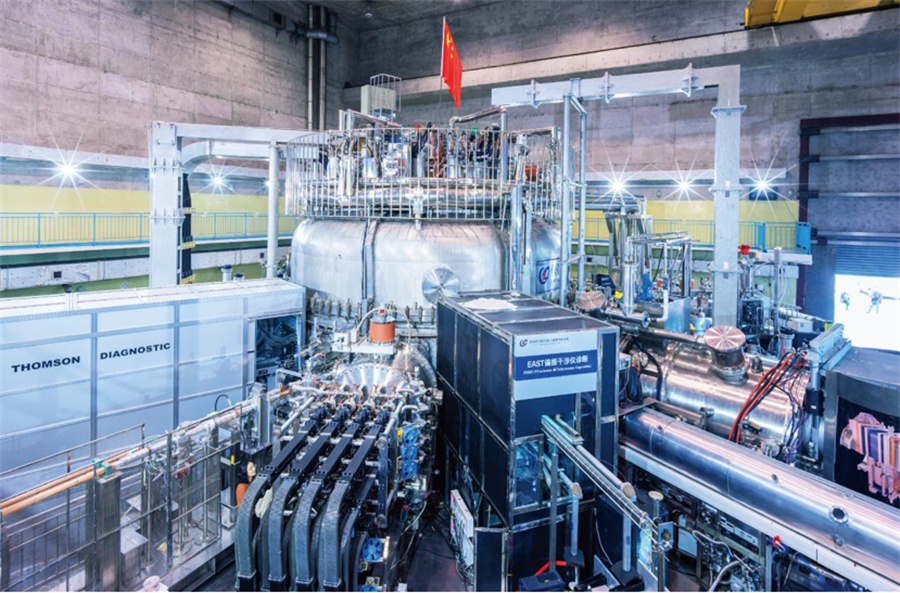
On January 20, 2025, the Experimental Advanced Superconducting Tokamak (EAST) of the Hefei Institute of Physical Science, Chinese Academy of Sciences, set a world record of "100 million degrees for 1000 seconds."
Currently, the commercial application of nuclear fusion has triggered an investment boom globally and shows a growing trend. According to the newly released "2025 Global Fusion Industry Report," in the past five years, the global nuclear fusion industry has witnessed explosive growth, with the total investment soaring rapidly from 1.9 billion US dollars in 2021 to 9.7 billion US dollars. The number of nuclear fusion enterprises has increased from 23 in 2021 to 53, a 143% increase.
The "2025 Global Fusion Industry Report" also shows that 35 global enterprises are expected to build commercial fusion demonstration power plants that can produce net energy gain between 2030 and 2035, and 28 enterprises are expected to connect to the power grid for power supply during this period, with only a few predicting grid connection after 2040.
A year ago, the report "Pathways to a New Nuclear Era" released by the International Energy Agency showed that nuclear power generation accounts for nearly 10% of global power generation and is the second - largest low - emission power source after hydropower. Currently, the global nuclear power installed capacity under construction has exceeded 70 million kilowatts, reaching the highest level in the past 30 years, and more than 40 countries and regions are formulating plans to expand nuclear energy projects.
If there are new breakthroughs in nuclear fusion technology and commercial applications, nuclear power will surely play a more important role in the future global power generation market. For the tortuous global carbon - neutral transformation, especially when new energy is still difficult to shoulder the main responsibility as the primary energy source, developing nuclear power may be a new idea.
This article is from the WeChat official account "China Energy Net", written by Liu Yang and edited by Jiang Bo. It is published by 36Kr with authorization.