Hardcore: A programmer spent 6 months working intensively to build a 486 motherboard from scratch. They completed everything from drawing schematics to soldering chips, and successfully ran Linux, DOOM, and Win3.1 on it.
If your understanding of "handcrafting a motherboard" still stays at soldering a few modules and inserting a ready-made chip, then the latest work of programmer and electronics enthusiast Maniek86 might directly reshape your perception.
Recently, Maniek86 spent less than six months to design a complete and usable Intel 486 architecture motherboard from scratch. He started with drawing the schematic diagram, then designed the printed circuit board (PCB) and implemented the chipset logic by himself.
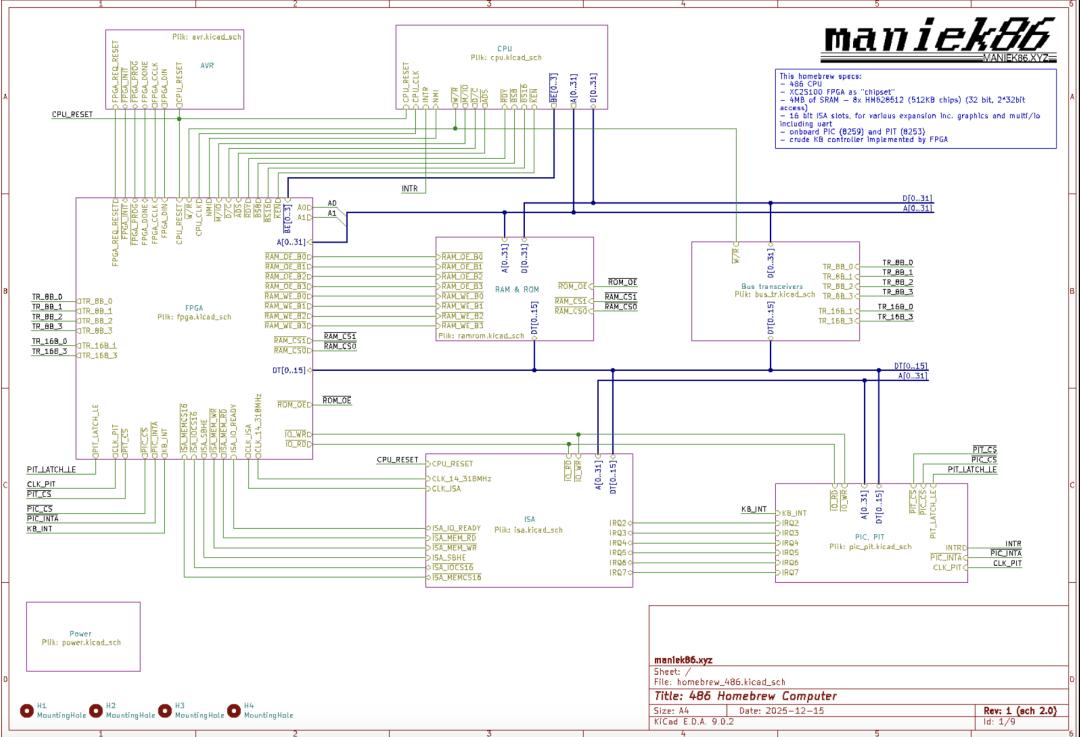
What's more noteworthy is that it can not only run systems like Linux, MS-DOS, and FreeDOS stably, but also make classic games such as "Doom" and "Wolfenstein 3D" work. It can also successfully run Windows 3.1 under specific circumstances.
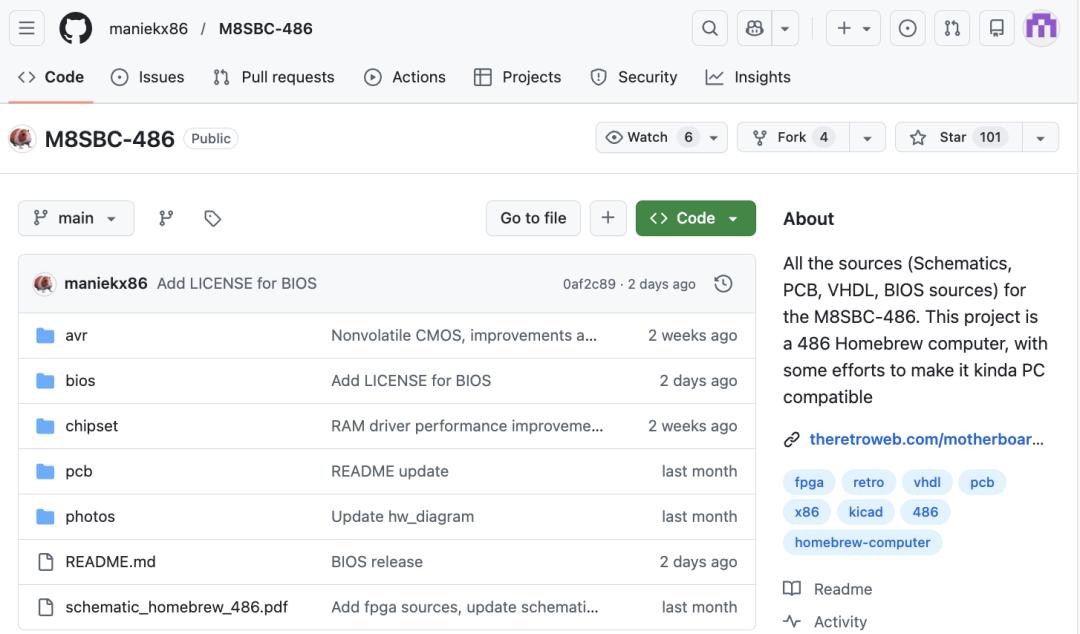
All this sounds like the result of a small team, but in fact, it's all the work of Maniek86 alone. Moreover, to allow more enthusiasts to participate, Maniek86 has also open - sourced the project on GitHub (https://github.com/maniekx86/M8SBC - 486) for everyone to refer to.
It All Started with a "Small Goal"
Looking back, Maniek86's initial idea wasn't grand.
He said he just wanted to make a "retro motherboard that can run Linux" and then run "Doom" as a verification standard for performance and compatibility. After all, for hardware enthusiasts, "whether it can run DOOM" is like the "universal exam question" in the hardware circle.
But things soon started to "get out of control".
In the process of continuously improving the design, Maniek86 found that as long as the working mode of the 486 was restored accurately, this board could not only "run one system" but also other interesting software.
The original toy project seemed to gradually turn into a complete PC replication experiment.
Not a "Modification", but Starting from Scratch
On the project's official website, Maniek86 shared the story of the project's starting point.
In April 2025, Maniek86 made some optimizations to his previously self - made 486 computer on a prototype board. However, he soon found that the specifications of that computer were not ideal, so he decided to create a better product.
In August of the same year, he began to sketch the design during his free time. Maniek86 revealed, "Before this, PCBWay had sponsored several of my small projects (such as ISA expansion cards). I thought maybe I could apply to them for sponsorship for a larger - scale project —— unexpectedly, they readily agreed! This gave me great motivation and made me determined to fully implement this idea."
So, he really started to code, draw schematic diagrams, and design the PCB.
He also specifically emphasized that this motherboard was not improved based on old reference designs but was truly designed from the very beginning —— including the chip logic, pin timing, and BIOS code.
This means that he had to understand many underlying details of the 486 CPU, such as the bus protocol, clock logic, interrupt control, and memory read - write timing.
It's imaginable that making a self - made motherboard requires both solid knowledge reserves and excellent technical skills.
On his personal blog, Maniek86 shared his experience of soldering and testing the first circuit board.
He started with small SMD components such as resistors and capacitors, and then gradually tackled the high - precision soldering of core components like the 144 - pin FPGA chip and the ATMega128 microcontroller. He even came up with a clever solution of cutting and splicing DIP sockets for the scarce PGA sockets.
The testing phase was also full of twists and turns. He encountered problems such as short - circuits caused by the inverted labels of purchased SRAM components, design mistakes due to the confusion of 8259 PIC and 8254 PIT packages, and the IRQ line suspension caused by the lack of an interrupt controller. He also debugged the FPGA through a self - made JTAG programming cable with a Raspberry Pi Pico and used isopropyl alcohol to clean the circuit board to optimize its stability.
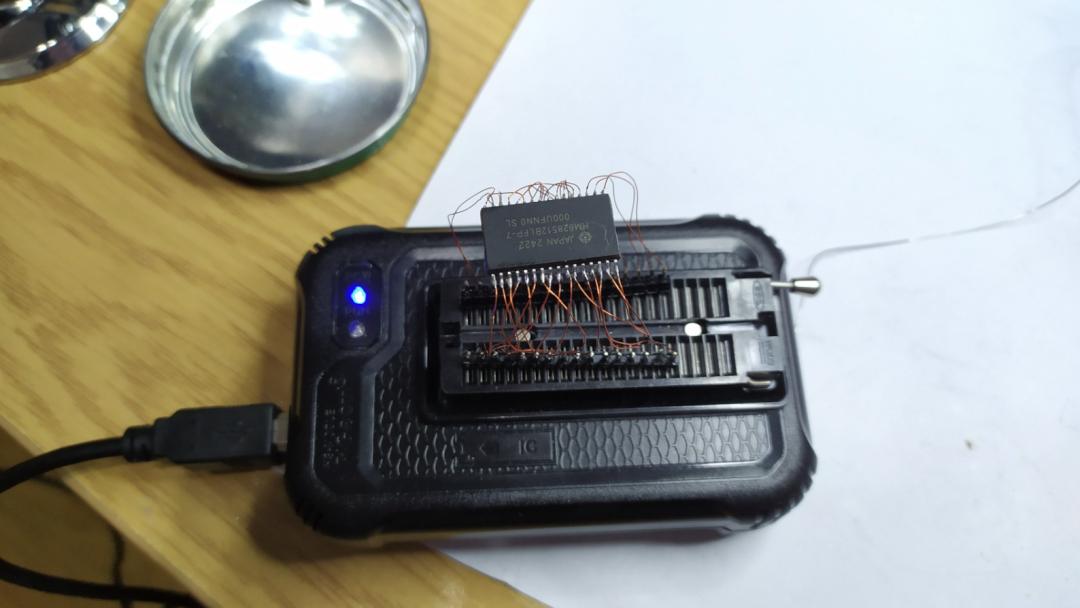
Fortunately, he solved the problems one by one through solutions such as temporarily adding pull - down resistors and self - made PLCC to DIP adapters.
Finally, with the assistance of an oscilloscope, he successfully made the 486 CPU run an infinite loop program on the self - made motherboard. Later, he also implemented the ISA bus function, completed the initialization of graphics cards such as the Trident TVGA8900C, and made the motherboard successfully enter the text display mode. Step by step, he achieved a full - process breakthrough from hardware soldering, fault troubleshooting to basic function verification, laying the foundation for subsequent running of DOS, Linux systems, and classic games.
The "Semi - Compatible PC" —— The M8SBC - 486 Motherboard
This board is named M8SBC - 486 and its size is only 150 × 150 mm, which is a bit smaller than the common Mini - ITX.
"I call it a'semi - compatible PC' because it has many commonalities with the early standard x86 architecture PCs, but lacks the secondary programmable interrupt controller (PIC) and direct memory access (DMA) functions. However, according to my tests on this motherboard, many programs can still run normally without these functions," Maniek86 said.
Specifically, the main configuration of the M8SBC - 486 is as follows:
A 150 × 150 mm four - layer PCB with a custom hole position design (slightly smaller than the 170 × 170 mm Mini - ITX standard)
A PGA - 168 socket supporting 5V - powered 486 processors
The current front - side bus (FSB) frequency is 24 MHz, and the DX2 processor can run at 48 MHz
The current system runs at a 24 MHz FSB
Xilinx Spartan II XC2S100 FPGA as the chipset (code - named Hamster 1)
4 MB SRAM
256 KB ROM for the BIOS (224 KB of which is accessible)
8254 programmable interval timer (PIT)
8259 programmable interrupt controller (PIC)
Two 16 - bit ISA slots
PS/2 keyboard interface (the controller is implemented by the FPGA)
A simple CMOS RTC and CMOS storage (also implemented by the FPGA)
ATMega128 microcontroller for reset control, non - volatile CMOS storage, and FPGA bitstream loading
Systems and Games, All Running!
Although the M8SBC - 486 still has some limitations, such as not fully supporting the ISA plug - and - play (PnP) function and direct memory access (DMA) yet, which results in the sound card not being supported for now (only the AdLib sound card may be compatible) and the floppy drive controller not being usable, its actual performance has exceeded expectations.
In terms of operating systems, it can successfully boot MS-DOS, FreeDOS, and Linux. For MS-DOS, the HIMEM memory management program needs to be disabled, while FreeDOS can be used normally with memory expansion programs such as Jemmex and HIMEMX. Linux 2.2.26 can also run stably after custom kernel compilation, redirecting the IDE interrupt request through flying wires, configuring relevant kernel parameters, and using a custom bootloader. It can even partially support Windows 3.1 (enhanced mode), being able to boot and enter the desktop for keyboard operations, only the mouse function doesn't work properly.
In terms of software and games, classic DOS games such as "Prince of Persia", "Wolfenstein 3D", and "Doom (FastDOOM)" can all run smoothly.
The Second Reality demo program, the FastTracker II audio editing program, and the 3DBench series of benchmarking tools can also work normally. Among them, FastTracker II can achieve sound output through the "pulse modulation mode" of the "PC speaker" or a parallel port digital - to - analog converter.
Even more surprisingly, this machine can also conduct simple network experiments through the serial port and even set up a Busybox HTTP service, fully proving its partial PC compatibility.
The Project Is Open - Sourced
One of the main reasons why the M8SBC - 486 has attracted wide attention is that it is completely open - sourced.
The schematic diagrams, PCB files, VHDL, and BIOS source codes are all on GitHub. Anyone can download, replicate, and even continue to tinker with it on this basis. The community has already started contributing improved codes, experimental scripts, and new ideas.
Maniek86 also frankly said that there is still room for improvement of this board. In the future, he hopes to further enhance PC compatibility, improve ISA expansion, and even try to make derivative designs for other x86 CPUs.
This means that the M8SBC - 486 is not an end - point but an open platform, and every improvement may bring new possibilities.
References:
https://maniek86.xyz/projects/m8sbc_486.php
https://www.tomshardware.com/video - games/retro - gaming/the - m8sbc - 486 - is - an - open - source - intel - 486 - mobo - built - from - scratch - in - under - 6 - months - the - original - idea - was - to - achieve - linux - and - doom - compatibility - but - it - achieves - far - more - than - that
https://maniek86.xyz/projects/m8sbc_486_board.php
This article is from the WeChat official account "CSDN". Arranged by Tu Min. Republished by 36Kr with authorization.