Thunderbird, Rokid, and Alibaba Make a Collective Move: China's AI Glasses Powerhouses Gear Up for a Breakthrough Moment
In 2007, the release of the iPhone inaugurated the era of smartphones. However, Apple wasn't the sole player in popularizing mobile phones from niche geek products to the mass market. The Android camp, represented by companies like HTC, Samsung, Huawei, and Xiaomi, also played a significant role.
Through the combination of "open operating systems + multi - tiered hardware," they boosted the annual mobile phone shipments from a few million to billions.
Today, a similar scenario is unfolding in the AI glasses market.
Domestic manufacturers such as Thunderbird Innovation, Rokid, INMO, and XREAL are attempting to replicate the Android success story. Relying on more open platforms and mature local supply chains, they aim to cover different consumer segments with multiple brands and price points, pushing AI smart glasses from "geek toys" to the mass consumer market.
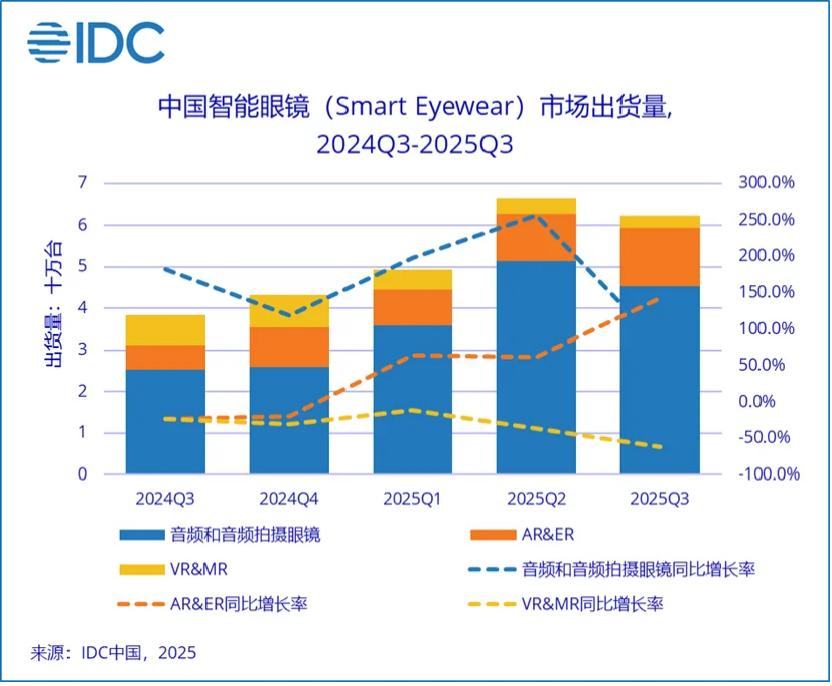
The trend is already evident. According to IDC data, in the first half of 2025, the global shipments of smart glasses reached 4.065 million units, a year - on - year increase of 64.2%.
Among them, the Chinese market witnessed the most rapid growth, with shipments potentially exceeding 1 million units, accounting for 26.6% of the global market share.
As the interaction dimension evolves from single "visual enhancement" to multi - sensory collaboration including voice, vision, and environmental perception, AI glasses are expected to become the next - generation universal computing portal after smartphones. They will redefine the way of traffic distribution and service delivery, thus becoming a crucial battleground that tech manufacturers can't afford to miss.
Chinese Companies Shine at CES
Google Glass can be regarded as the "pioneer" of AI glasses. The first mass - produced smart glasses developed by Google X were released in 2013.
However, due to various issues such as the high price of $1,500, the nearly closed "Explorer Program," and privacy concerns caused by the always - on camera, the product failed after two years on the market and failed to achieve large - scale popularization in the consumer market.
It is Meta that truly brought AI glasses from a niche concept into the mainstream view.
In September 2023, Meta and Ray - Ban jointly launched the second - generation smart glasses, Smart Glasses, which received an unexpectedly positive market response. In 2024, the shipments exceeded 1 million pairs.
In the latest "Global Smart Glasses Market Quarterly Tracking Report" released by IDC, Meta alone accounted for 75.7% of the market share.
In the past two years, the market landscape has changed, and Chinese manufacturers have gradually taken the center stage. Among the top five global smart glasses manufacturers, except for Meta, the other four are all from China, namely Xiaomi, Thunderbird, Xreal, and Viture.
China has become a key driving force for the global growth of smart glasses sales, especially leading in the AR and optical fields.
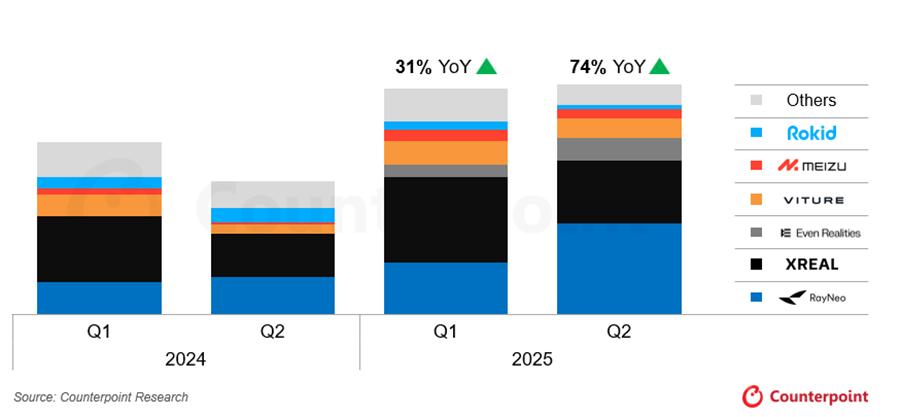
Shipments of major global AR smart glasses manufacturers
In the first half of 2025, the global AR market shipments increased by 1.3% year - on - year, with China accounting for 57.3% of the market share.
In the "China Smart Glasses Market Report for the First Half of 2025" released by IDC, in the field of binocular full - color glasses (currently mainly using the Birdbath + MicroOLED solution, focusing on projection viewing), Chinese manufacturers' shipment share accounted for over 97% of the global market.
At this year's CES, the "Chinese strength" was more clearly demonstrated. According to incomplete statistics, among more than 50 exhibitors related to AI glasses, at least 20 - 27 were Chinese companies, accounting for nearly half.
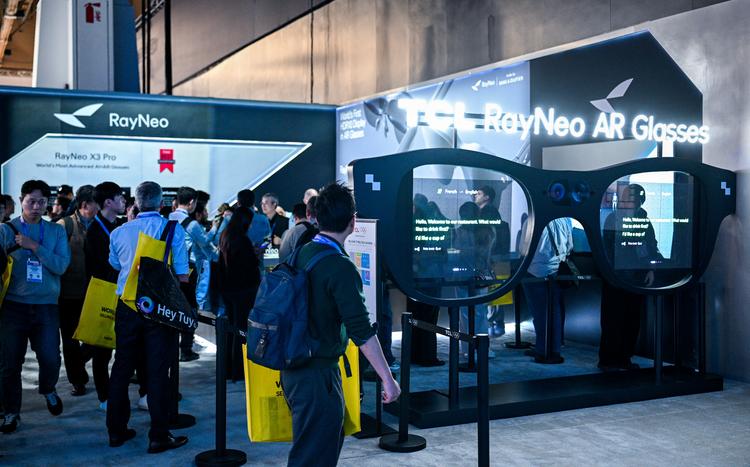
Looking at the new products unveiled at CES, "AR display + AI assistant" is the standard configuration, and extreme lightweight design is the common pursuit. The Rokid Style weighs only 38.5 grams and supports multi - model AI interaction, allowing consumers to "use the AI assistant just like wearing ordinary glasses."
The RayNeo X3 Pro (Project eSIM) breaks the dependence of AR devices on mobile phones. It supports independent 4G calls, multi - modal AI conversations, real - time translation, and streaming media playback, enabling consumers to enjoy the freedom of an "independent terminal once worn."
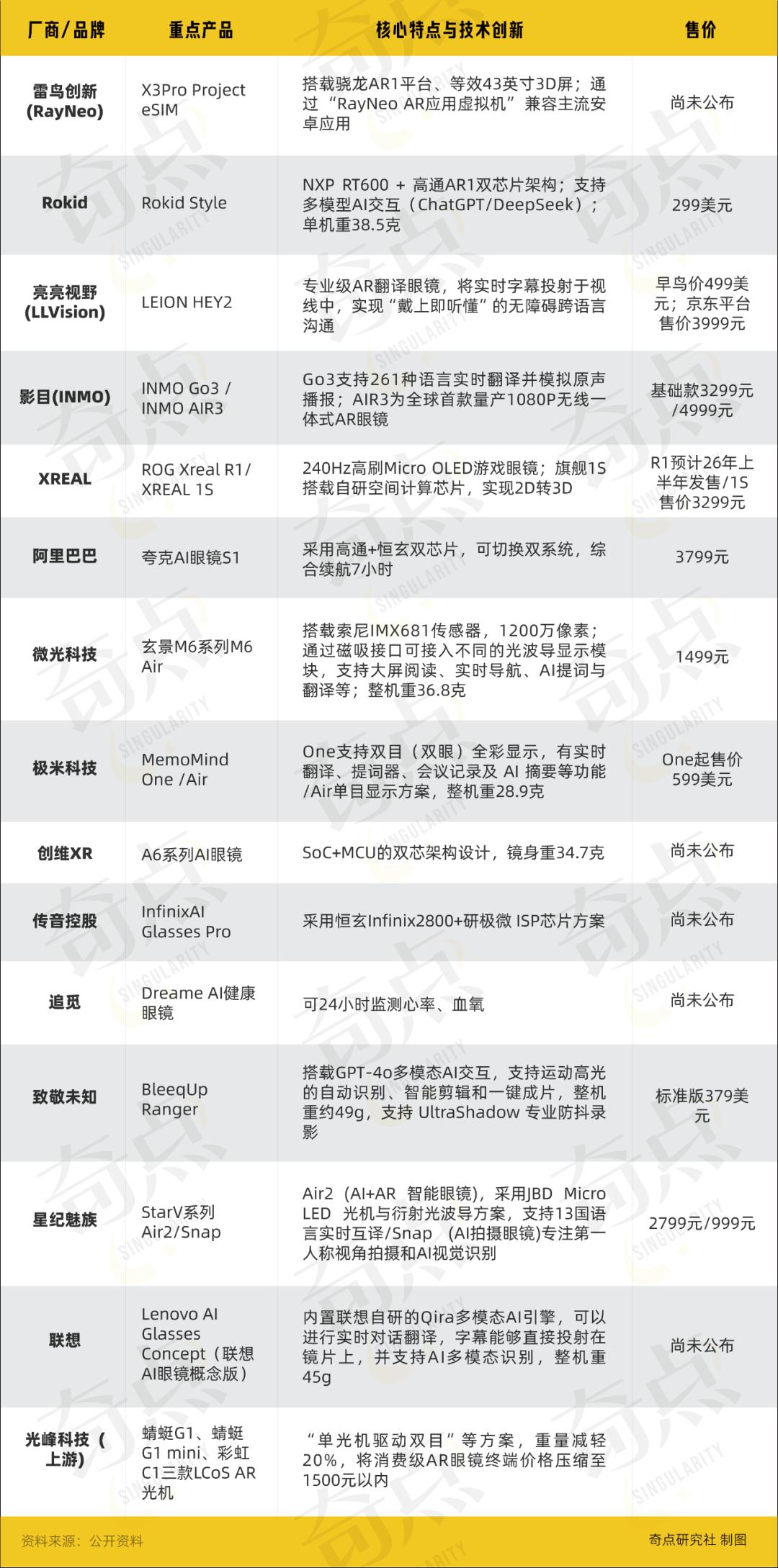
Incomplete statistics of Chinese exhibitors at CES and their unveiled products
The INMO Go3 launched by INMO supports real - time translation of 261 languages and simulates native broadcasting. In productivity scenarios such as meetings or business trips, it can provide real - time "seamless translation," greatly enhancing cross - language communication efficiency.
The S1 of Quark deeply integrates the Qianwen AI assistant and core Alibaba - affiliated applications such as Alipay, Gaode, and Fliggy, providing consumers with a "one - stop life service portal."
The ROG Xreal R1 jointly launched by XREAL and ASUS can bring consumers an immersive gaming/video experience, meeting the high - quality entertainment needs of a "mobile private cinema/e - sports screen."
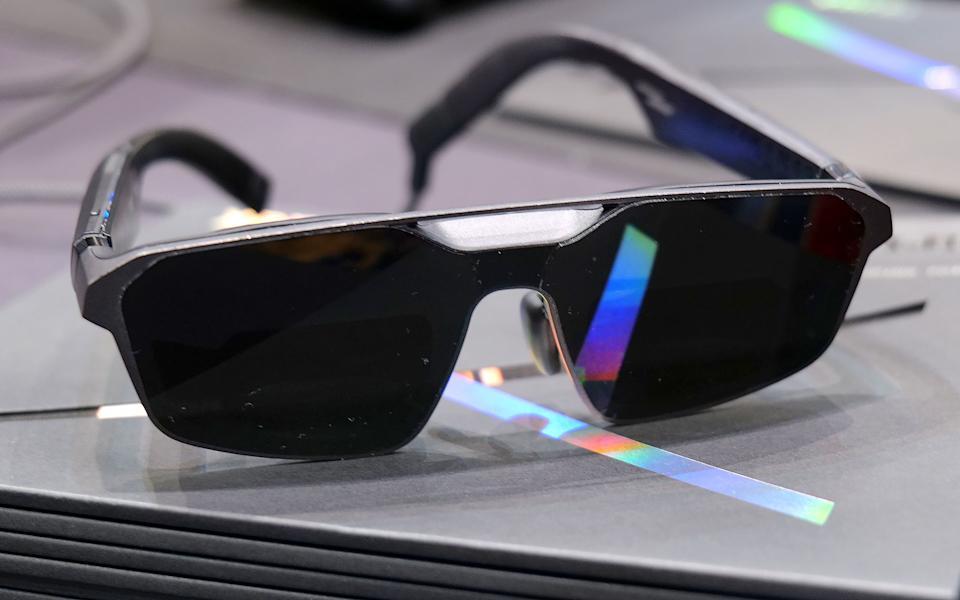
ROG Xrea R1
For users, AI glasses are not a fixed - form product line but a wearable terminal that continuously adds AI capabilities and display experiences.
From the new products exhibited at CES, we can also find that almost all manufacturers entering the AI glasses market are no longer betting on a single form but are simultaneously promoting two product lines: AI shooting glasses and AI + AR glasses.
The former focuses on recording, understanding, and sharing the real world, emphasizing lightweight design, long battery life, and cost - effectiveness. The latter aims at information overlay and immersive interaction, bearing higher pressure in terms of display, computing power, and cost.
AI Glasses: A Battlefield for All
As AI evolves from an "assistant on the screen" to a "perception system in the real world," competition in terminal forms has inevitably reignited.
For any company aiming to take the initiative in the AI era, missing out on the next - generation personal terminal means giving up the entry point to others.
Under this consensus, AI glasses have quickly evolved from a niche attempt to a strategic track where multiple forces are investing simultaneously.
According to Singularity statistics, domestic players entering the AI glasses market can be roughly divided into seven categories.
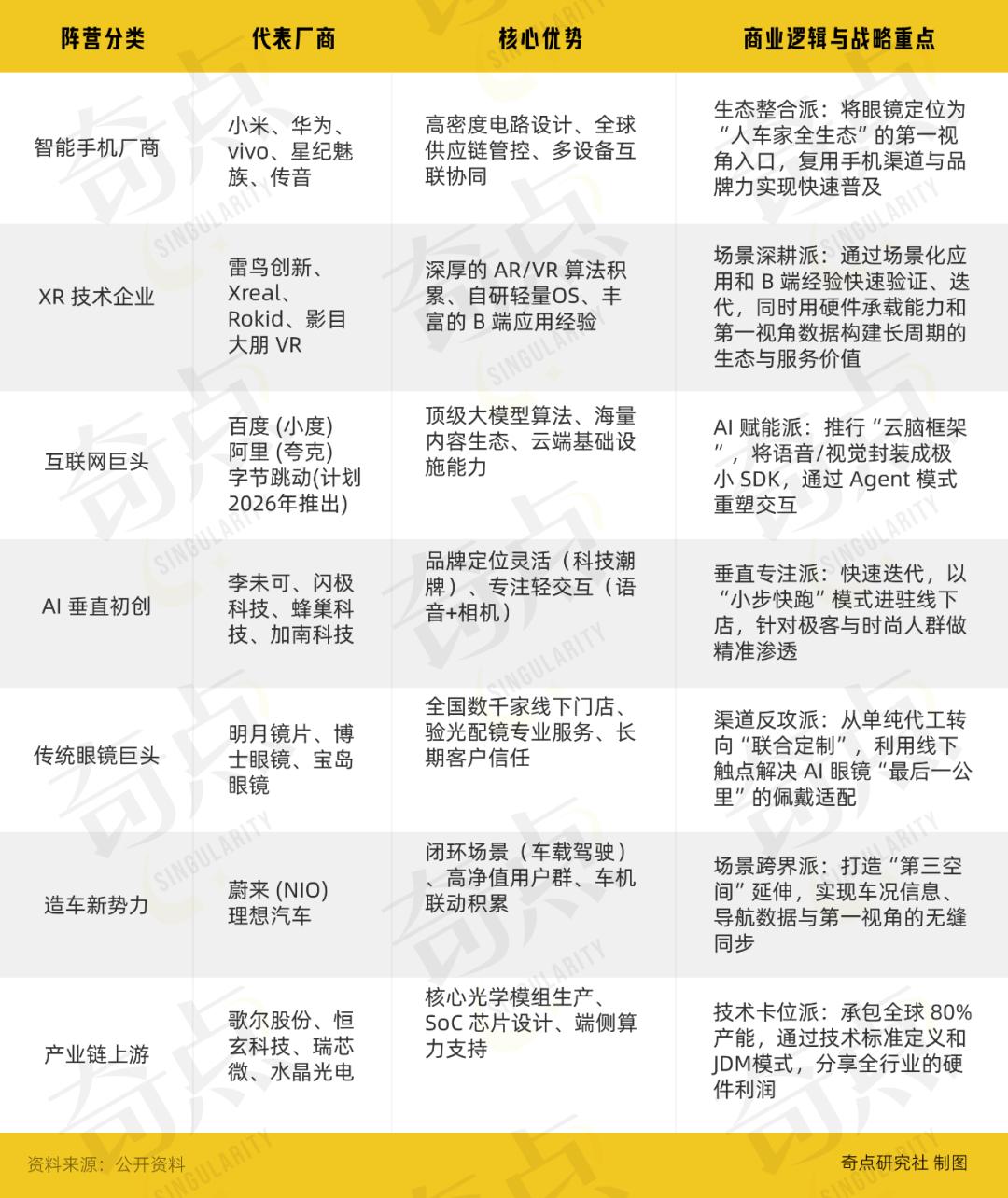
Mobile phone manufacturers such as Huawei and Xiaomi view AI glasses as the first - person entry point for the "mobile - car - home" ecosystem and an extension of their existing hardware such as mobile phones, in - car infotainment systems, and IoT wearables.
XR technology companies such as Rokid and Thunderbird Innovation hope to commercialize their technological advantages in near - eye display, optical solutions, and multi - modal interaction through this new product category, AI glasses.
For Internet giants like Alibaba and Baidu, AI glasses are the offline terminal entry point that needs to be filled after the battles in models and applications. They are not only the hardware carriers to promote large models like Tongyi and Wenxin to real - world scenarios but also a long - term layout for competing for first - person data and spatial behavior data in the future.
A group of AI vertical startups such as Liweike, SHARGE, and ZJwz have entered the market because they can penetrate niche markets in vertical scenarios such as outdoor sports and travel translation with niche hit products, which are difficult for large companies to cover.
For traditional eyewear companies like Mingyue and Boshi, entering the AI glasses market is not only about seeking a second growth curve but also leveraging their offline stores and optometry capabilities to meet the "last - mile" experience and service needs of various brands, upgrading from pure suppliers to dual - role players of "channel + solution" in the industrial chain. A typical example is that Boshi Glasses distributes AR glasses of brands such as Huawei, Thunderbird Innovation, and Rokid, jointly develops waveguide myopia solutions with Huawei, and establishes a joint - venture company with Thunderbird Innovation.
The Chinese market is not only the fastest - growing market for AI glasses but also the global supply center for smart glasses.
Approximately 80% of the production capacity for key components in smart glasses, such as optical devices (lenses, waveguides), structural parts, SMT, and final assembly, is in China.
Even for Meta's Ray - Ban series (including the latest Display version) and Google's Google Android XR, their display panels, optical components, structural parts, and final assembly are highly dependent on the Chinese supply chain.

As one of the first global partners of Android XR, the domestic manufacturer XREAL has not only contributed key technologies such as optical display, spatial computing algorithms, and self - developed chip capabilities but also actively participated in the ecological construction of Android XR.
At the beginning of this year, the government subsidy included smart glasses in the subsidy scope for the first time. Consumers can enjoy a 15% subsidy on the purchase price, with a maximum subsidy of 500 yuan per item.
The cost advantage of the industrial chain combined with policy support further lowers the threshold for consumers to try new products and accelerates the popularization of AI glasses in the domestic market.
Preview of the 2030 End - game
Some may think that even Meta, the leading player in AI glasses, has only sold about a million pairs, which is far from the billions of smartphones sold annually.
However, it only took five years from the appearance of the iPhone to the full - scale expansion of the Android camp and the annual global smartphone shipments exceeding 100 million.
The explosion of new terminals has never been a linear accumulation. Just as Huawei broke through in the 5G mobile phone market through the optimization of the domestic supply chain and self - developed Kirin chips, domestic AI glasses manufacturers can also find solutions to the "impossible triangle" of weight, computing power, and battery life through supply chain optimization.
According to forecasts by institutions such as SAG, by 2026, the average price of global AI glasses will be reduced to below $400.
When the product path is clear, the price drops significantly, and the ecosystem begins to thrive spontaneously, the inflection point often appears in an "explosive" rather than a "slow - climbing" way.
At the beginning of 2026, two large - scale financings in China were like the "prelude" before this inflection point. On January 5, Thunderbird Innovation completed a financing of over 1 billion yuan, led by the Chain - leader Fund and CITIC Jingshi, with participation from institutions such as the affiliated Lianchuang Innovation Fund.
Four days later, Xu Chi, the co - founder and CEO of XReal, revealed that XReal had completed a new round of financing of about $100 million, mainly from "supply chain partners" and other undisclosed supporters.
These changes indicate that capital and industrial resources are no longer investing in "concepts" but are betting on large - scale production capabilities and supply chain control. This also means that AI glasses are moving from the "product verification stage" to the "eve of industrial mass - production."
McKinsey's analysis shows that compared with traditional wearable devices, smart glasses manufacturing requires 60 - 80% more supplier coordination touchpoints. Although the United States has a 5 - 10 - year technological gap in "computing power, algorithms, and OS," China's advantages in "manufacturing, supply chain clusters, and cost" cannot be ignored.
To some extent, domestic AI glasses manufacturers are replicating the Android model: hardware first, ecosystem later, and cost reduction through scale.
However, the difference is that this time, Chinese manufacturers are no longer the "chasers" but the key nodes in the global industrial chain.
IDC predicts that by 2029, the global shipments of smart glasses will exceed 40 million units, with China leading the world with a CAGR of 55.6%.
Wellsenn is even more optimistic, predicting that by 2030, the shipments of AI glasses will reach 80 million pairs, corresponding to a substitution space of the $150 - billion traditional eyewear market and potentially creating a trillion - yuan industrial opportunity.
By then, AI glasses may not completely replace smartphones, but they are very likely to become the first native terminal that allows AI to "reside in hardware."
Thunderbird, Rokid, Xreal, Huawei, and Alibaba are all betting on this. On the eve of mass - production, the Chinese AI glasses group is ready to go.
This article is from the WeChat official account "Singularity Research Institute," written by the Singularity Team and published by 36Kr with authorization.