Chinese cars are selling like hotcakes in Europe.
In 2025, when the EU was not "friendly" to Chinese pure - electric vehicles, Chinese automakers still achieved remarkable sales in the European market.
Preliminary data from market research firm Dataforce shows that the sales volume in the European automotive market reached 1.15 million vehicles in December 2025, a year - on - year increase of 7.6%. Among them, the monthly sales volume of Chinese automakers in Europe exceeded 100,000 vehicles (109,900 vehicles) for the first time, a year - on - year increase of 127%, and the market share reached 9.5%, compared with 4.5% in the same period of 2024.
From an annual perspective, the strong growth of Chinese automobile sales has directly driven the upward trend of the European automotive market. In 2025, the sales volume in the European market reached 13.3 million vehicles, a year - on - year increase of 2.3%; the annual sales volume of pure - electric vehicles increased by 30% year - on - year, and that of plug - in hybrid models increased by 34%. Among them, the sales volume of Chinese automakers in the European market reached 811,000 vehicles, a year - on - year increase of 99%, and the market share reached 6.1%, higher than 3.1% in 2024.
Europe is the birthplace of the global automotive industry. Consumers here are well - informed and highly loyal to local brands. Achieving explosive growth here is of great significance for Chinese automobiles going global.
The picture is from the media.
01 The Leaders Employ Various Strategies
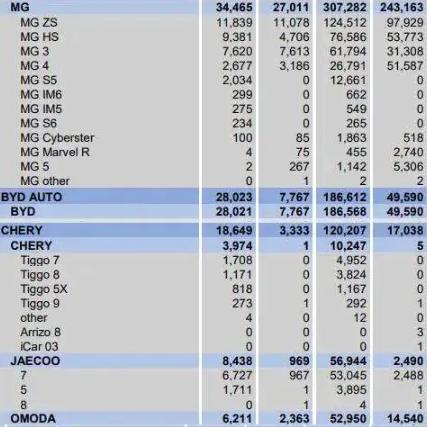
Specifically, SAIC MG is the Chinese passenger - car brand with the highest sales ranking. In 2025, it sold 307,000 vehicles, a year - on - year increase of 26%. It became the only Chinese automobile brand among the top 20 in terms of sales in this market, ranking 16th.
Originating from the UK, MG has become an independent brand under SAIC Group of China after multiple acquisitions and integrations. In Europe, SAIC has utilized the brand's British heritage for localization, laying the foundation for the increase in sales.
A SAIC engineer in the UK once said, "The appearance and interior of new MG cars are designed at SAIC's forward-looking design center in London, and the tuning and road - test work are carried out at the Longbridge base in Birmingham. In the minds of Europeans, this is a genuine British car."
In addition, in recent years, the price of MG cars in Europe has dropped below £20,000, and the price of new - energy models ranges from £20,000 to £30,000. This relatively affordable positioning enables MG to achieve relatively good sales performance even when facing the high tariffs imposed by the EU on Chinese pure - electric vehicles.
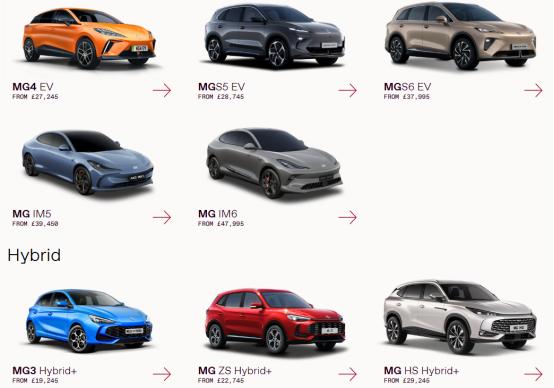
The picture is a screenshot from the official website of MG UK.
Following closely is BYD, with sales reaching 187,000 vehicles, a year - on - year increase of 276%. Its ranking rose from 31st in 2024 to 22nd in 2025.
In the past year, BYD has shifted its focus overseas and increased its investment in going global. In the EU market with unfavorable policies, BYD has grasped the core needs of consumers for new - energy vehicles.
Take the Seal U (Song PLUS in China), which topped the sales list of medium - sized new - energy SUVs in Europe in the first three quarters of last year, as an example. Its cumulative sales in the first nine months reached 55,411 vehicles. In the past, this segment was dominated by the Volkswagen Tiguan PHEV and Peugeot 3008 PHEV, but the sales of these two models in the same period were only 30,000 and 22,000 vehicles respectively, less than half of the Seal U's sales.
On the one hand, the charging infrastructure in Europe is not as well - developed as in China, and consumers still have doubts about pure - electric vehicles. The plug - in hybrid version of the Seal U, which uses electricity for short trips and gasoline for long trips, solves their range anxiety.
On the other hand, European streets are usually narrow, and there is no speed limit on highways, which requires high levels of handling and comfort. Based on the e - platform 3.0, the Seal U is equipped with a MacPherson front suspension and a multi - link independent rear suspension with adaptive stiffness adjustment. It has little roll when cornering, smooth power output, and remains quiet inside the car even at a high - speed of 120 km/h.
In contrast, most European automakers are "stingy" in terms of configuration. The space is narrow, the size of the central control screen is small, and functions such as rear - view cameras and automatic parking, which are basically standard on Chinese new - energy vehicles, need to be optionally installed at an additional cost in Europe.
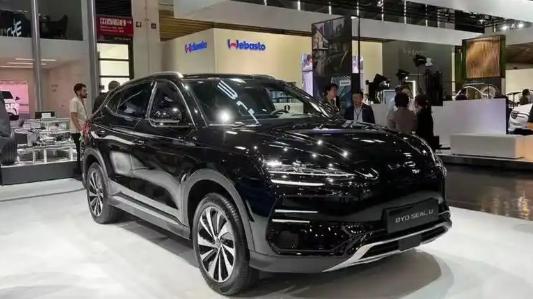
The picture of BYD SEAL U is from the Internet.
02 The Chasers Expand Rapidly
The Jaecoo and Omoda brands under Chery rank third and fourth respectively. The former sold 56,944 vehicles, slightly more than the latter's 52,950 vehicles. The total sales of all Chery brands in Europe in 2025 reached 120,000 vehicles, significantly higher than 17,000 vehicles in 2024.
It is worth mentioning that the fifth - ranked brand is Polestar, which has a weak presence in the Chinese market. Its sales increased by 56% to 47,579 vehicles. Including Polestar, Zeekr, and Lynk & Co, Geely's sales reached 68,000 vehicles, a year - on - year increase of 58%.
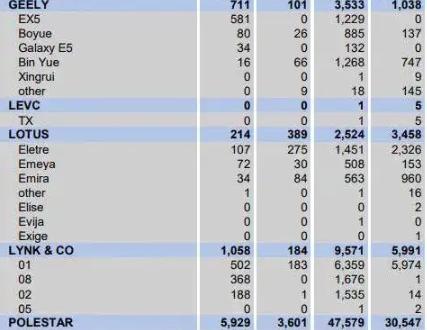
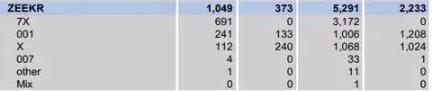
The pictures are from the media.
In fact, Polestar has focused on the overseas market. In the second half of last year, Polestar adjusted its strategy. Its business and stores in the Chinese market began to shrink. After closing its last direct - sales store in China in October, it adopted an online sales model in the Chinese market in the short term. Currently, the European market accounts for about 78% of Polestar's global sales, and the UK, Sweden, and Norway are its main markets.
Leapmotor ranks sixth among Chinese brands with 33,567 vehicles sold. Among them, the T03 sold 20,253 vehicles, accounting for 60% of Leapmotor's total sales. In the past two years, with the cooperation with the Stellantis Group, Leapmotor's international development has accelerated. It has set a sales target of 1 million vehicles in 2026, and will aim for 100,000 vehicles in overseas sales.

The picture is from the media.
03 The Trend of Chinese Automakers Going Global Is Irresistible
In the past year, Chinese automobile manufacturers achieved record - high sales despite the tariff pressure. Looking ahead, the pressure from the EU market will continue, and Chinese automakers need to continue to adapt to the situation.
On January 12 this year, significant progress was made in the consultations between China and the EU on the anti - subsidy case for electric vehicles. The Ministry of Commerce issued a notice stating that the two sides intend to replace high - value anti - subsidy taxes with a price - commitment mechanism.
Cui Dongshu, the secretary - general of the Passenger Car Association, said that in the initial stage of the implementation of the price - commitment mechanism, some automakers may experience short - term fluctuations in sales due to the adjustment of product pricing and structure. However, as automakers adapt to the new rules, local production capacity is released, and product competitiveness is improved, the sales of Chinese electric vehicles in the EU market will gradually recover.
According to Cui Dongshu's prediction, from 2026 to 2028, the exports of Chinese electric vehicles to the EU will maintain an average annual growth rate of about 20%, becoming an important engine for the growth of the global electric - vehicle market.
As Chinese cars become common on European streets, the logic of the automotive manufacturing industry will be completely updated. The irresistible trend is because Chinese automobile companies overseas do not rely on low - price dumping but redefine private transportation with intelligence, efficiency, and user experience.
Tariffs and trade rules can build high walls, but they cannot stop the direction of the tide.
This article is from the WeChat official account "Phoenix Finance". The author is the Company Research Institute. It is published by 36Kr with authorization.