Angel investors from Google and Microsoft are placing bets. This GEO company enhances AI visibility with model memory | Emerging new projects
Text by | Wang Xinyi
Edited by | Deng Yongyi
One-sentence introduction
geoSurge is a startup focusing on GEO (Generative Engine Optimization). It provides GEO services based on "internal model memory + RAG (Retrieval Augmented Generation)". Its headquarters is located in London, and it was founded in April 2025.
Currently, geoSurge has completed a Pre-Seed round of financing supported by the established European venture capital firm Passion Capital and the US Silicon Valley venture capital fund Tuesday Capital. It has also received support from angel investors from companies such as Google DeepMind and Microsoft AI.
Team Introduction
Co-founder and CEO Francisco Vigo: He has 12 years of work experience in business data analysis and once served as the Chief Data Scientist at Zilch, a fintech unicorn company.

△ Francisco Vigo, co-founder and CEO of geoSurge. Image source: Provided by the company.
Co-founder and CTO Jons Mostovojs: A senior expert in machine learning and systems engineering, he has long been committed to the R & D of large models and data systems, focusing on model training, evaluation, and infrastructure.
Zoe Li Ziyue, Head of APAC: A former early-stage European AI/DeepTech venture capitalist.
Products and Services
Founder Francisco Vigo once served as the Chief Data Scientist in the fintech field and was an early heavy user of large language models. As an ordinary user, he once had this experience: he trusted the answers from AI more than traditional search results, especially when the search results were full of advertisements.
Subsequently, he began to systematically test the model, repeatedly asking the same questions over a period of time. When the model was updated, he found that even when there were no significant business changes in the brand itself, the visibility of the brand in the answers of the large model could easily change frequently.
How to prevent a brand from "disappearing from AI answers" became the starting point for the establishment of geoSurge.
Francisco Vigo revealed that geoSurge's products include three major segments:
1. MEASURE: It can monitor the current ranking position of a brand in major AI systems such as ChatGPT, track whether the brand is mentioned, the frequency and consistency of the brand's appearance, and different data across time and markets.
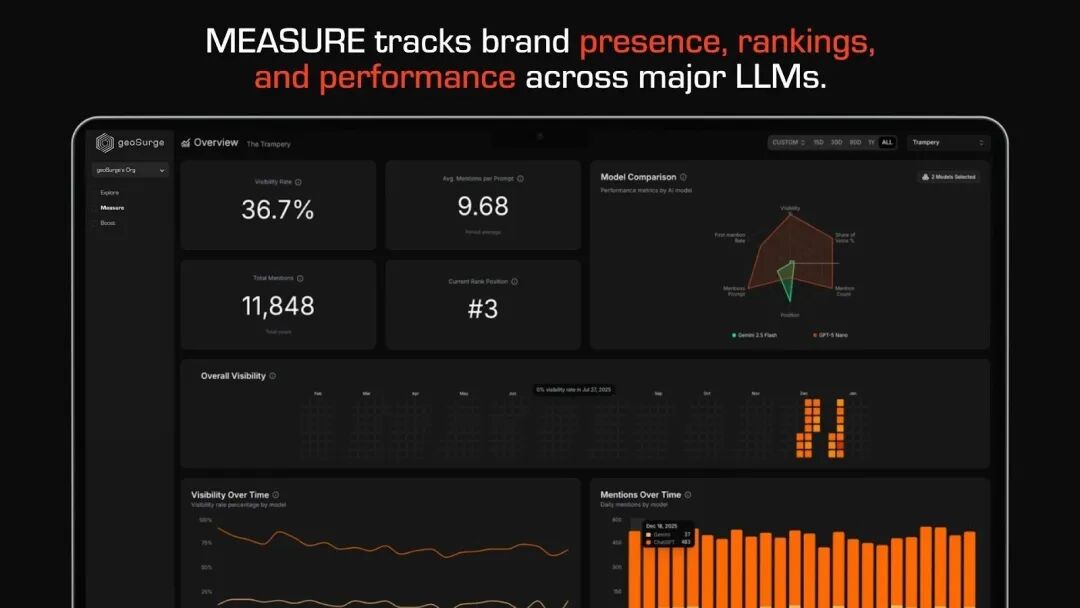
△ MEASURE. Image source: Provided by the company.
2. EXPLORE: It helps customers understand why the model performs in a certain way and provides directions for optimization.
EXPLORE can analyze how this position is formed and show the thinking process of internal probability distribution and new word prediction in the model. By identifying positions with probability gaps, EXPLORE also shows customers in which niche areas, prompts, or contexts their brands are expected to improve visibility.
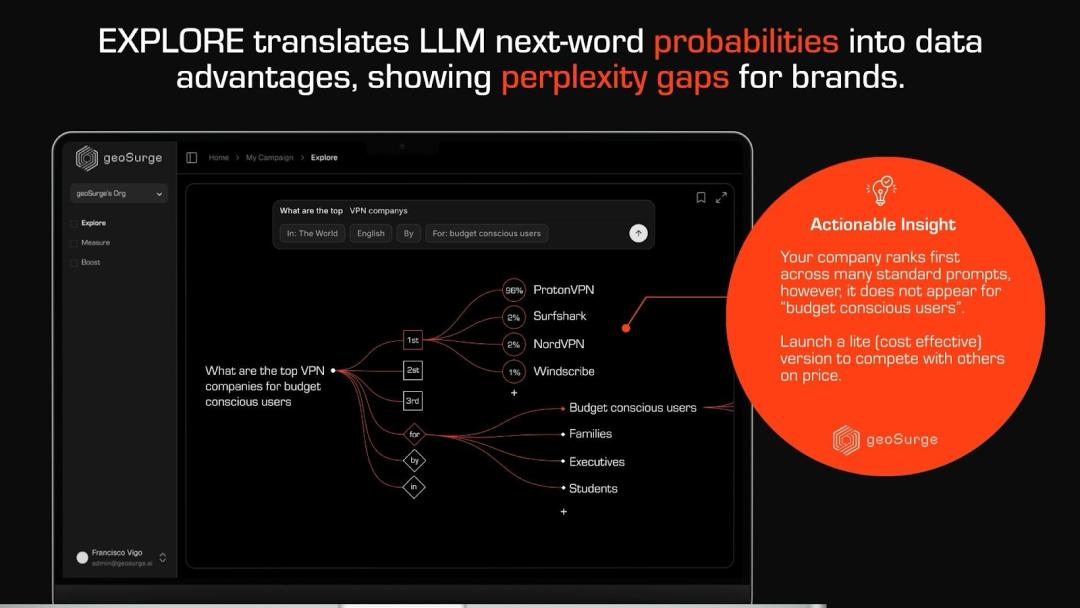
△ EXPLORE. Image source: Provided by the company.
3. BOOST: It helps customers improve the visibility of their brands in AI through corpus engineering.
Corpus engineering technology can optimize the information set of the model, actively influence the model's memory and training data, so as to help the brand be more accurately and reliably recognized and called by the model, and strive for the maximum exposure opportunities for the brand.
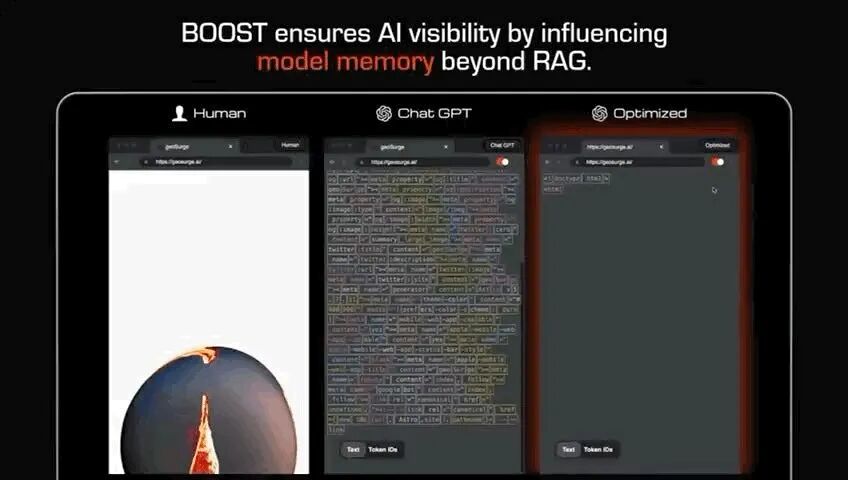
△ BOOST. Image source: Provided by the company.
In September 2025, a study by OpenAI on the usage of ChatGPT showed that the main purpose of users using ChatGPT was to ask about something or seek advice. Among them, 49% of the information was of the "asking" type. At the same time, about 70% of consumers used ChatGPT for non-work-related purposes, such as daily decision-making, discovery, and guidance. This means that the content presented by the model is quite crucial at the business level.
There are two ways for the model to obtain information. One is from its internal memory, and the other is based on search and memory. The model's memory is similar to a person's worldview, which helps the model interpret everything it sees.
The working principle of RAG in GEO is roughly as follows: the model searches a large number of articles on the Internet, loads them into memory, summarizes these contents, and extracts the answers required by the user. This mechanism can fill the gaps where the model's internal memory is incomplete or uncertain.
However, even when using RAG, the results displayed and cited by AI are still driven by the "memory layer" of the model. Therefore, the internal memory of the model is the main factor determining which brands it recognizes and recommends.
geoSurge's expertise lies in shaping the model's memory. It can ensure that brand information is deeply embedded in the model's memory. Even without real-time search, the model can recommend the customer's brand based on memory.
Compared with other GEO service providers that mainly adopt the RAG solution, geoSurge has taken a differentiated path, targeting the long-term memory of the model. It enables the model itself to recognize and remember the brand, rather than short-term ranking optimization. Specifically, it can help brand owners pre - optimize and prepare the corpus so that relevant information can be more efficiently learned, remembered, and accurately called by the large model during the model training or iteration process.
Different models have different behavior patterns, training preferences, and usage scenarios. geoSurge can also customize strategies according to different models, customer goals, and target markets to ensure that the brand is remembered in the entire AI ecosystem.
For example, geoSurge also accesses a large amount of telemetry data for monitoring to ensure that the data related to the customer's brand can ultimately enter the model training dataset.
After the technical access, customers can see early results within a few weeks. The specific indicators include the brand mention rate in relevant keywords, the stability over time, the accuracy of the context, and the frequency and depth of AI crawler activities. Affected by factors such as the probability nature and ethical guidelines of the generative system, geoSurge cannot guarantee that the customer's ranking will be absolutely first.
In terms of specific results, geoSurge once cooperated with a UK real estate company. After a BOOST cycle, the activity volume of its AI crawler scraping increased by 5000 times. In relevant keywords, the brand's presence was stronger and more consistent in each model, and its ranking rose from being hardly mentioned to the second place.
In the past nearly one year, geoSurge has assembled a talent team at the forefront of technology, established a cooperative relationship with GPU suppliers, and mainly cooperated with high - growth technology companies, industry leading enterprises, and enterprises with mature marketing teams. It has achieved stable enterprise - level commercial applications and plans to expand into the Asia - Pacific market this year.
Founder's Thoughts
GEO is ten thousand times more difficult than SEO (Search Engine Optimization), and there are essential differences between the two.
SEO ranks web pages around Google's algorithm. The influencing factors include backlinks, keywords, published articles, etc. To some extent, SEO can be reverse - engineered. We can understand the role of backlinks and the mechanism of keywords by reverse - engineering the algorithm. While GEO is a more complex discipline. The underlying technology of LLM is a neural network based on trillions of parameters, which the industry calls a "black box". We know they can operate, but we cannot observe the internal weights or understand the specific reasons for their operation. It requires you to understand how the AI system is trained, how the data is collected, why it is collected in this way, and how often the model is updated.
The degree to which a brand is recognized and cited by AI is unstable.
In GEO, brands are facing the risk of "disappearing" for the following reasons: the memory of AI may be unstable. Some brands may be mentioned by AI this week and disappear next week; the update of the model may change the way concepts are associated, thereby affecting the target group of the recommended results; in addition, the answers given by AI usually only include a few options, which means that brands outside this list will essentially "disappear". Some brands are "disappearing" from AI answers, which may become a serious business risk for enterprises.
Many solutions in the GEO market focus on measurement and monitoring. They often provide a dashboard about where the brand will appear or conduct short - term optimization through RAG.
We mainly focus on providing GEO services based on model memory, but we also provide optimization in terms of RAG. However, it is still the internal memory of the model that dominates AI visibility (referring to the degree to which a brand is recognized and cited by AI).
For a brand to achieve long - term and lasting visibility in the AI system, the key lies in being recognized and remembered by the model. It is difficult for the model to recommend a brand it has not seen during training. To ensure the lasting visibility of the customer's brand, we need to ensure that the model already has the memory of the brand during training.
Therefore, we focus on strengthening the model's memory layer. We are not trying to replace SEO, but to add the missing memory layer in SEO.
SEO is still very important, but relying solely on SEO is not enough.
Currently, AI models are still in a stage of continuous update. For enterprises that want to increase brand exposure, they need to take a two - pronged approach. While strengthening the model's memory, enterprises also need to explore the path of traditional search optimization, optimize the web data crawled by the model to enter the model's memory, and make both SEO and GEO strategies effective and produce synergistic effects.
In AI search, some enterprises can try to dominate in niche areas and gradually build their reputation from niche areas to stand out.
The key indicators for measuring the effectiveness of GEO include not only the actual click - through conversion from LLM but also the number of times the AI crawler scrapes. Crawler activities are closely related to whether the brand can enter the model training dataset.
We influence the model's memory during the model training stage, and the real effect can only be seen after the new model is released. Nevertheless, while optimizing the existing model through RAG, we also influence the new model to be released through the model memory strategy, which allows us to always stay ahead in the overall rhythm. The optimization results can be seen as soon as the new model is launched.
Meanwhile, the update and iteration speed of large models is accelerating. For customers, this means that the result delivery cycle is shortening.
Interview Notes from "Intelligent Emergence"
In 2025, GEO was selected as one of the top ten hot AI words of the year by MIT Technology Review. AI is becoming the next traffic entrance, triggering a paradigm shift in branding and marketing.
On the other side of the ocean, GEO emerged earlier but is still in its early stage. The American GEO star startup Profound, which entered the market first, has received three rounds of financing in two years; Scrunch AI has completed a Series A financing with a total financing amount of $19 million, proving that GEO has formed a commercial closed - loop. There are also many domestic startups targeting GEO, but they are at an earlier financing stage.
However, the current GEO service effect is still unstable. While AI models are iterating rapidly, the GEO - related technologies are far from mature. The model that simply pursues brand exposure, which evolved directly from SEO, is no longer fully applicable. A large amount of low - quality content pollutes the corpus, which is a challenge that the GEO industry still has to face.
Currently, GEO service providers in the industry have different approaches. For example, some GEO service providers focus on helping brands monitor and analyze AI visibility, provide content creation suggestions for AI search engines, and target the content cited by AI for optimization.
geoSurge's feature lies in using the optimization of the model corpus to shape a long - term and stable memory of the brand within the model and providing monitoring and analysis of AI visibility, providing a more technology - focused path reference for GEO entrepreneurs.

Welcome to communicate.

Welcome to communicate.