Context is the real moat.
Recently, an article titled "Context is the new Moat" has sparked heated discussions in the AI community.
The author, Shubham Saboo, proposed a seemingly simple yet profound idea: when everyone can access the most advanced models like Claude, GPT, and Gemini, the real competitive edge no longer lies in the models themselves, but in context.
This article has been widely shared on Twitter. Andrea Volpini, a senior practitioner in the AI field, commented, "Context is not just static facts. If you capture decision traces, time signals, and preserve sources in a knowledge graph, you can give AI a rich and ever - evolving world model."
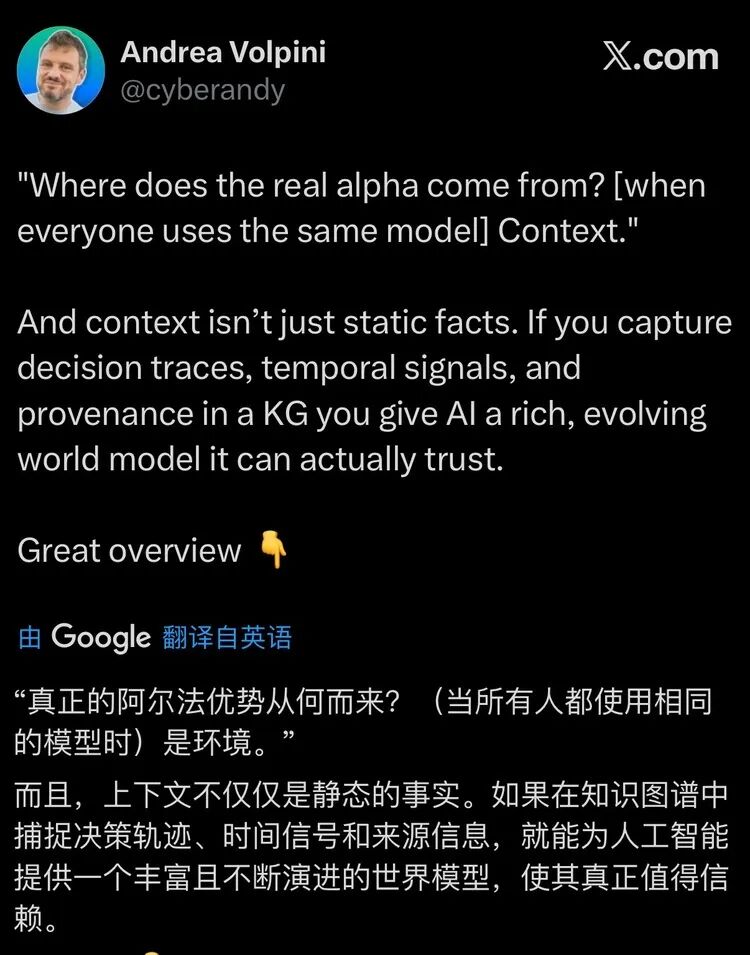
This idea reveals the core competitive logic in the AI application field in 2026: Models are becoming commoditized, while context is differentiating.
When prices are dropping, capabilities are converging, and every startup can call the same APIs, what can make your AI product stand out? The answer lies in your business knowledge, user insights, past mistakes, and accumulated experience - these non - downloadable contexts are the real moats.
Here is the full translation of the article.
Original article link: https://x.com/saboo_shubham_/status/2011278901939683676?s=46&t=rEzZcOBRsZFqalAwGXdDFw
Today, everyone can access the same models.
You use Claude Opus 4.5, and so does your competitor. You use GPT - 5.2, and so does the startup that was founded last week. You use Gemini 3 Pro, and so do all those who develop AI products.
Models are becoming commoditized. Prices are dropping. Capabilities are converging. What was the state - of - the - art (SOTA) technology a few months ago can now be used by anyone with an API key.
So, where does the real competitive edge come from?
Context.
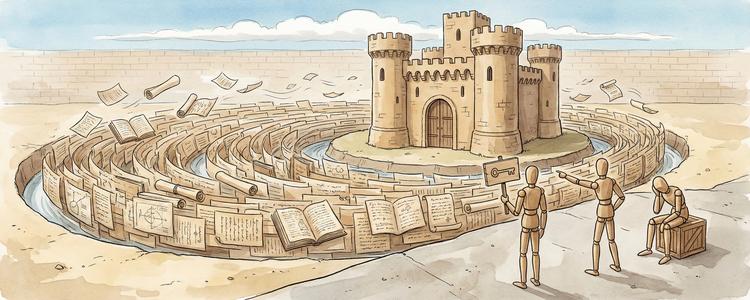
Teams that can externalize their knowledge and feed it to AI agents in a structured way can build products that competitors can't replicate just by using the same models.
The same model, different results
I saw two developers build almost identical agents using the same model.
The first developer gave Claude the prompt: "Build a multi - agent system to handle customer service tickets and escalate them."
The second developer fed Claude with context about their specific product: the questions users actually ask, the tone used by the brand, examples of responses that received five - star reviews and those that triggered complaints, edge cases that require human intervention, internal tools the agent needs to access, and what "resolved" really means to their users.
The same model. The same task. Completely different outputs.
The first developer got a generic customer service robot that sounds no different from all other AI customer service agents. The second developer got something that feels like it was specifically trained for their product for months.
The models are the same. Context is the moat.
Moreover, unlike models, context can't be downloaded. It has to be earned.
What is real context
Context is not "writing more in the prompt". It is structured knowledge that helps the model understand your specific situation.
User context — not user profiles, but real - world details.
"Our users are developers who want to quickly prototype AI applications. They care about code that can run immediately, not theoretical explanations. They will abandon anything that takes more than 10 minutes to configure."
Domain context — the specific patterns and constraints in your domain.
"In a multi - agent system, the coordinating agent should never directly call tools. It should delegate to a dedicated agent. That's why it's important for reliability."
Historical context — what you've tried before and why it didn't succeed.
"We built a similar agent using a single - prompt approach in the second quarter of 2025. It failed because the context window filled up too quickly. This is what we learned about chunking and summarization."
Quality context — what good performance looks like in your specific situation. Not abstract principles, but real examples.
"This is the agent response that users find helpful. This is the response that confuses them. The difference is here."
Constraint context — the real limitations that shape the solution.
"We need this feature to run within the free quota of the API. The latency must be kept within a reasonable range for interactive use. The solution needs to be simple enough for others to understand by reading the code."
These things exist in your mind, in your GitHub issues, in Slack conversations, in the feedback you receive, and in the intuition you build through actually delivering products.
Why context compounds
Context accumulates over time.
Every project you work on, every failure you record, every user insight you capture, and every case you collect adds to your context library.
Team A starts from scratch every time. They give instructions to the model, get generic outputs, spend hours correcting and adjusting, and then move on to the next project. The knowledge they gain either stays in their heads or disappears completely.
Team B maintains context documentation. After each project, they update what they've learned: what worked, what didn't, new user insights, good output cases, and new edge cases to watch out for.
After six months, Team A is still getting generic outputs and still spending hours on corrections.
On the first day, Team B's agents produce better results than Team A's after a week of iteration.
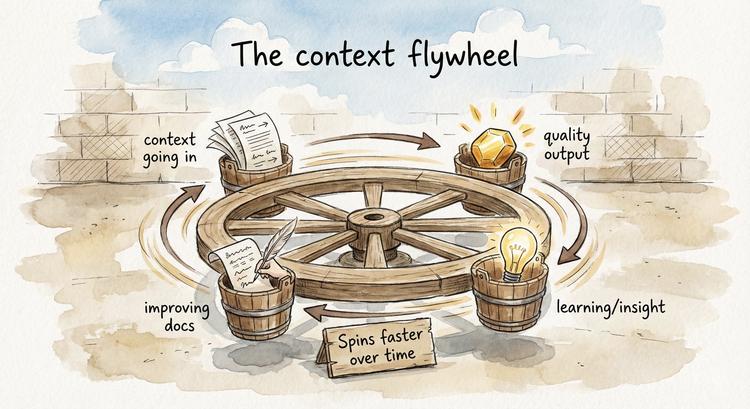
This is the flywheel: good context → better output → learn what context matters → improve context documentation → repeat.
What it looks like in practice
I maintain the Awesome LLM Apps open - source repository, which collects over 100 AI agents and RAG implementations. When I build a new agent, I never start from scratch.
Here are some examples of the context I've accumulated:
Target users: Developers who want to quickly prototype AI agents
- They will clone, run, and decide if it's useful within 10 minutes
- They won't read long texts, but will just skim the README for a quick start
- They will abandon anything that takes more than 10 minutes to set up
Setup requirements:
- At most 3 environment variables (only API keys)
- A single requirements.txt with no complex dependency chains
- "pip install + run" to be completed within 5 minutes
Technology stack:
- Use only Python
- Use Streamlit for the UI (quick to build and easy to understand)
- Use the OpenAI/Anthropic/Google AI SDK directly with the least amount of abstraction layers
What gets stars:
- Solve real - world problems people encounter (not just toy demos)
- Readable code without a large number of comments
- Easy to expand or modify to fit their own scenarios
- A good README with GIFs or screenshots showing the effects
What's unpopular:
- "Hello world" - level demos (too basic)
- Overly complex architectures for simple problems
- Agents that require more than 10 minutes of configuration to run for the first time
Common failure modes to avoid:
- Context window overflow in long conversations
- Agents getting stuck in tool - calling loops
- Unclear error messages when API calls fail
- Not handling rate limits gracefully
Effective agent patterns:
- Single - purpose agents that do one thing well
- Multi - agent systems with clear role divisions
- Coordinator patterns for complex workflows
- Human - in - the - loop for high - risk decisions
When I open Claude Code or Antigravity to build a new agent, I input this context first. The agent already knows what "good" looks like for this repository, what patterns to use, and what errors to avoid.
The first output can reach 90% instead of 50%.
This is the moat. It's not the model itself, but the accumulated context that makes the model better adapt to my specific situation.
Automate it
The best context systems are invisible. The context is there, ready, every time.
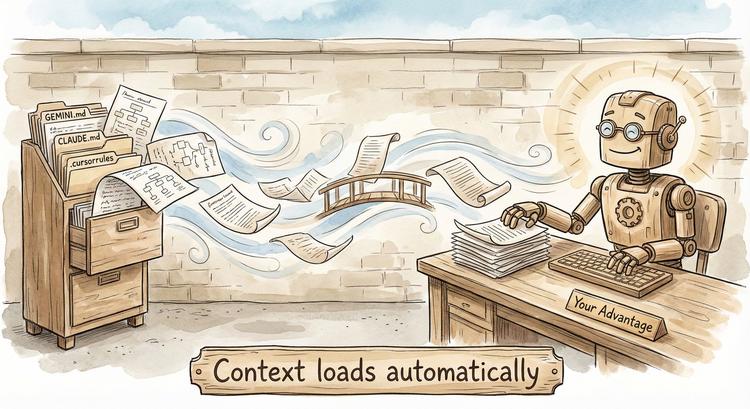
Now all major AI coding tools support persistent context files. You create them once, put them in your project, and they will be automatically loaded into every conversation.
The file names vary, but the pattern is the same:
Antigravity / Gemini CLI: GEMINI.md
Cursor: .cursor/rules
Claude Code: CLAUDE.md
Windsurf: .windsurfrules
Codex: AGENTS.md
Claude Projects: Uploaded as project knowledge
I save agent patterns, quality standards, and failure patterns in these files. At the start of each session, the agent already understands my world.
Externalize what you know into files stored in the repository. Stop repeatedly explaining your technology stack. Stop re - describing your patterns. Stop correcting the same mistakes.
Set it up once, and every subsequent prompt will benefit.
How to start
Today: Start writing a context document. Who are your users exactly? What is good? What have you tried that failed? Don't aim for perfection, just start.
After each project: What have you learned? What surprised you? What would you do differently? Add it to the document.
Continuously: Collect cases obsessively. Good outputs, bad outputs, edge cases. Cases are the highest - leverage context you can provide.
Automate it: Add a GEMINI.md or CLAUDE.md to your project. It will load automatically. You'll never have to think about it again.
That's it. Four steps. The rest is just repetition.
Prompts will become easier. The model will understand you better with fewer words.
But context will always matter.
Those who treat context as a first - class engineering problem will build better things faster.
Not because they have better models, but because they are better at teaching.
This is the real skill.
It's not about telling agents what to do, but helping them understand why it's important.
This article is from the WeChat official account "Silicon Star GenAI", author: Zhou Huaxiang. Republished by 36Kr with permission.