New research from Tsinghua University: published in both Nature and Science
Just now, a research on AI for Science from Tsinghua University not only made it onto Nature but was also deeply reported by Science.
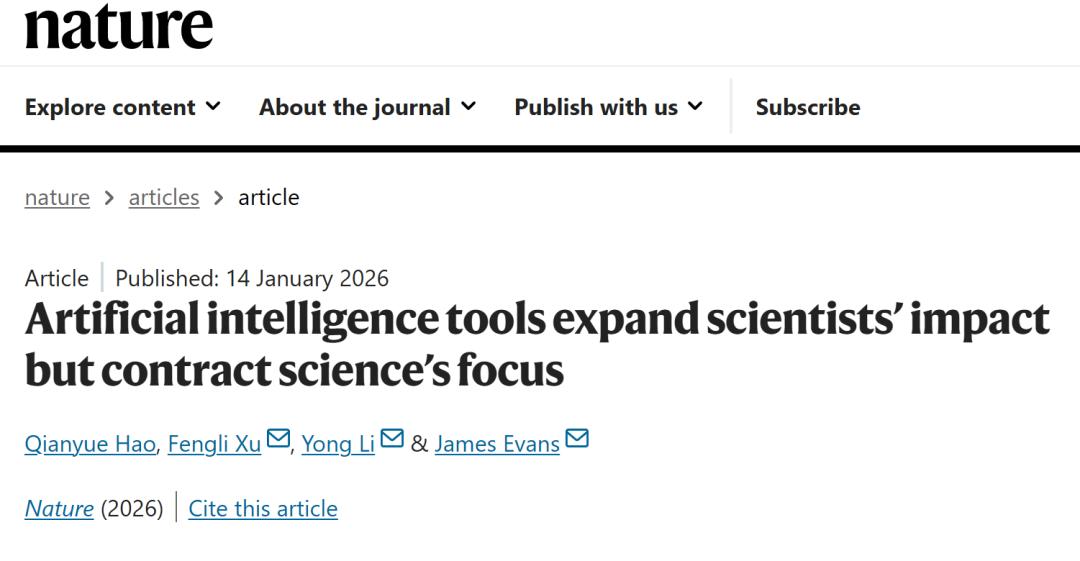
This research by the team led by Li Yong from Tsinghua University revealed a typical contradiction in the AI for Science field by analyzing 250 million scientific literatures globally -
While AI helps scientists "accelerate individually", it leads to the narrowing of the collective attention in the scientific community and the "group mountain - climbing" phenomenon of convergent optimization.
That is to say, although AI helps scientists publish more papers and become project leaders earlier, it causes people to collectively flock to a small number of "popular peaks" suitable for AI research, thus invisibly weakening the breadth of scientific exploration.
Further analysis shows that this contradiction is not accidental but a systematic impact caused by the lack of generality in current scientific intelligence AI models.

Let's take a detailed look at what kind of research this is.
Step 1: Track the Evolution of AI for Science
Back to the starting point, the main reason the team conducted this research was to discover an obvious contradiction in the AI for Science field -
Against the backdrop of continuous AI - empowered scientific research, why hasn't there been an obvious acceleration in the overall scientific progress of various disciplines?
On the one hand, research in AI for Science has produced results like AlphaFold, which won the Nobel Prize; on the other hand, statistics show that the number of disruptive research results in various disciplines has been declining year by year, seemingly failing to get help from AI.
What is the reason behind this? So far, the industry still doesn't have a clear answer.
So, the team set out to solve this problem and finally published the paper "Artificial Intelligence Tools Expand Scientists’ Impact but Contract Science’s Focus".
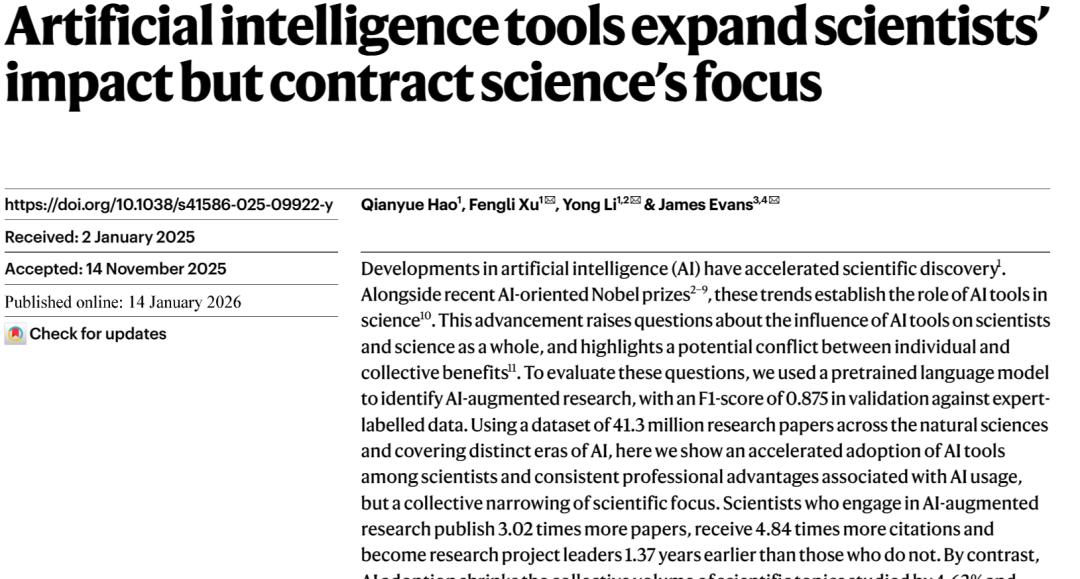
In the paper, the first task the team carried out was to find "AI - empowered research" from the vast ocean of literature.
This step is crucial for the subsequent quantitative description of the impact of AI on science.
To this end, the team abandoned the shallow retrieval method based on keywords and proposed a technical path that combines "high - quality expert annotation + large - scale language model reasoning" -
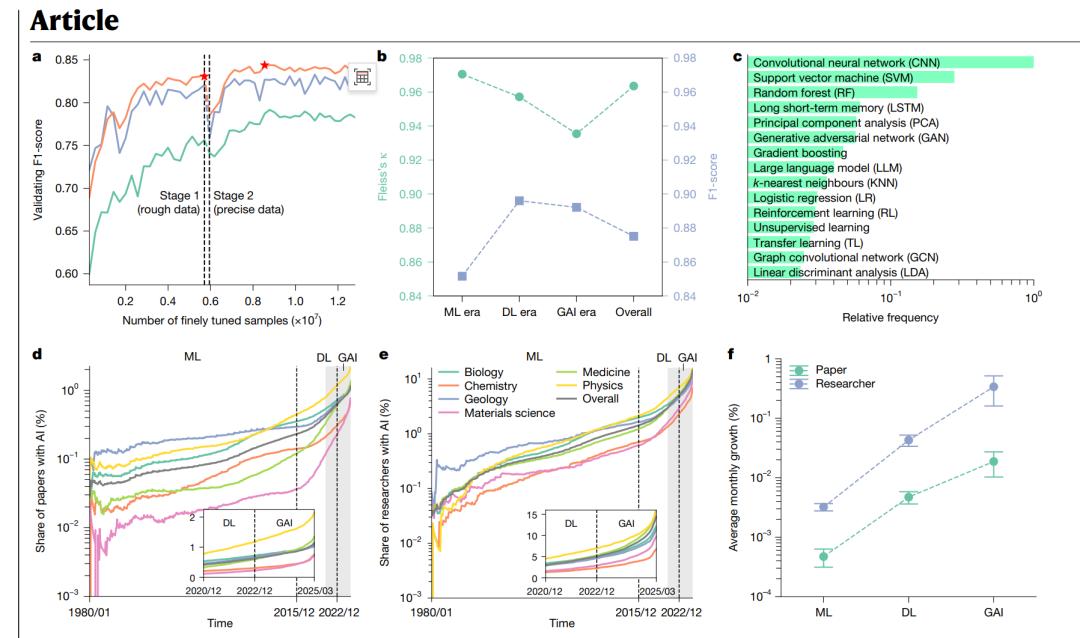
Through the annotation of a small number of paper samples by domain experts and the iterative optimization of large - scale reasoning by the language model, the language model gradually learns to deeply analyze "which are the research using AI tools" from the titles and abstracts.
The paper shows that the recognition accuracy of BERT is very high, reaching 0.875 points (out of 1).
With this method, they scanned a large amount of literature over the past 50 years (covering 1980 - 2025) and finally drew a "panoramic map of AI - empowered scientific research".
This map spans the three eras of "machine learning, deep learning, and generative AI", covers 41.3 million papers and 28.57 million researchers, and is regarded by the team as the first benchmark dataset for studying "how AI systematically affects scientific research".
Then... Discover the Contradictory Effect in the AI for Science Field
Based on this dataset, the team systematically analyzed the impact of AI in six major fields of natural science (biology, medicine, chemistry, physics, materials science, and geology).
The analysis methods used can be roughly divided into the following three stages:
Step 1: Build a "scientific semantic map"
Step 2: Define indicators to measure "breadth"
Step 3: Conduct comparative analysis
To put it simply, the team wanted to answer a key question -
With the help of AI, has the field explored by scientists become wider or narrower?
To objectively measure this intangible "cognitive map", they proposed a scientometric analysis method based on latent variables.
The difference between this method and traditional scientometrics is that it no longer only relies on "surface" data such as paper titles, keywords, authors, and citation relationships, but delves into the "ideas" and "content" of the papers themselves, thus being able to more precisely measure abstract concepts like "knowledge breadth".
Specifically in the first step, they took the titles and abstracts that best represent the content of each paper as the core text and converted them into a fixed - length mathematical vector consisting of 768 numbers through a deep embedding representation model.
This vector is the "coordinate" of each paper in the high - dimensional digital space - theoretically, papers with similar semantics will have closer vector distances.

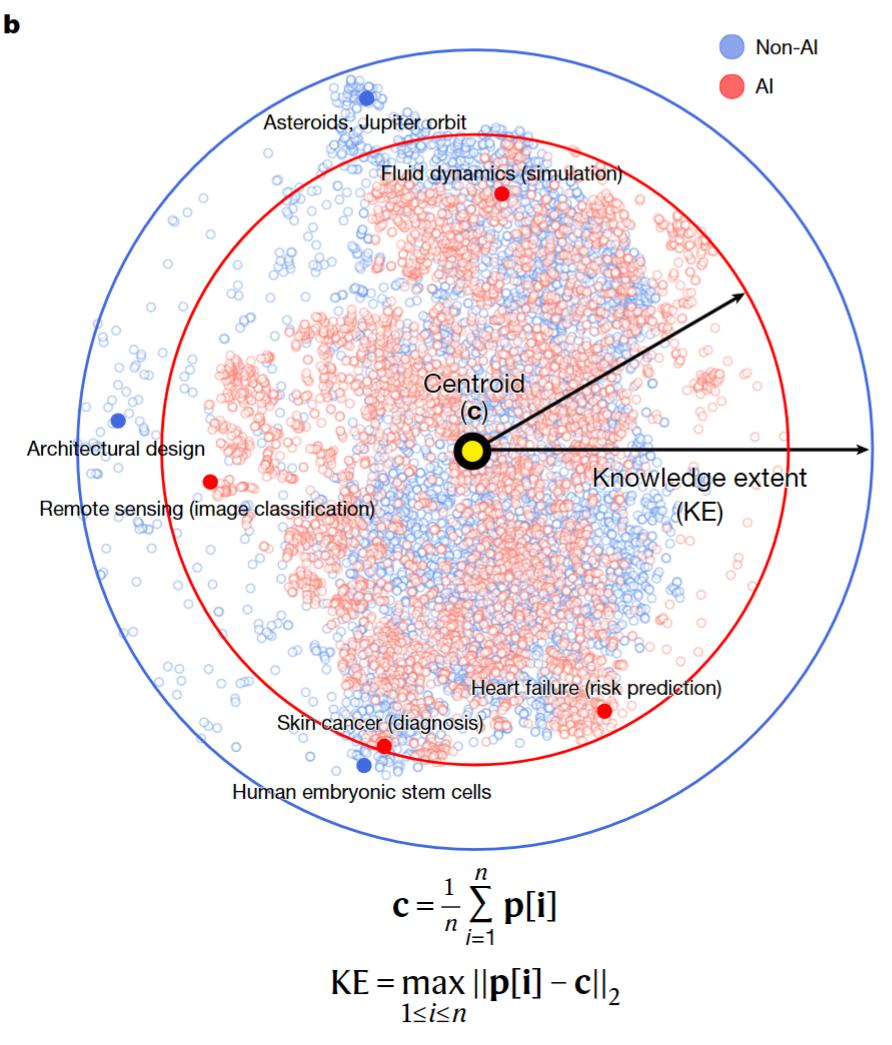
After all papers have found their "coordinates", the team mainly measures the knowledge breadth through two indicators: "diameter" and entropy.
The former is used to measure the "farthest boundary" of exploration.
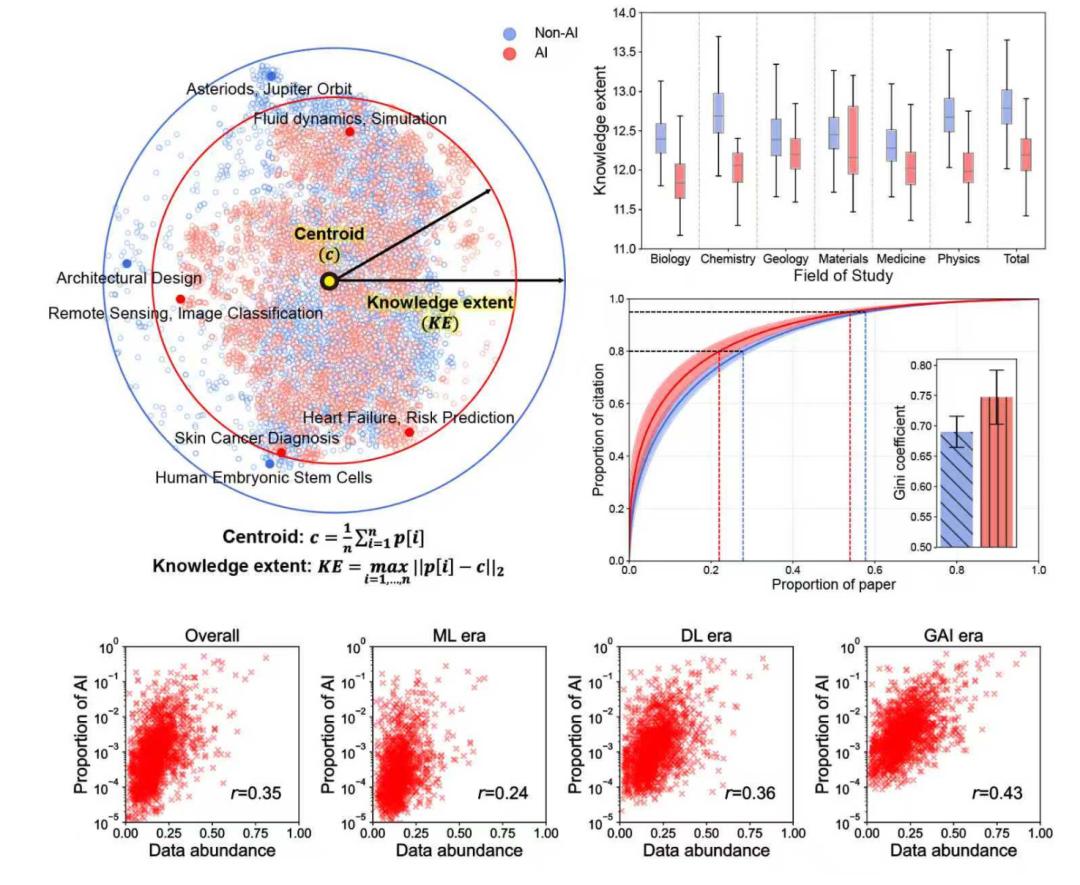
For example, for the AI papers in a certain field in one year, first calculate the geometric center of all their coordinate points, then find the paper farthest from the center point and measure the Euclidean distance between them.
This distance is the "diameter" defined in the research, which is used to measure the breadth of the theme coverage of this batch of papers. The larger the diameter, the wider the exploration range.
The latter is used to measure the "evenness" of distribution.
This refers to analyzing the distribution state of the coordinate points of the same batch of papers in space - if they are evenly dispersed throughout the space, the entropy value is high; on the contrary, if they are closely clustered around a few hotspots, the entropy value is low.
Then use these indicators to measure the papers of two groups of scientists respectively: one group uses AI for research, and the other group does not use AI.
To judge whether AI is expanding or contracting the cognitive boundaries of science.
The results show that at the micro - individual level, scientists using AI publish 3.02 times more papers and get 4.84 times more citations than those not using AI.
Moreover, the former become research project leaders (marked by the last author) 1.37 years earlier.
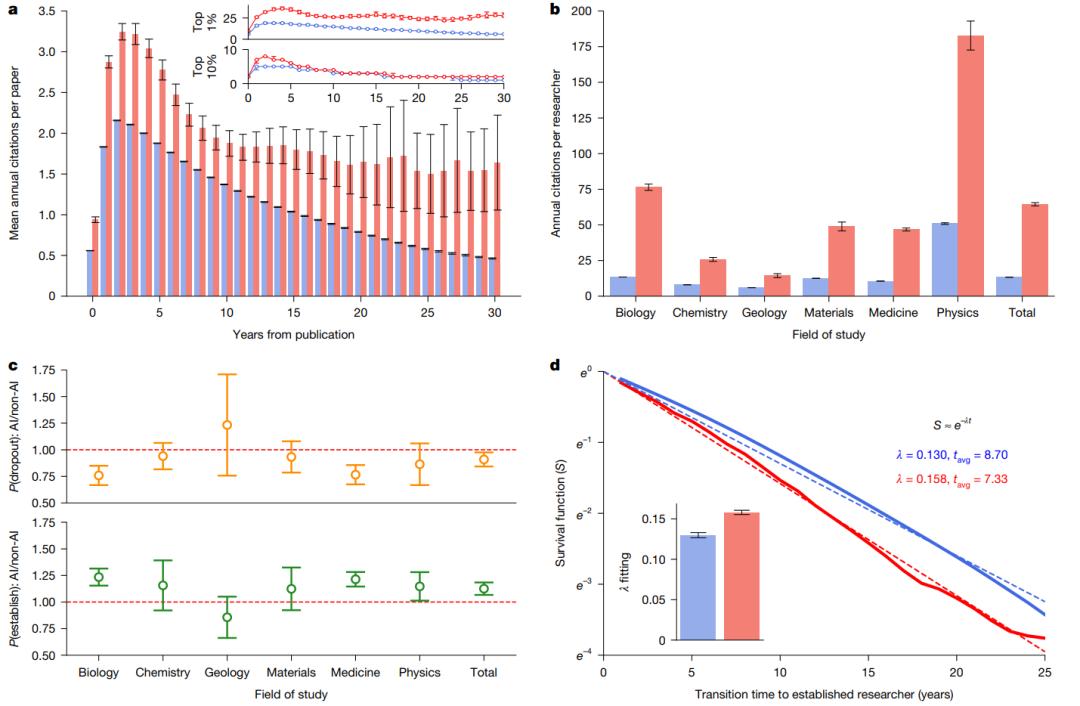
However, behind the individual scientific research acceleration is the abnormal contraction of the overall scientific map of humanity.
At the collective level, the knowledge breadth of scientific research projects combined with AI has decreased by 4.63%, the cross - boundary interaction between scientists in different fields has decreased by 22%, and the citation of AI papers presents a "star - shaped structure" -
Almost all of them cite the same or a few classic and pioneering AI works, which indicates that the research tends to be concentrated and singular, lacking innovative vitality.
So, what exactly causes this contradictory phenomenon?
Uncover the Reason Behind: Lack of Generality in Current Models
The paper gives a clear conclusion -
This is a systematic impact caused by the lack of generality in current AI for Science models.
The team found that the high efficiency of AI has produced a powerful "scientific intelligence gravitational" effect. It guides researchers to collectively flock to a small number of "popular peaks" suitable for AI research, that is, those research directions with a large amount of existing data and suitable for quickly producing results with existing AI methods.
This "group mountain - climbing" model, although accelerating the solution of known problems, also invisibly solidifies the path of scientific exploration and systematically weakens the breadth of scientists' exploration of "unknown peaks".
Finally, the phenomenon of "breadth giving way to speed" is formed.

The team said that the discovery of this contradictory mechanism is a deep reflection on the AI - empowered scientific research model:
Although the existing AI for Science has greatly promoted local efficiency improvement, it is difficult to drive scientific research innovation across the entire chain and multiple fields.
To break through this limitation, the team led by Professors Xu Fengli and Li Yong finally launched a full - process, interdisciplinary scientific research intelligent agent system - OmniScientist. (Access URL: OmniScientist.ai)
This system realizes interdisciplinary, full - process, and multi - modal systematic scientific research support by deeply exploring the general reasoning ability of large - model intelligent agents, thus enabling AI to evolve from an "auxiliary tool" to an "AI scientist" capable of "actively proposing hypotheses, independently designing experiments, analyzing results, and forming theories".

Finally, the completion units of this research are the Department of Electronic Engineering at Tsinghua University and the Department of Sociology at the University of Chicago. The corresponding authors are Assistant Professor Xu Fengli, Professor Li Yong, and Professor James Evans. The first author is Hao Qianyue, a doctoral student in the Department of Electronic Engineering at Tsinghua University.
Paper: https://rdcu.be/eY5f7
Reference links:
[1]https://www.nature.com/articles/s41586-025-09922-y
[2]https://www.science.org/content/article/ai-has-supercharged-scientists-may-have-shrunk-science
This article is from the WeChat public account "QbitAI", author: Yishui. It is published by 36Kr with authorization.