The Linux founder's "I was so wrong" moment: once mocked AI programming as garbage, now personally dives into AI-assisted programming.
[Introduction] The father of Linux has "defected"! Linus Torvalds, who once angrily criticized AI, admits that it's really great for AI to write code!
On an ordinary afternoon in January 2026, a tweet caused a stir in the programmer community.
Someone noticed that Linus Torvalds, the father of Linux, quietly updated a project called AudioNoise on GitHub in the past two days.
This wasn't anything unusual at first - this 55-year-old Finnish man has always been tinkering with his guitar effects pedals, using digital circuits to simulate various audio effects, which is just a hobby.
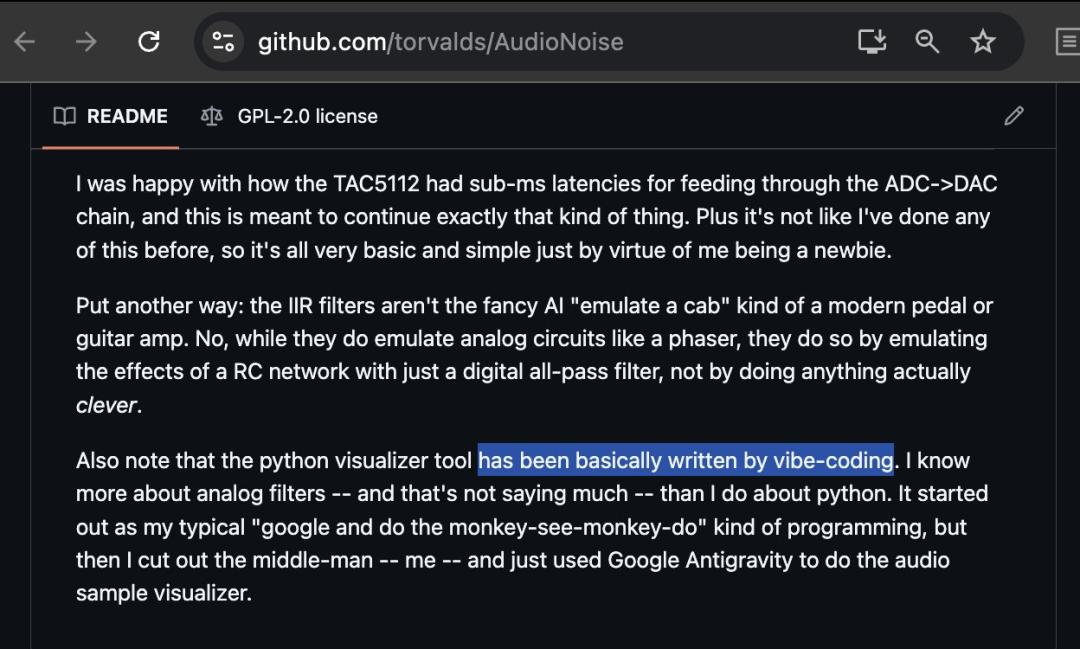
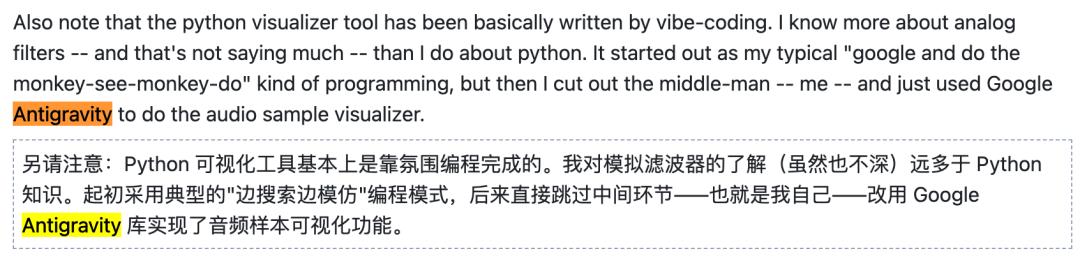
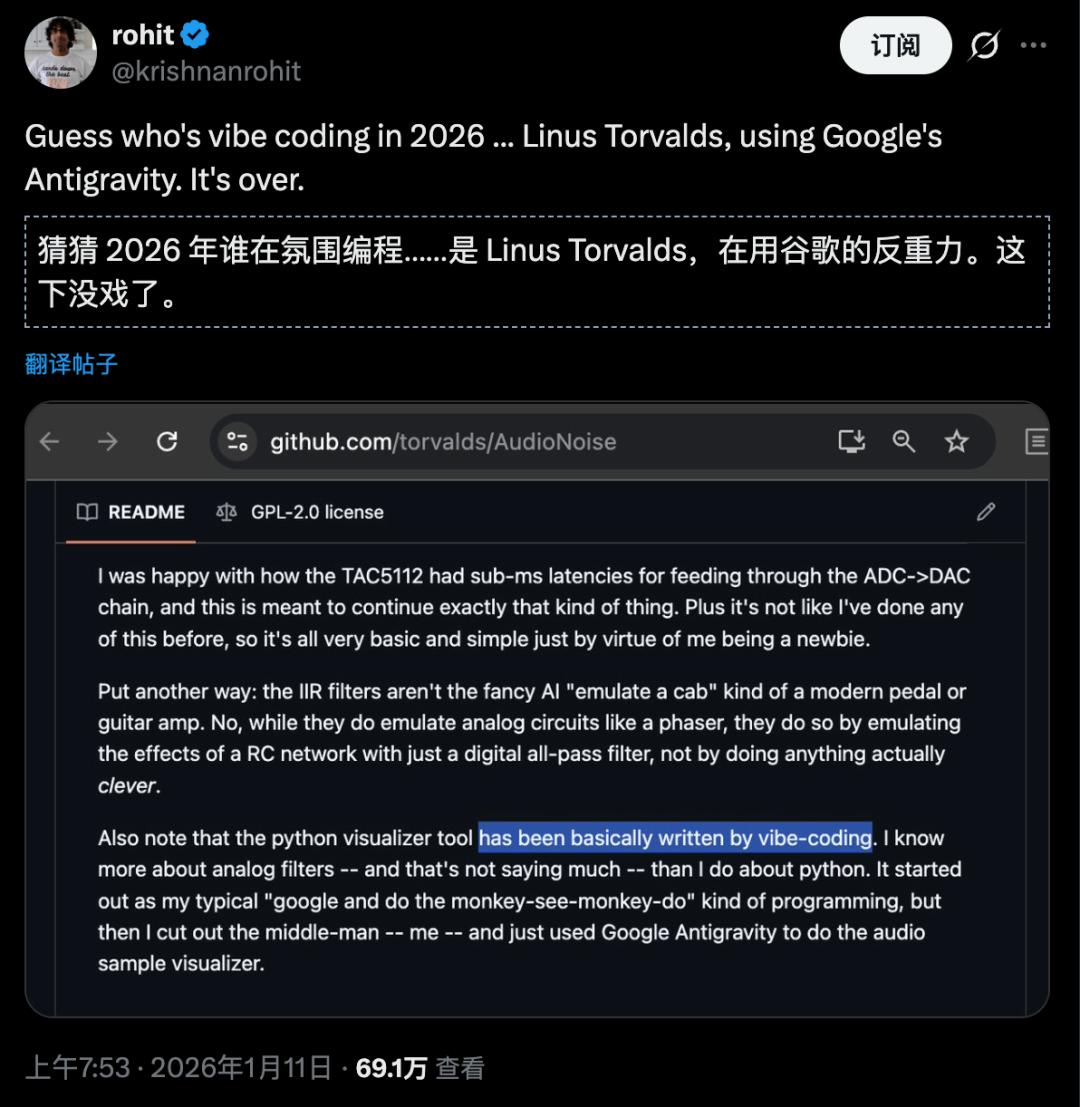
What really made people sit up and take notice was this sentence in the project description:
The Python visualization tool was basically created through Vibe Coding... I skipped the intermediate step - myself - and used Google Antigravity to implement the audio sample visualization function.
Wait, what?
Linus Torvalds, the man who gave the middle finger to NVIDIA, the grumpy guy who scolded bad code mercilessly in the email list, and the hardcore programmer who once publicly said that "AI-generated code is garbage" -
He actually used AI to write code?
And even admitted that the results were better?
This is like a master watchmaker from Patek Philippe suddenly wearing an Apple Watch and saying, "It really keeps accurate time."
Or, it's like a Michelin three-star chef suddenly starting to use pre-made ingredients and saying, "It tastes good."
Master, why have you also joined the Vibe Coding game?
A "boring" guitar project
The story starts with one of Linus's "boring repositories".
As the creator of the Linux kernel, Linus's main daily job is to review code submissions from all over the world, scold the bad ones, and merge the good ones.

Master's GitHub repository with 200,000 stars can be said to be the foundation of the whole world!
It was updated two days ago
But in his spare time, this living fossil in the programmer community has a little-known hobby - DIY guitar effects pedals.
He's recently been tinkering with a digital guitar effects pedal based on the RP2354 and TAC5112 chips.
The hardware part is working, but he's not satisfied with the choice of analog interfaces - the potentiometers don't feel good, and the clicking sound of the foot switches is getting on his nerves.
So, he decided to put the hardware aside for now and focus on digital audio processing.
"Since it's all digital, focus on simulation and don't get too caught up in the hardware," Linus wrote on GitHub.
The code for these effects pedals is very basic - there's no fancy FFT vocoder, just IIR filters and basic delay loops.
In his own words, "They're all toy-level designs that don't require too much precision."
But the problem is: he needs a visualization tool to observe the audio waveforms.
This tool must be written in Python.
And Linus's knowledge of Python, in his own words, "is less than his knowledge of analog filters - and that's not much either."
At first, he used the most classic method for programmers: Google it and copy it.
"It's a typical programming pattern of searching and imitating," he described it like this.
But later, Linus made a decision that shocked the entire programmer community -
He skipped the "himself" intermediate step and used Google Antigravity to write it.

"Vibe Coding", personally tested and proven effective by the master
What is "Vibe Coding"?
This concept was first proposed by Andrej Karpathy, the former research vice president of OpenAI, and it means:
You don't need to write every line of code precisely. You just need to describe the function you want, and leave the rest to the AI.
It's like telling an experienced programmer, "Help me create an audio visualization," and he'll do it. You just need to check the results.
Linus used Google's Antigravity - a new-generation AI programming tool released at the end of 2025.
He told the AI what he needed, and the AI wrote the entire Python visualization tool for him.
How was the result?
Linus didn't say directly, but his silence is the best answer.
You know, this is a person who has an obsessive commitment to code quality.
He once sent a contributor's submission back five times because of an improper variable name.
He once said, "If your code needs comments to explain it, it means your code is poorly written."
For a person like this to use AI-generated code to make his project work and then publicly post the code on GitHub - that says it all.
After the news spread, a user on Twitter sighed:
"Guess who's doing Vibe Coding in 2026... It's Linus Torvalds, using Google's Antigravity. It's over."
Guillermo Rauch, the CEO of Vercel, listed three major events that happened "on the tenth day of entering 2026" on Twitter:
Terry Tao announced that GPT and Aristotle independently solved the Erdős problem.
Linus Torvalds admitted that in his non-kernel projects, Vibe Coding is better than manual coding.
DHH retracted his statement on the Lex podcast six months later that AI can't code.
Acceleration is coming!
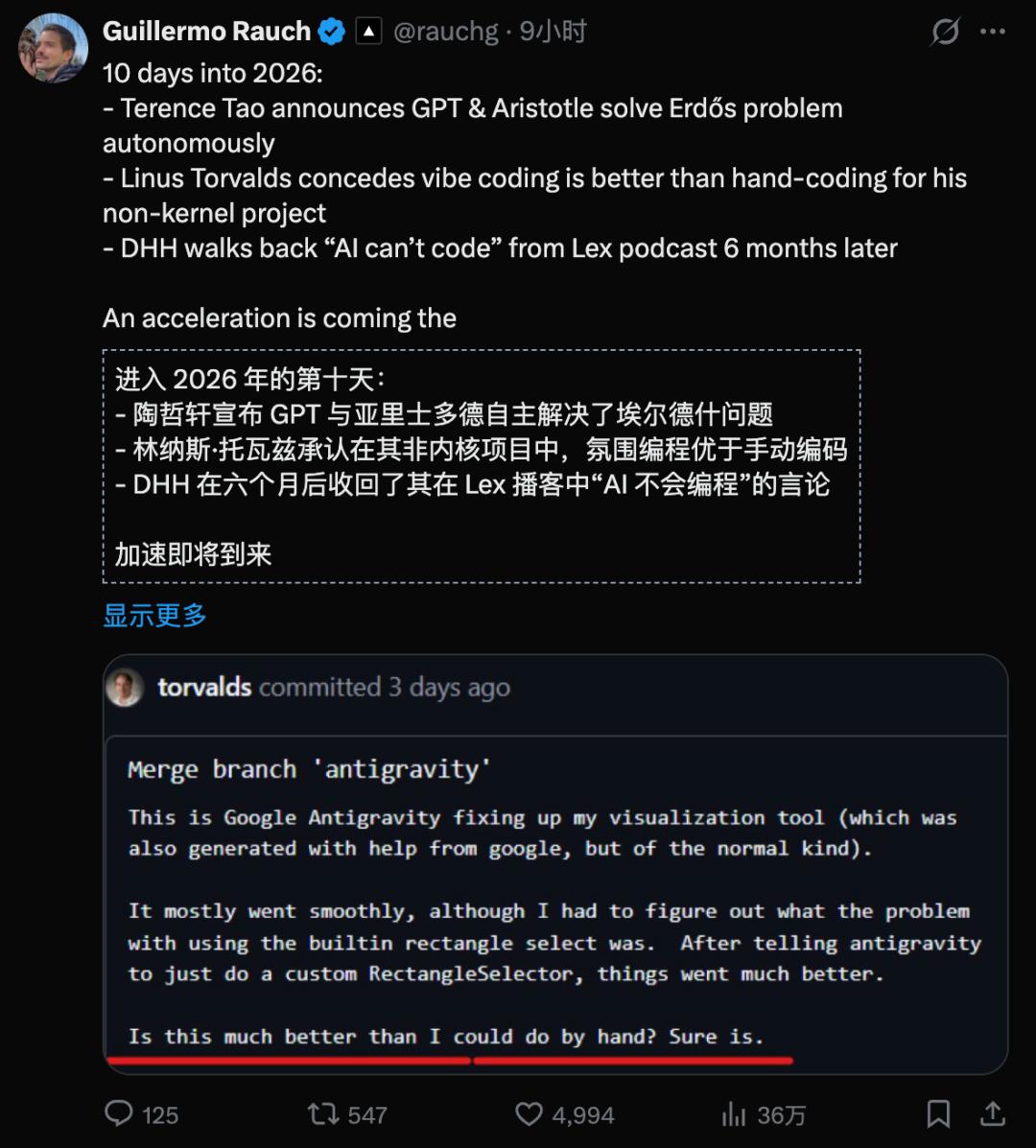
This tweet is full of information -
The top genius in the mathematical world, the master in the programming world, and the founder of Ruby on Rails, three legendary figures in different fields, all bowed to AI in the first week of 2026.
This is not a coincidence. It's a sign of the times.
From the most fierce opponent to a silent user
What makes this story particularly interesting is Linus's past attitude towards AI.
This man, known as the "god of programmers", has never hidden his disdain for AI-generated code.
As early as 2023, when ChatGPT kicked off the first wave of AI programming fever, Linus's attitude was: disdainful.
He said on multiple occasions that although AI-generated code may seem to work, it lacks an understanding of the underlying logic and is full of potential risks.
He even mocked programmers who rely on AI to write code as "CV engineers" (an upgraded version of Copy-Paste engineers).
In 2024, when someone asked him if he would introduce AI tools in Linux kernel development, his answer was even more straightforward:
"The Linux kernel has tens of millions of lines of code, and every line is crucial for the stable operation of global servers.
Do you think I'd let an AI that can't even explain 'why it's written like this' touch it?"
This attitude made Linus the most famous representative of the "traditionalists" in the era of AI programming.
But in 2026, the situation changed.
There was no public statement, no long blog post, just a casual sentence in the GitHub project description:
"The Python visualization tool was basically created through Vibe Coding."
The low-key nature of this change actually makes it seem more real.
Linus isn't the kind of person who changes his stance just to follow the trend.
He's the kind of person who "only uses it if it really works."
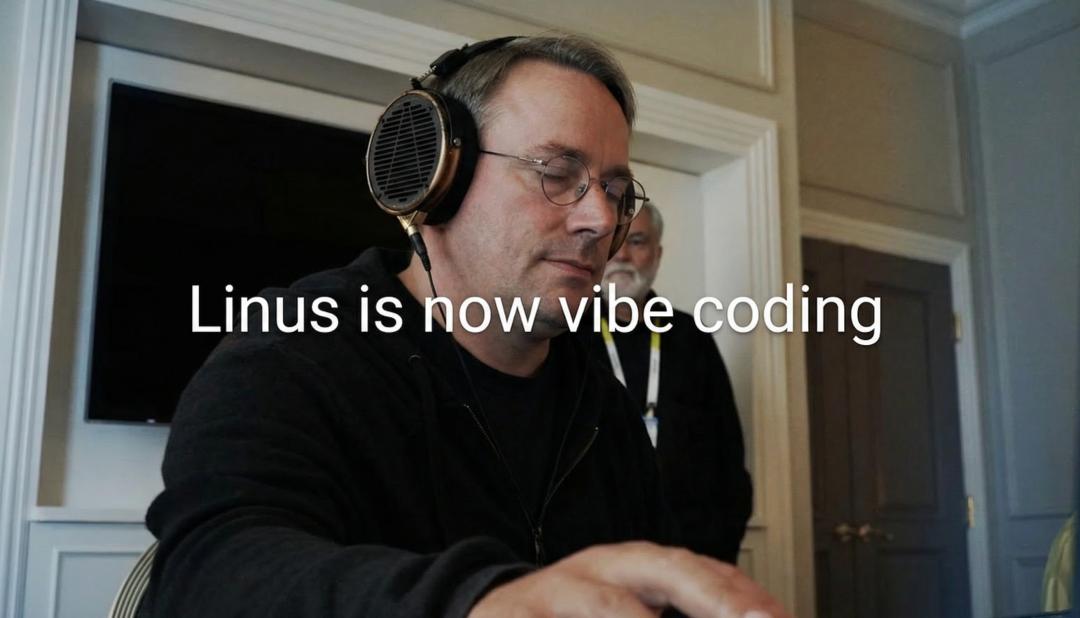
The collective "fall" of the bigwigs
Linus isn't an isolated case.
At the end of 2025, a quiet revolution was taking place in Silicon Valley.
Andrej Karpathy sighed after testing the latest AI programming tools: "It's ten times more powerful than a year ago."
DHH (the founder of Ruby on Rails), once one of the most fierce critics of AI programming, now says:
"I was wrong. This thing really works."
Jaana Dogan, a former Google engineer, used AI to build a distributed proxy system in an hour - which used to take a team a week.
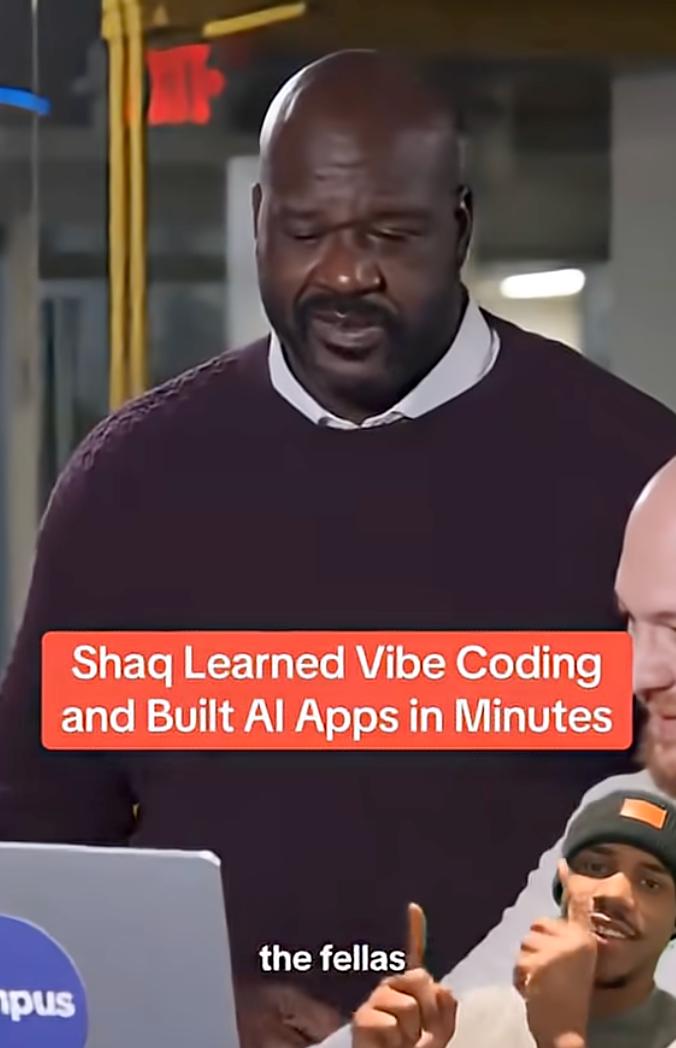
Even Shaquille O'Neal - yes, the NBA Hall of Famer - is using AI to write apps.
Gergely Orosz, the author of "The Pragmatic Engineer", wrote in his long article at the beginning of 2026:
We're witnessing a turning point. By the end of 2026, 90% of the code in startups and new projects may be AI-generated. It's not because developers are getting lazy, but because it's truly a more efficient way.
When a "traditionalist" like Linus Torvalds starts using AI to write code, this revolution is truly irreversible.
The paradigm shift in AI Coding, we're at a watershed
Let's step back and look at the bigger picture.
From the release of ChatGPT in 2022, to the maturity of models like Claude and Gemini in 2024, and then to the concentrated explosion of Opus 4.5, GPT-5.2, and Gemini 3 at the end of 2025:
AI programming tools have evolved from "toys" to "tools" to a "productivity revolution".
This isn't a gradual improvement, but a paradigm-level leap!
In the past, programming was like this:
- You needed to master the syntax of a programming language
- You needed to remember the usage of various APIs and frameworks
- You needed to write, debug, and refactor code line by line
Now, programming is becoming like this:
- You need to clearly describe what you want
- You need to be able to verify whether the AI-generated code is correct
- You need to understand the system architecture and business logic
The act of writing code itself is changing from a "skill" to a "tool".
Just like the invention of the calculator didn't eliminate mathematicians, but allowed them to focus on higher-level problems.
AI programming tools won't eliminate programmers, but they will redefine the meaning of "programmer".
Future programmers may be more like a combination of "code architects" and "AI trainers".
The paradigm has changed, the era has arrived
In January 2026, when Linus Torvalds quietly used AI programming in his hobby project, he may not have realized that he was making history.
Just like in 2012, when Hinton used deep learning to defeat all traditional algorithms in ImageNet, most people didn't realize that the artificial intelligence revolution had begun.
But history always becomes clear in hindsight.
When the father of Linux, once the most fierce critic of AI programming, starts to admit that