The game table has been overturned, and Chinese models have found a different way to win.
Everyone knows about the big event in the AI circle today.
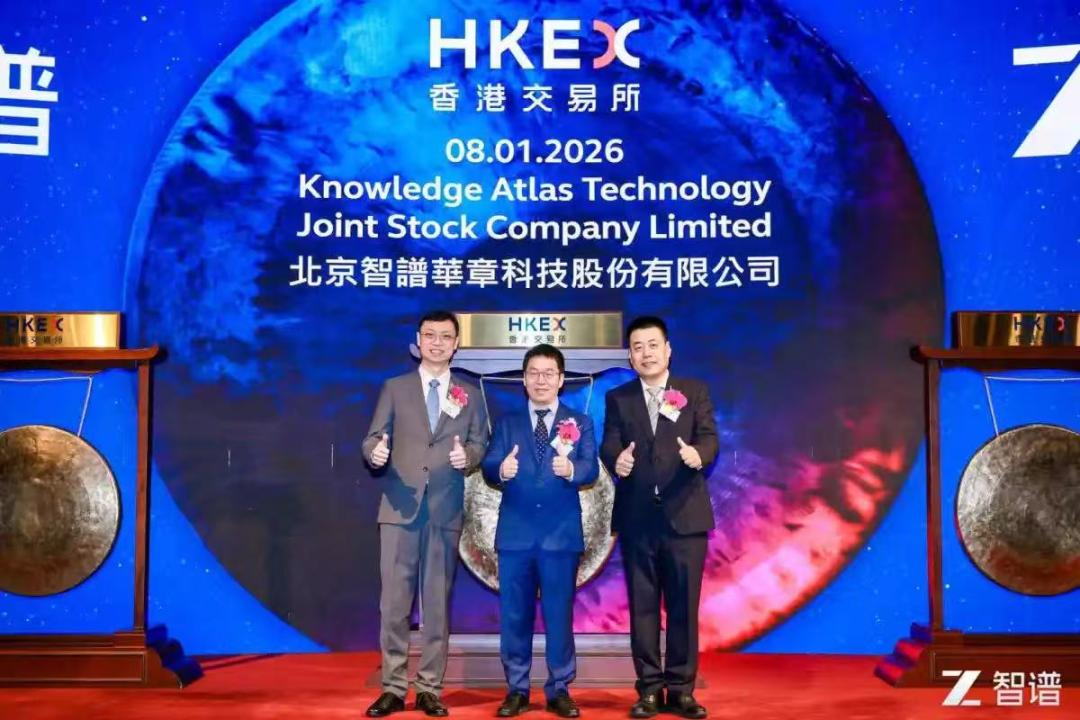
On January 8, 2026, Zhipu, a Chinese startup in the field of large AI models, was officially listed on the Hong Kong Stock Exchange, becoming the "world's first large - model stock." One day later, another model company, MiniMax, will also ring the bell.
It's not easy to stand at the forefront of the wave after only three years of technological change.
In 2023, these idealists in AGI (Artificial General Intelligence) were quickly pushed to the forefront. Along with high valuations and high starting points, inevitable came the most rigorous scrutiny and comparison. For example, in early 2025, the sudden rise of DeepSeek forced several of the "Six Little Tigers" to quickly adjust their businesses and downsize teams to get through the darkest hour.
In the field of large models with long - term development potential, any temporary lag or misjudgment can be evidence of "inadequate virtue for the position." Even at the moment of successful IPO, the losses on the balance sheet are more of a topic of discussion than blessings.
However, we often overlook that it is precisely these large - model startups with limited funds but high trial - and - error costs that mark several important nodes in China's large - model development process.
China's first MoE (Mixture of Experts) large model came from Beijing Academy of Artificial Intelligence's "Wudao", and the first popular AI application, Kimi, came from Dark Side of the Moon.
Later, the world's first general agent capable of operating mobile phones was AutoGLM released by Zhipu, 14 months earlier than Doubao's mobile - phone - operating agent. Now, the world's first large - model startup to go public is also Zhipu from China.
Rather than nitpicking the losses in the prospectus, for the cutting - edge innovative industries and entrepreneurs today, a more valuable proposition is to analyze how these Chinese large - model startups have demonstrated strong vitality in the highly competitive large - model track and how they have been leading the AI marathon.
IPO is an optimistic signal for both Zhipu and MiniMax and for technology entrepreneurs on the way. It means that innovators will not be easily abandoned by the times.
01
The Six Little Tigers Reclaim Their Glory
Looking back a year ago, the excellent reputation of DeepSeek V3 and R1 at the beginning of the year brought the Six Little Tigers to the darkest moment in terms of reputation and market share.
The innovative training and inference architecture made DeepSeek instantly become the most well - known Chinese large model internationally. To compete with the open - source DeepSeek for market voice, the Six Little Tigers had to reluctantly sacrifice some of the profits from their closed - source models and quickly catch up.
As a result, "frustration" became the norm. According to data from Maimai, as of July 2025, 41.07% of the employees of the Six Little Tigers changed their status to "job - hunting."
Unexpectedly, since the second half of 2025, the Six Little Tigers have shown far more explosive power than expected in model research and development breakthroughs.
"The performance of the base model is the competitiveness of model manufacturers." DeepSeek's sudden rise quickly brought the model industry to a common understanding on this point. One of the most intense scenes occurred in July 2025. To compete for the SOTA (State - of - the - Art) position in the global open - source model field, all players went all out.
An investor of Zhipu told us that with each model iteration after DeepSeek, Zhipu's employees held the belief of "fighting a desperate battle" and polished the performance to the "sharpest."
GLM - 4.5, released on July 28, 2025, jumped to the top of the global trending list on Hugging Face within 48 hours of its release. In September of the same year, GLM - 4.5 also ranked among the top five globally in the authoritative model arenas, ChatBot Arena and WebDev Arena.
The result of the desperate battle is a healthy competition in the industry: the iteration rhythm of flagship models is not only faster, but the iteration quality also remains high.
Only two months after the release of GLM - 4.5, Zhipu released GLM - 4.6, which ranked first in coding ability alongside Anthropic and OpenAI. Three months later, GLM - 4.7, whose code ability was comparable to Claude Sonnet 4.5 in mainstream benchmark tests, was open - sourced.
In December, GLM - 4.7 topped both the open - source model and domestic model lists in the comprehensive model ability ranking, Artificial Analysis.
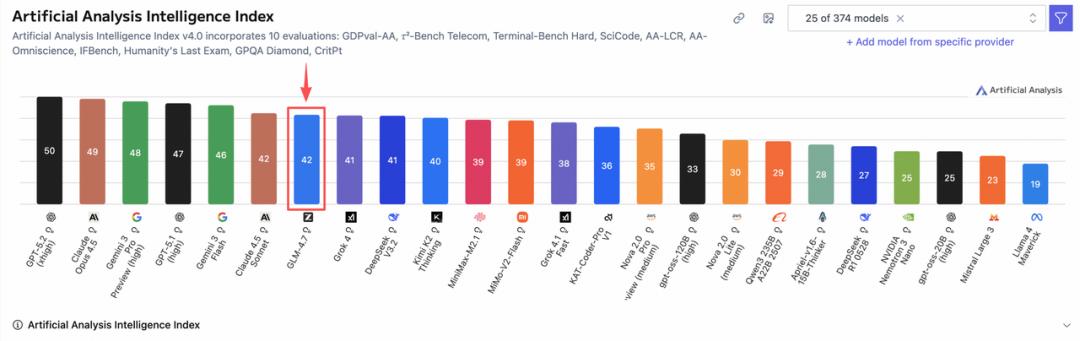
Source: Artificial Analysis
Today, Tang Jie, the founder and chief scientist of Zhipu, issued an internal letter announcing that GLM - 5 will soon be launched. The letter stated that after the release of Zhipu's flagship model GLM - 4.7, the annualized MaaS ARR revenue increased from 20 million to over 500 million, a 25 - fold increase in 10 months, in sync with Anthropic's exponential growth.
Another reversed fact is that the B - side business, once considered "devastated by DeepSeek," has instead become a "certain source of income" in the second half of the year.
Although DeepSeek shook the B - side market, its popularity also indirectly completed the market education of enterprise customers. Zheng Can, the managing director of Linear Capital, once said in a media interview, "The role of DeepSeek, especially in market education, has significantly saved costs."
Meanwhile, enterprise customers also realized that while emphasizing model capabilities, B - side services are a system that emphasizes the industry knowledge and service capabilities of model manufacturers. This means that understanding the enterprise's business and providing customized training and deployment services based on professional data have certain thresholds.
Soon, some B - side customers found the drawbacks of deploying DeepSeek: too many hallucinations and deficiencies in truly understanding business. Half a year later, the market's enthusiasm for DeepSeek returned to rationality.
Relatively, the expanded B - side market was taken over by model manufacturers with mature service capabilities. The most representative case is Zhipu, which mainly relies on large - model API calls as its business model. According to data from the global large - model platform OpenReutor, since the launch of GLM - 4.5 and GLM - 4.6, their call volumes have remained among the top 10 globally, and the paid traffic revenue exceeds the sum of all domestic models.
More importantly, the commercialization ecosystem of large models on the B - side has gradually shed the stereotype of "only targeting government and enterprise markets" and "doing the dirty work" and has become more mature and healthy.
Wu Weijie, the senior vice - president of Zhipu, said on Xiaohongshu that among Zhipu's customer groups, government customers account for less than 20%, and Internet customers account for 50%. At the same time, the company's local gross profit margin has always remained above 60%, twice the average of traditional companies, and the payment cycle is also much shorter than the industry average.
In the prospectus, we may only see that in the first half of 2025, the revenue from local deployment accounted for as high as 84.8%. However, what the prospectus does not show is that with the release of a series of high - performance models such as GLM - 4.5, API calls and subscriptions have gradually replaced local deployment as the primary growth curve of Zhipu's revenue.
According to 36Kr, in the Zhipu MaaS open platform (bigmodel.cn), the ARR of the subscription product GLM Coding for developers exceeded 100 million yuan within two months of its launch. In 2025, the year - on - year growth rate of Zhipu MaaS exceeded 900%, showing a significantly better exponential growth trend than overseas leading companies in the same period.
Ultimately, whoever masters the most cutting - edge technology will have the right to set the rules of the business game.
02
From "China's OpenAI" to "China's Models for the World"
A year ago, it was normal to chase after OpenAI. Until the end of 2024, the consensus among senior AI practitioners was that Chinese large models were still about six months behind OpenAI.
This also led to the fact that any model update or release by OpenAI would trigger the "fear of being swallowed" among Chinese AI entrepreneurs. Sam Altman, the founder and CEO of OpenAI, once said bluntly, "Any startup or product trying to be established within our explosion radius will be crushed."
Since this year, a quiet change in the model field is that becoming "China's OpenAI" or "China's Anthropic" is no longer frequently mentioned as a positioning or goal by Chinese manufacturers.
It is a definite fact that Chinese models are being recognized by the world. The main force is not entirely large companies with abundant resources, but several of the Six Little Tigers, whose "endurance" was once not optimistic.
The overseas commercialization performance is a side - proof that Chinese models are recognized and accepted by the overseas market. In the recent prospectuses of two of the Six Little Tigers, it can be seen that as of September 30, 2025, MiniMax's overseas revenue accounted for 73.1% of its total revenue.
Zhipu, which is subject to US export controls, seemingly lost the opportunity to enter the largest overseas market in North America. However, unexpectedly, 36Kr learned that Zhipu's model business for developers has 150,000 developers from 184 countries around the world paying monthly.
This means that whether in terms of model capabilities, cost - effectiveness, or application scenarios, Chinese model startups have unique advantages.
Let's first look at a case of an American developer. In September 2025, Manpreet Singh, a data scientist from the United States, posted a complaint about the defective coding ability of Claude Code under Anthropic. Earlier, Anthropic also officially admitted that due to the update of the inference stack, the quality of Claude Opus 4.1 and Opus 4 had indeed declined.
However, the lowest subscription price (Pro plan, not including the usage right of Opus 4.1) for a package that includes the usage right of Claude Code is still $17 per month (about 120 yuan).
Finally, this data scientist switched to using Zhipu's model GLM - 4.5. He mentioned in his blog that the coding performance of GLM - 4.5 is close to that of Claude Sonnet 4, but the API price is only 1/7 of the latter. The monthly fee of the GLM Coding Plan, which includes coding functions, is only 20 yuan at the lowest, 1/6 of the price of Claude Code.
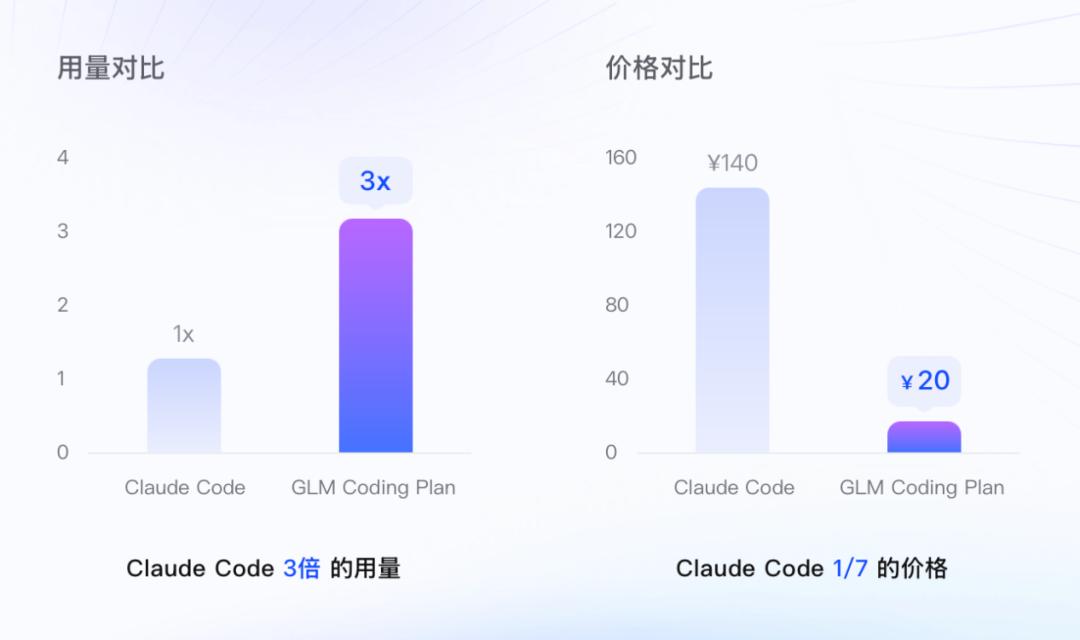
This is a microcosm of the high cost - effectiveness of Chinese large models being recognized by the world.
Zhipu's model GLM - 4.6 has appeared in the product services and base models of Cerebras, the world's largest inference chip company, mainstream AI platforms such as Cline, Kilo, and Vercel, and top - tier AI coding tools such as Cursor and Windsurf this year.
Recently, Kimi - K2 of Dark Side of the Moon and MiniMax's models were also launched on Amazon Web Services' model service platform Bedrock. Earlier, Chamath Palihapitiya, the founder of Silicon Valley fund Social Capita, publicly led the "defection" to Chinese models. After shifting a large amount of workload to Kimi K2, he commented, "The performance of K2 is indeed strong enough, and to be honest, it is much cheaper than OpenAI and Anthropic."
Rebuilding the pricing order of large models with high cost - effectiveness is just one aspect of Chinese models.
The existence of independent Chinese model development manufacturers is of crucial significance for providing global customers with diversified model options and establishing a healthy business ecosystem.
One typical case is that in early 2025, Zhipu won an overseas order worth tens of millions of dollars from a Belt and Road country. Recently, Malaysia announced that its national - level MaaS platform will be built based on Zhipu's open - source basic model Z.ai. A person familiar with the matter once told 36Kr that the nature of these orders is the co - construction of a "national - level sovereign large model." Considering national data security, third - party independent model manufacturers will play an increasingly important role.
"(Zhipu) locks in China's systems and standards in emerging markets before its US or European competitors." The rise of this independent force has also attracted the attention of OpenAI. In June 2025, OpenAI analysts found that Zhipu had won government orders in multiple regions. They commented, "Zhipu presents a responsible, transparent, and auditable Chinese AI alternative."
This means that Chinese large models are by no means "substitute products." As Wu Weijie, the senior vice - president of Zhipu, said, "China has begun to export sovereign large models to help the country build digital sovereignty."
03
What is Long - termism in the Field of Large Models?
At this point in time, many people may have forgotten the situation in early 2023.
Back then, the technological mystery and high costs made large - model entrepreneurship a "desperate gamble." When Wang Huiwen, the co - founder of Meituan, first entered the large - model track, he once said to 36Kr's "Intelligent Emergence," "I think we should all work together in the AI field now and not undermine each other." "I applaud those who have the courage to embark on this path. Those who set out on this journey are all warriors."
Two years have brought great changes. Among the Six Little Tigers, two companies have suspended the pre - training of base large models. Some have focused on specific industries such as healthcare, while others have started to transform and provide various industry solutions. For most large - model startups, "surviving" has become a more important proposition than "exploring the upper limit of intelligence."
The losses on the balance sheet are a footnote to this "desperate gamble."
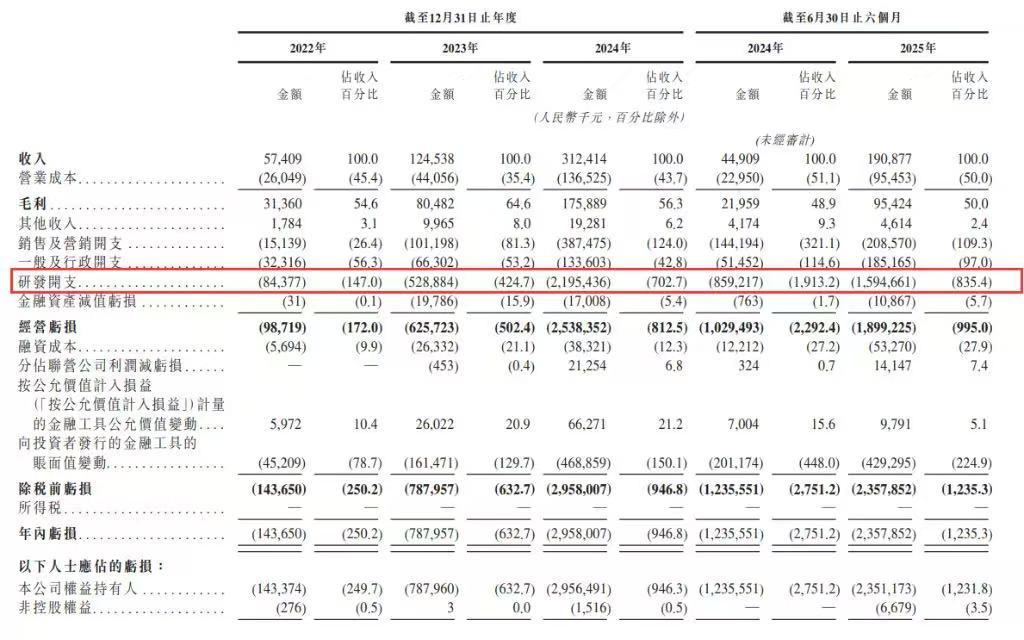
The prospectus shows that Zhipu and MiniMax have burned nearly 11 billion yuan in the past three years. Nearly 70% of the expenditure was used for model research and development. Especially Zhipu, whose R & D investment in 2024 reached 2.195 billion yuan, accounting for about 80% of the total expenditure that year.
Someone once compared the battle of large models to a "journey with no end in sight and no way to stop." After all, the leading window of each advanced model is often only a few months. For startups with limited resources, each model training is a gamble on tens of thousands or even hundreds of thousands of computing