Boom! Hundreds of new products are launched in a frenzy, and tens of billions of funds are pouring in. Ten founders summarize the history of smart glasses in 2025 in tens of thousands of words.
2025 was an extraordinary year. From a business perspective, large AI models made significant inroads, intelligent agents were implemented across various industries to validate their commercial value, humanoid robots could run a marathon, the low - altitude economy took off, and controlled nuclear fusion sparked an investment boom... The business world is never short of good stories.
Focusing on smart hardware, in 2025, new species emerged frequently in the AI hardware market, and the smart wearable track attracted a large amount of capital inflow. "In the AI era, all hardware is worth being reshaped with AI." This has become a widely recognized consensus.
In 2025, the smart glasses industry remained highly popular. With the accelerated arrival of the AI era, new possibilities for human - machine interaction emerged. Driven by imagination, many enterprises entered the fray.
In this article, Yiou interviewed the founders, CEOs, and senior executives of more than a dozen leading smart glasses companies. These enterprises are the mainstream players on the "table." Through the perspectives of front - line entrepreneurs, this article presents the changes in the smart glasses industry in 2025.
This article is a bit long. The following is a summary of the content:
Section 1: The "Battle of a Hundred Glasses," with 76 new products setting a new record.
Section 2: The expansion of players, with 176 listed companies entering the market.
Section 3: Frequent blockbusters, with popular products making their debuts one after another.
Section 4: Accelerated financing, with nearly 10 billion yuan in funds flowing in.
Section 5: The industry's shift, from competing in products and marketing to competing in technology and innovation.
Section 6: Trend analysis, what to expect in 2026?
Section 1: The "Battle of a Hundred Glasses," with 76 new products setting a new record
Compared with 2024, the popularity of the smart glasses industry in 2025 continued to rise. The number of products is an important observation dimension.
Statistics from Yiou show that a total of 76 new products emerged in the Chinese market throughout 2025, a year - on - year increase of approximately 40% compared with 2024.
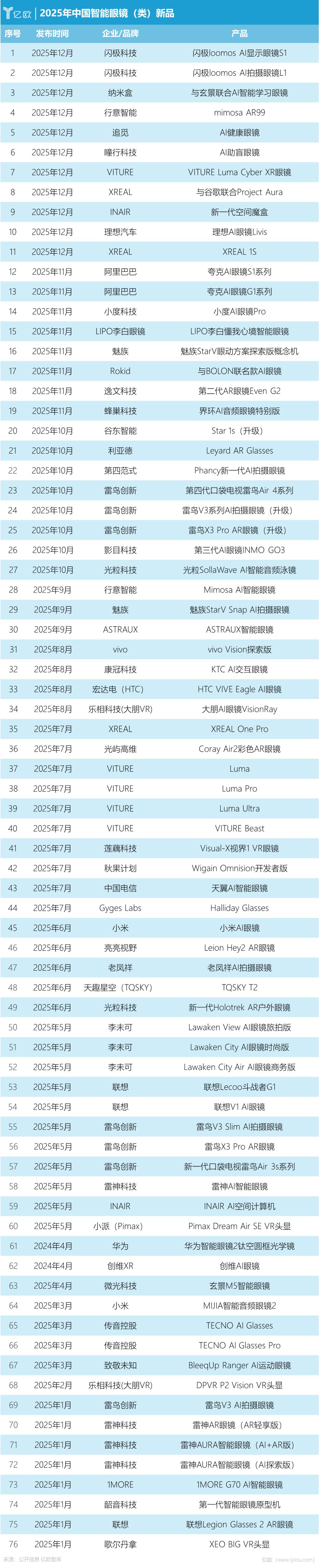
Among many brands, RayNeo was the one with the fastest product iteration speed.
In 2025, new products such as the RayNeo V3 AI shooting glasses, RayNeo Air 3s series, RayNeo X3 Pro AR glasses, RayNeo V3 Slim AI shooting glasses, and RayNeo Air 4 series were launched one after another, with many innovative features.
Among them, the binocular color waveguide glasses, RayNeo X3 Pro, are of milestone significance. Li Hongwei, the founder and CEO of RayNeo, told Yiou that in terms of optical display, the RayNeo X3 Pro weighs only 76g but can achieve a peak eye - entering brightness of 6000 nits, color 3D display, and 95% rainbow pattern suppression. For this purpose, RayNeo created the world's smallest full - color MicroLED optical engine, the "Firefly Optical Engine," with a volume of only 0.36 cubic centimeters.
It is worth noting that RayNeo also applied the lithography technology used in making mobile phone chips to the glasses, creating the currently industry - leading lithography - etched waveguide, the "RayNeo Waveguide," which enables the glasses to be clearly visible and have excellent color performance even in strong outdoor light.
Li Hongwei introduced that in the SLAM algorithm, which is the core of spatial computing, RayNeo can run the SLAM algorithm completely locally on a 4nm chip, with an accuracy close to that of Apple, an initialization efficiency of only a few milliseconds, and a power consumption half of the industry's excellent level. In terms of human - machine interaction, in addition to traditional interaction methods such as touch, voice, and buttons, it also supports gestures with the help of auxiliary devices such as smart watches to achieve a human - machine interaction effect similar to that of Vision Pro. In terms of AI capabilities, RayNeo developed the first visual large - scale model optimized for AR glasses together with Alibaba Tongyi. With this model, the interaction efficiency and application scenarios of the glasses will be greatly improved.
Yiou learned that in addition to smart glasses, RayNeo also released the world's first AI development platform for AR glasses, the "RayNeo AI Studio," which allows users and developers to develop AI Agents without coding, and also provides the AI intelligent agent store, RayNeo AI Store.
In 2025, INMO Technology made remarkable achievements in exploring lightweight integrated "AI + AR" smart glasses. The INMO AIR and GO series led the way in different dimensions.
For example, the INMO AIR3 became the industry's first mass - produced 1080p integrated AI + AR smart glasses, already showing the prototype of an "AI mobile phone" in glasses form. Another example is the INMO GO3, which is equipped with 8mm smart glasses temples, promoting smart glasses to become a fashion item. The INMO GO3 is also the industry's first mass - produced smart glasses with replaceable batteries, using a dual - chip architecture and equipped with two removable batteries.
Yang Longsheng, the founder of INMO Technology, told Yiou that in terms of differentiation, the attempts made by INMO mainly focus on the long - term exploration of "lightweight integrated AI + AR glasses," always constructing smart glasses as an independent intelligent entity.
Yang Longsheng introduced that INMO never regards smart glasses as "peripherals" of mobile phones or ecosystems. Instead, it designs them as "independent terminals" from the very beginning. Currently, it is trying to connect the entire AI interaction link on the glasses. It is collaborating with industry partners to promote this attempt, making AI the central hub for cross - APP collaboration, enabling smart glasses to dispatch applications and complete tasks just by receiving simple text/voice instructions, truly assisting humans in life and work.
In addition, the Lawaken View AI glasses travel version, Lawaken City AI glasses fashion version, Lawaken City Air AI glasses business version, etc. launched by Liweike Technology are worth mentioning, performing well in terms of user wearing time.
Gu Jian, a partner of Liweike Technology, told Yiou that statistics from partners show that during the exhibition, the cumulative usage time of the AI glasses' translation function exceeded 30,000 minutes. Many Chinese and foreign audiences wore Liweike AI glasses on - site for real - time communication and translation.
Liweike Technology focuses on the full - scenario application of AI glasses in foreign trade and has also independently developed the WAKE - AI large - scale model for the foreign trade industry. According to Gu Jian, WAKE - AI has the capabilities of real - time multi - language translation, multi - language voice recording and sorting, exhibition booth recognition, exhibition intelligent agent Q&A, business card recognition, photo translation, etc., and can provide users with real - time, professional, and accurate intelligent services in scenarios such as exhibition sites, overseas business negotiations, overseas business trips, and tourism.
Entering the stage of the "Battle of a Hundred Glasses," many brands rushed to launch new products. The earlier the release time, the easier it is to capture users' minds.
In this regard, BleeqUp performed quite well.
BleeqUp focuses on the vertical scenario of sports and health. At the beginning of 2025, BleeqUp launched a new AI sports brand, BleeqUp, and successfully launched the first AI sports glasses, the BleeqUp Ranger (Chinese name: Chaoyingqing), into the market, becoming the world's first mass - produced and delivered AI sports glasses, with a release time six months earlier than Meta.
In September 2025, Yiou interviewed Wu Dezhou, the founder and CEO of BleeqUp. Before writing this article, Yiou contacted BleeqUp and interviewed them on multiple issues such as business progress.
In terms of products, Wu Dezhou told Yiou that especially among core sports enthusiasts such as cyclists and hikers, the repurchase and recommendation intentions are very high, and the word - of - mouth of the first - batch users is quite solid. Users are most satisfied with the BleeqUp Ranger in three aspects:
First, the "seamless integration" integrated design. The BleeqUp Ranger integrates a sports camera, sports headphones, and a walkie - talkie into the form of sports glasses, so users don't need to carry additional devices. Second, the audio capabilities. When exercising, music playback and real - time communication through the walkie - talkie function are both clear and stable, and can adapt to complex outdoor noise environments. Third, the shooting anti - shake capabilities. It can shoot stable and smooth first - person view pictures even in bumpy scenarios such as high - speed cycling, horseback riding, and running.
From the above feedback from users on the BleeqUp Ranger, for smart glasses to be recognized by users, although "flashy features" can attract attention, real - quality materials are the key.
In addition to many startups, many AI hardware companies, mobile phone manufacturers, Internet companies, and automobile manufacturers have also joined the competition.
For example, in November 2025, Xiaodu Technology launched the Xiaodu AI Glasses Pro. Xiaodu Technology told Yiou that the effort Xiaodu puts into smart glasses is mainly to solidify functions with real user value. In addition, it is also continuously making some innovative attempts, such as the mood playlist function, which can automatically provide users with appropriate music by recognizing the scenery and pictures in front of them.
Xiaodu Technology has been deeply involved in the hardware field for many years. The sales of its hardware products such as smart speakers, smart screens, girlfriend machines, fitness mirrors, and smart cameras are quite impressive, and it has a profound understanding of how to create AI hardware.
Xiaodu Technology believes that for AI hardware to truly enter the mass market, it must transform from a "geek toy" to a "daily tool." The core path is not to pursue the infinite superposition of functions but to focus on a few core scenarios that can create real user value and polish these functional experiences to the extreme.
In 2025, the pace of launching new smart glasses continued until the end of the year.
On December 29, AnkerMake brought a grand finale to the smart glasses industry. That night, two new products, the AnkerMake loomos AI Display Glasses S1 and the AnkerMake loomos AI Shooting Glasses L1, were launched. At the same time, AnkerMake also released a new generation of AI glasses base platform.
Compared with the first - generation AI shooting glasses, the two new products launched by AnkerMake this time have been comprehensively optimized. For the old users of the first - generation AI glasses, AnkerMake launched a rather generous compensation and discount plan, showing great sincerity to the old users.
At the beginning of December 2025, Zhang Bo, the founder and CEO of AnkerMake, told Yiou that it is expected to hold a press conference in March 2026, and more information may be further announced.
In terms of the number of products, the Chinese smart glasses industry truly blossomed in 2025.
At the beginning of 2026, ByteDance's entry into the market added a "fiery atmosphere" to this industry. The rumor that ByteDance would enter the AI glasses market has been around for a long time. On January 5, the market reported that ByteDance's Doubao AI glasses were about to enter the shipment stage. It was learned from the supply chain that about 100,000 units of the first - generation AI glasses will be produced, and ByteDance may continue its cautious release strategy in AI hardware.
It should be said that especially the entry of giants such as Xiaomi, Alibaba, and ByteDance has brought a huge amount of traffic to this industry and has greatly promoted the current smart glasses industry.
Due to space limitations, this article will not elaborate on each case.
What this reflects is that many smart glasses have achieved mass production and delivery and are increasingly recognized by consumers.
Section 2: The expansion of players, with 176 listed companies entering the market
The smart glasses industry developed at an accelerated pace in 2025. "The progress of the industry is mainly reflected in three aspects: the market has shifted from being 'technology - driven' to 'value - driven', users have changed from being 'parameter - sensitive' to 'experience - sensitive', and products have evolved from 'hardware stacking' to 'deep scenario integration'," Wu Dezhou believes. "The industry progress in 2025 is a systematic qualitative change driven by the four factors of market, technology, scenario, and ecosystem."
Wu Dezhou introduced that at the market level, there has been a change from "quantitative accumulation" to a "qualitative inflection point," and the market has entered the stage of "scale cultivation" from "niche experimentation." The most intuitive signals are the dual leaps in scale and public awareness. The sales volume of smart glasses has increased significantly, which further indicates that smart glasses are changing from geek toys to "quasi - mass consumer products" with a certain degree of popularity. As the market enters the scale cultivation stage, users' perception of AI glasses has shifted from "what is this" to "what can this do for me," which is the cornerstone for the long - term healthy development of the category.
At the technical level, the intuitive progress is the essential optimization of the wearing experience: the large - scale mass production of ultra - thin waveguide lenses, the upgrading of dedicated chips and sensors, have further reduced the weight of mainstream products, and the battery life has been greatly improved. Moreover, as the industry's popularity has increased, the first - generation AI glasses have completed the key step of user education. After experiencing the products, consumers clearly feedback the pain points, forcing the industry to enter the "demand - driven iteration" stage.
At the same time, the explosion of terminal demand has also promoted the maturity of the upstream and downstream supply chains. From the thinner and more transparent waveguide lenses to the miniaturization and low - power consumption of sensors, a positive cycle of "user feedback - manufacturer iteration - supply chain upgrade" has been formed.
At the scenario level, one of the improvements is the verticalization of scenarios. In 2025, many AI glasses products no longer pursued being "all - purpose" but focused on vertical scenarios such as sports, health, and office work. Scenario verticalization has become the most efficient evolution path at the current stage. Whether it is for sports, health, translation, or office work, products are accumulating user stickiness and data flywheels by solving the specific needs of specific scenarios.
At the ecosystem level, the industry ecosystem has shifted from "scattered layout" to "collaborative construction." The intensive entry of giants has formed diverse competitive camps, from mobile phone manufacturers such as Xiaomi and Lenovo, to Internet giants such as Alibaba and Baidu, and then to the in - depth development of professional brands, which has accelerated the maturity of all aspects of the industrial chain.
"The next focus of competition will no longer be the comparison of hardware parameters but whether a complete closed - loop of 'perception - decision - interaction' can be constructed in a specific scenario and a sustainable user value and business model can be formed." Wu Dezhou said.
Yang Longsheng also has a similar view on the industry changes in 2025. Yang Longsheng introduced that in 2025, the Chinese consumer - grade smart glasses industry entered a period of rapid development. From the intensive entry of mobile phone manufacturers and Internet giants, to the accelerated development of the upstream and downstream industrial chains, and then to the significant improvement of consumers' awareness, smart glasses are no longer just about novelty. Now they are useful and practical in many vertical scenarios.
Moreover, Yang Longsheng believes that the focus of the industry is also shifting, from technical feasibility and function/parameter stacking to all - day wearing and real - world use value. The maturity of AI is also upgrading smart glasses from single - function tools to interactive portals with perception, understanding, and instant feedback capabilities.
These improvements are inseparable from the joint efforts of many players.
According to Yiou's statistics, in 2025, at