Is the AI bubble bursting? Will the US stocks fall by 20%? Will quantum computing disrupt cryptocurrencies? Here come the top 10 predictions for Wall Street and the tech circle in 2026.
In 2026, the global market will enter a critical turning point, with multiple variables densely intertwined. Can the U.S. stock market maintain its upward trend? Will the AI industry experience a bubble burst or enter the era of industrialization? Will quantum computing and brain-computer interfaces bring about disruptive changes? How will the "mystery" of the Federal Reserve's personnel and policies stir up the global market? How high will the gold price rise?
……
Based on the latest judgments of Wall Street investment banks, well-known economists, leaders in the technology circle, and analysts, reporters from National Business Daily have compiled the top ten predictions for the global market in 2026.
How long can the U.S. stock market keep rising? Wall Street has different expectations
The U.S. stock market continued its bull run in 2025 but surprisingly underperformed international markets. The MSCI All Country World ex-U.S. Index rose about 29% for the year, significantly outpacing the 16% gain of the S&P 500 Index. This is the largest gap between the two since 2009.
How will the U.S. stock market perform in 2026? Wall Street investment banks have issued their predictions.
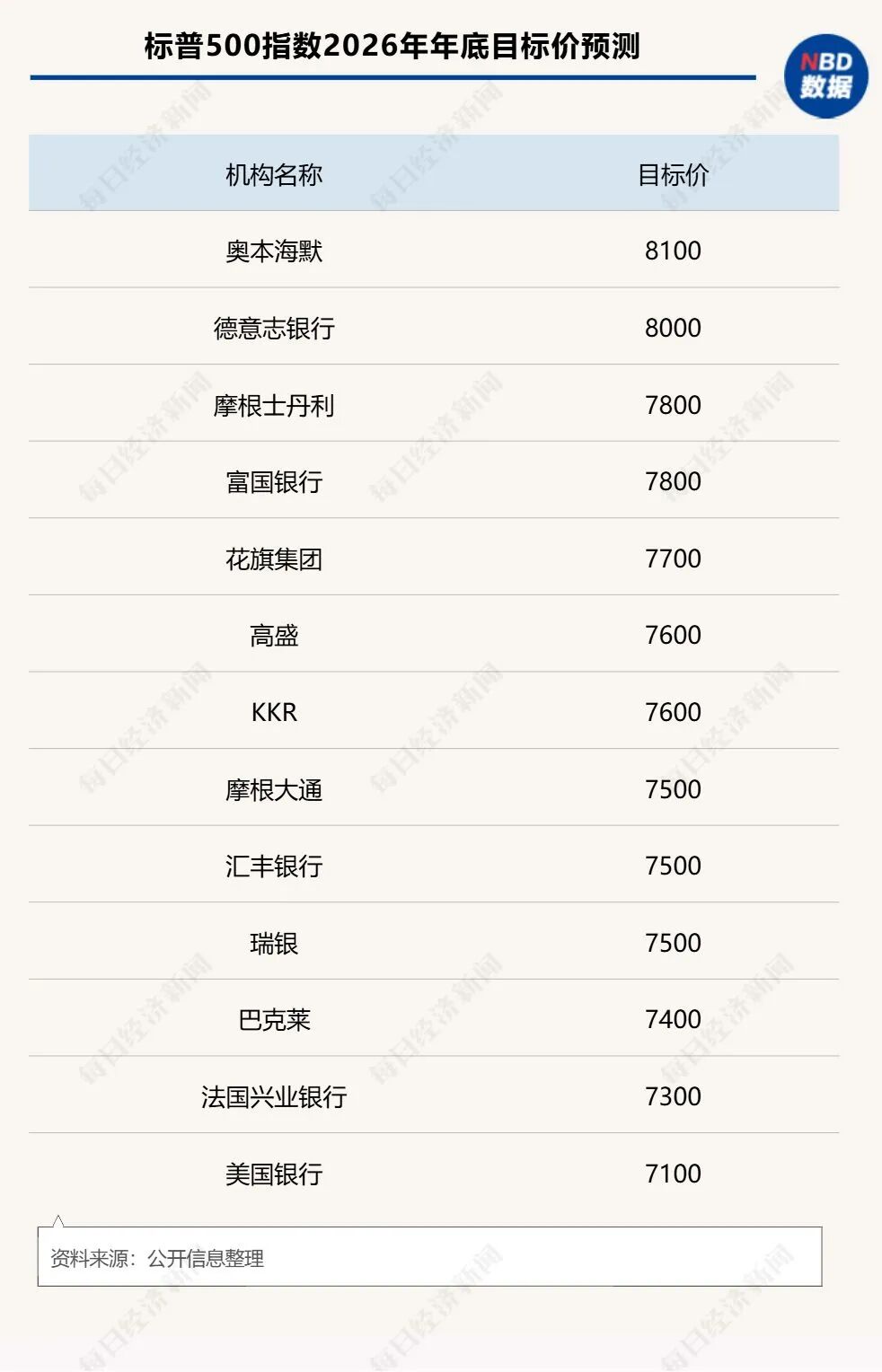
Morgan Stanley predicted in its 2026 Investment Outlook report that the U.S. stock market will outperform global stock markets in 2026, and the S&P 500 Index will rise to 7,800 points in the next 12 months, about 14% higher than the current level (6,858 points).
Goldman Sachs predicted in its 2026 Outlook report that the S&P 500 Index will reach 7,600 points by the end of 2026.
Savita Subramanian, head of U.S. equity strategy at Bank of America, predicted that the S&P 500 Index will only rise 4% - 5% in 2026, with a year-end target of 7,100 points.
Dubravko Lakos-Bujas, a stock analyst at JPMorgan Chase, said that the S&P 500 Index will reach 7,500 points by the end of 2026 and could exceed 8,000 points if the Federal Reserve eases its policies more than expected.
Sean Williams, an analyst at Motley Fool in the bear camp, wrote in an article on January 1, 2026, stating that the U.S. stock market will fall by at least 20% this year. His core basis is as follows: First, the Shiller P/E ratio of the S&P 500 Index has reached the second-highest level in history, only lower than that before the burst of the Internet bubble. Second, since 1871, the P/E ratio has only exceeded 30 times six times, and the U.S. stock market has fallen by at least 20% after each of the previous five occurrences.
Will the AI bubble burst or will a new industrial era begin?
At the end of December 2025, Ruchir Sharma, a well-known economist and current chairman of Rockefeller International, pointed out that the AI bubble may burst at some point in 2026. He said, "The burst of all bubbles stems from the same factor: higher interest rates. Once rising inflation in the U.S. economy forces the Federal Reserve to turn to raising interest rates, the current over-investment bubble driven by AI capital expenditure will come to an end."
Lazard Asset Management said in its 2026 Investment Outlook that AI-related capital expenditure increasingly relies on debt financing, and related assets may become obsolete quickly, posing risks of overcapacity and delayed returns. If technology companies' earnings fall short of expectations, it will trigger a significant market correction.
The bull camp believes that AI has already launched a new industrial era. Andrew Ng, co-founder of Google Brain, cited data from Harvard economist Jason Furman on December 26, 2025, saying that data center and AI investment contributed all of the U.S. GDP growth in the first half of 2025. The infrastructure construction boom has created real jobs and sales, marking the beginning of a new industrial era in 2025.
Are the three "super IPOs" of OpenAI, SpaceX, and Anthropic coming?
Recently, some media reported that OpenAI, SpaceX, and Anthropic all plan to proceed with IPOs in 2026. Among them, SpaceX, owned by Elon Musk, currently has a valuation of $800 billion, and its IPO plan is still in the early stage. OpenAI is preparing for an IPO as early as the second half of 2026 and has communicated with investment banks about the listing path. Its current valuation is $500 billion. Anthropic is also in contact with financial institutions to evaluate the feasibility of an IPO in 2026 and is negotiating a new round of financing at a valuation of over $300 billion.
PricewaterhouseCoopers pointed out in its 2026 Outlook for the U.S. Capital Market that in 2025, IPOs were interrupted due to regulatory reviews halted by the government shutdown. A large number of companies postponed their listing plans to 2026, forming a huge backlog of "IPO-ready" companies that may be released in the first half of 2026. The current pool of potential new stocks has significantly expanded, including more than 800 unicorn companies.
Five AI companies to watch in 2026, according to analysts
Dan Ives, an analyst at investment bank Wedbush, nominated five AI companies that will become the focus of the market in 2026 in an article titled Disruptive Technologies - The Top Five Companies Leading the AI Revolution to 2026.
◆ Microsoft: Fiscal year 2026 will be a real turning point for Microsoft's AI growth as other companies are actively deploying its related applications.
◆ Apple: With the world's largest consumer installed base of 2.4 billion iOS devices and 1.5 billion iPhones, now is the best time for it to accelerate its AI strategy. AI commercialization is expected to contribute $75 - $100 to earnings per share in the next few years. Tim Cook will remain as CEO until the end of 2027 to promote the AI transformation.
◆ Tesla: Its valuation will transform towards AI-driven in the next 6 - 9 months. The popularization of FSD (Full Self-Driving) and the development of CyberCab (driverless taxis) will significantly enhance its profitability. Its market value is expected to reach $2 trillion in the next year and may reach $3 trillion by the end of 2026 in an optimistic scenario.
◆ Palantir: The strong demand for its AI solutions in the commercial and government sectors is expected to enable it to grow into a company with a trillion-dollar market value.
◆ CrowdStrike: The cybersecurity field will be one of the core beneficiaries of the AI revolution. In the next 12 - 18 months, the company's product suite will continue to expand into the enterprise market, increasing its market share and brand recognition, but the company's growth potential is underestimated.
Will 2026 be a milestone year for quantum computing and lead to a cryptocurrency crash?
In an article published on January 1 in Think magazine under IBM, Jamie Garcia, director of strategic growth and quantum partnerships at IBM, said that 2026 will be a milestone year for the development of quantum computing - quantum computers will surpass traditional computers for the first time in specific tasks, achieving "quantum supremacy," that is, having comprehensive superiority in problem-solving ability over all traditional computing methods.
Jamie Garcia said, "As quantum technology matures, its commercial value will continue to rise."
However, breakthroughs in quantum computing may trigger a major upheaval in the cryptocurrency market. Neil Wilson, an investor content strategist at Danish investment bank Saxo Bank, said on December 2, 2025, that the "Quantum Day" will arrive in 2026. At that time, a truly functioning quantum computer will prove that it can break through the most commonly used digital security standards today. Overnight, the security encryption promises of emails, bank transfers, cryptocurrency wallets, and enterprise systems will cease to exist. Wilson predicted that the price of Bitcoin will plummet to near zero.
However, Sean Williams, an analyst at Motley Fool, wrote in an article on January 1, 2026, stating that the quantum computing bubble itself is on the verge of collapse. Although its long-term potential is clear, its current commercialization is still in its infancy, and the risk of valuation bubbles is extremely high - the price-to-sales ratios of four listed quantum computing companies are as follows: IonQ (146 times), Rigetti Computing (981 times), D-Wave Quantum (270 times), and Quantum Computing (2,990 times).
The mystery of Powell's tenure: Will the market flee from U.S. dollar assets?
Jerome Powell will step down as chairman of the Federal Reserve in May 2026, but his term as a governor still has two years left. Whether he will remain as a governor has become a core concern of the market.
The intensity of the discussion on this issue is rarely seen in decades (previously, most former Federal Reserve chairmen left office before the end of their governor terms). Behind the controversy is a fierce game between U.S. President Trump's attempt to interfere with the Federal Reserve's policies and the Federal Reserve's efforts to maintain its independence.
On December 29, 2025, Naka Matsuzawa