Top 10 Keywords in the Business World in 2025
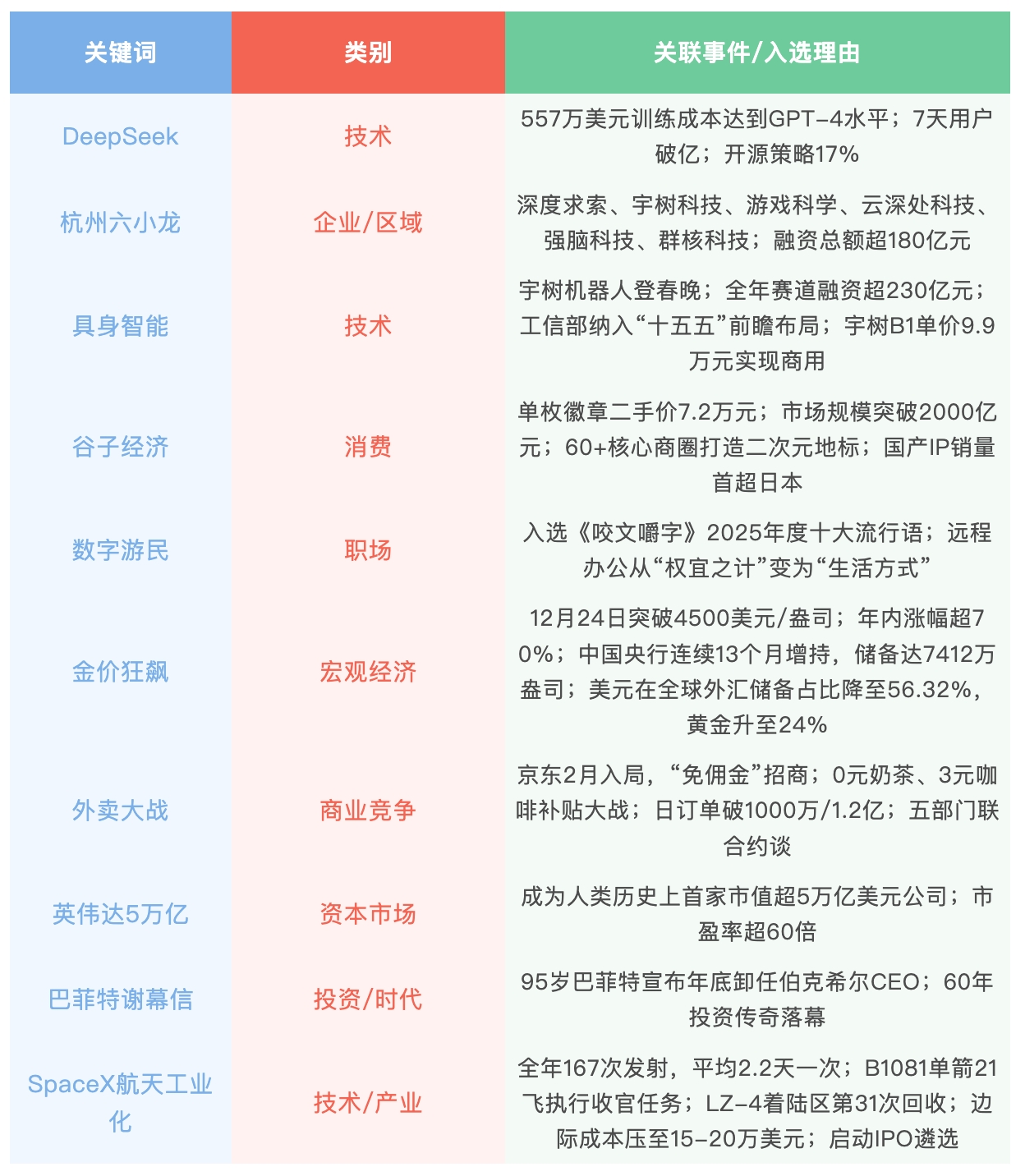
On January 27, 2025, NVIDIA's stock price plummeted by 17% in a single day, wiping out nearly $600 billion in market value and setting a record for the largest single - day market value loss in the history of the U.S. stock market.
What panicked Wall Street was not the Federal Reserve, nor geopolitical conflicts, but a Chinese company that most Americans had never heard of - DeepSeek.
This company achieved with a training cost of $5.57 million what OpenAI could only achieve with a cost of $100 million. What really rattled Silicon Valley was that it chose to go open - source. Within seven days of its launch, the number of users exceeded 100 million, shattering the growth record held by ChatGPT.
The U.S. media called this the "Sputnik Moment" in the field of AI. When the Soviet Union launched the first artificial satellite in 1957, Americans were in a similar state of shock.
However, this analogy may underestimate the severity of the problem. Sputnik proved that "others can do it too," while DeepSeek proves that "you can do better with fewer resources, and I'm sharing it with the world."
Under the condition of limited computing power, the solutions forced out sometimes turn out to be the better ones.
The start of 2025 gave everyone a shock like a thrilling novel.
In the next 11 months, the gold price broke through $4,500 per ounce, takeout orders cost only $3, an anime badge was resold for $72,000, Warren Buffett announced his retirement, NVIDIA became the first company in history to exceed a market value of $5 trillion, and Elon Musk's rockets flew 167 times in a year...
We use ten keywords to record this extraordinary year.
DeepSeek

Let's start with DeepSeek.
What does $5.57 million mean? It is said that OpenAI spent $100 million training GPT - 4, and a single NVIDIA H100 chip costs $30,000. Yet DeepSeek accomplished its tasks with less than $6 million.
As soon as these figures came out, Wall Street's first reaction was: Do we need to recalculate the logic of betting on "computing power is king" in the past two years?
Indeed, we do need to recalculate.
In the past few years, global tech giants have been hoarding GPUs frantically, with the reasoning that the capabilities of large models are directly proportional to computing power. The one with more GPUs can train stronger models.
However, the emergence of DeepSeek has opened a crack: If the algorithm is smart enough, can we achieve the same results with less computing power?
Of course, there are also many skeptical voices. Some say that DeepSeek's cost is "selectively disclosed," some claim that it used OpenAI's distilled data, and others say that going open - source is just to disrupt the market. These doubts are not entirely unfounded, but they all avoid a core fact: Under the high - pressure of U.S. chip bans, Chinese teams have found a different technological path.
Constraints can sometimes be the catalyst for innovation. The Japanese proved this in the automotive industry, and the Chinese have also proved it in photovoltaics and batteries.
In 2025, it's AI's turn.
The Six Rising Stars in Hangzhou
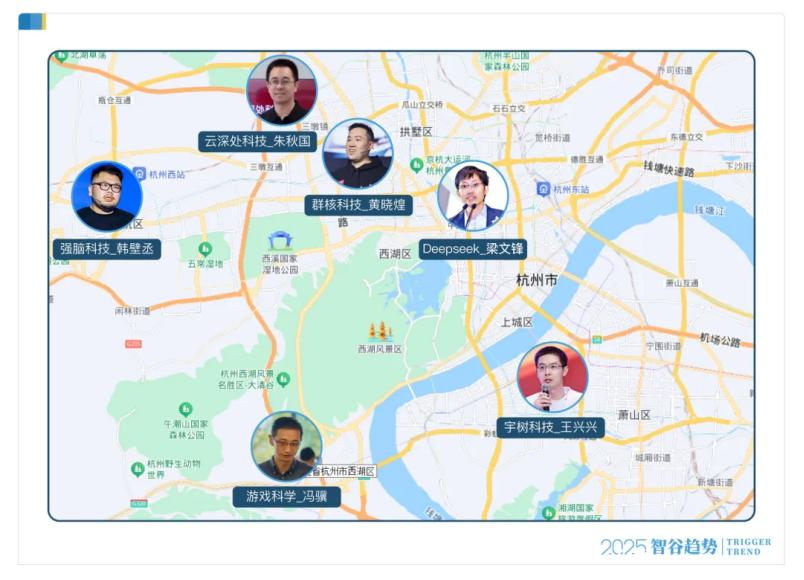
After DeepSeek became popular, an interesting phenomenon emerged: Media outlets in various provinces began to collectively "soul - search."
Hangzhou has DeepSeek. What do we have?
This question is so poignant because DeepSeek is just the tip of the iceberg. DeepSeek, the Unitree Technology robots that danced the yangge at the Spring Festival Gala, and Game Science, the developer of the globally popular game "Black Myth: Wukong," all come from the same city - Hangzhou. Coupled with YunShenChu Technology, QiangNao Technology, and QunHe Technology, these six companies are known as the "Six Rising Stars in Hangzhou," with a total financing of over $18 billion.
This is different from Hangzhou a decade ago.
The previous generation of Hangzhou's Internet giants - Alibaba, NetEase, and Mogujie - changed consumption habits. The "Six Rising Stars" are technology - driven and aim at more fundamental things: large models, robots, brain - computer interfaces, and 3D engines.
This transformation from an e - commerce capital to a high - tech hub did not happen overnight.
Behind it are patient capital, the synergy of industry, academia, and research, the recruitment of talents, and a service - oriented government.
Embodied Intelligence
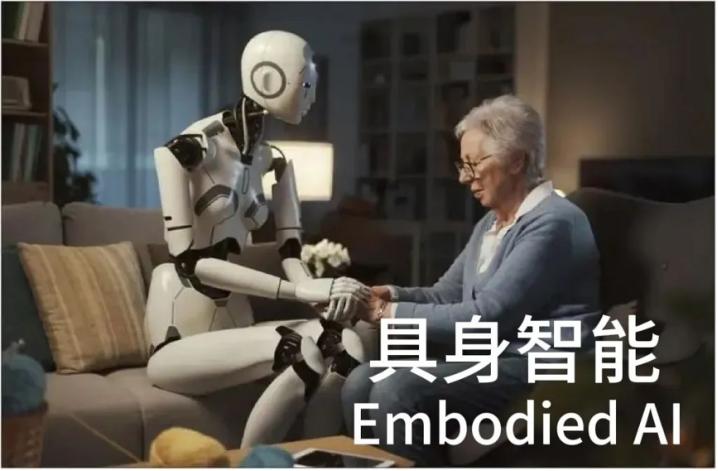
Image source: CCTV.com
At the 2025 Spring Festival Gala, Unitree Technology's humanoid robots danced the yangge on stage, making the audience burst into laughter.
After the laughter, the capital market's reaction was serious: The total financing in the field of embodied intelligence exceeded $23 billion throughout the year, and the Ministry of Industry and Information Technology included humanoid robots in the forward - looking layout of the 14th Five - Year Plan.
The term "embodied intelligence" may sound a bit esoteric, but its meaning is simple: Give AI a physical body.
In the past two years, the main theme of AI has been "able to speak and write" - ChatGPT writes copy, Midjourney creates images, and Sora shoots videos. But the new proposition in 2025 is: Can we make AI walk, grab things, and do work?
This is much more difficult than generating a piece of text.
The physical world does not allow "hallucinations." If a large model makes a mistake in a number, users may not notice. But if a robot fails to grab a cup, it fails; if it misses a step, it will fall. Every action in the real world requires real - time perception, real - time decision - making, and real - time feedback.
Currently, Tesla's Optimus and domestic companies like Unitree and Zhiyuan are leading the way. Unitree's robotic dog B1 booster is priced at $99,000 and has been used in industrial inspections and emergency rescues.
For enterprises, a new question has emerged: Which jobs are suitable for humans, and which are suitable for machines?
Anime Goods Economy
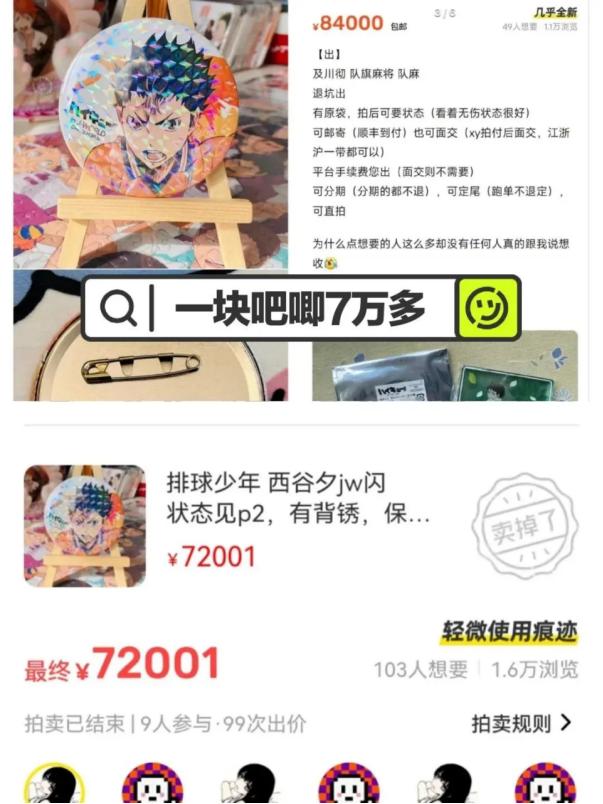
In 2025, an iron badge with an anime character printed on it was resold for $72,000 on a second - hand platform.
This is not an isolated case.
"Guzi" - a transliteration of the English word "Goods," generally referring to the peripheral products of anime and game IPs - is propping up a $200 - billion market. More than 60 core business districts across the country are creating second - dimensional consumption landmarks. Currently, the number of Chinese companies related to the anime goods economy has exceeded 6.67 million, and 96.7% of them were established in the past five years. Some old shopping malls on the verge of bankruptcy have been revived by introducing anime goods stores.
Who are the people buying anime goods?
More than 60% are women, and the core group consists of those born in the 2000s and 2005s. They "buy anime goods" 2.9 times a month on average, with a single - purchase consumption exceeding $100. They are willing to pay a 300% premium for emotional products.
Traditional consumption emphasizes functionality, cost - effectiveness, and practicality. But for Generation Z, the value of a badge lies not in what it can do, but in the emotions it carries - the love for a certain character, the resonance with a certain story, and the sense of belonging to a certain circle.
"It's hard to buy happiness with money" is not just a joke; it's a real - money consumption choice.
Another notable change is that domestic IPs are on the rise. In the first quarter of 2025, the sales of domestic game IPs such as "Love and Deep Space" and "Identity V" exceeded those of Japanese anime goods for the first time, and the peripherals of "Black Myth" and "Ne Zha 2" were in short supply.
Whoever can create content that makes young people "addicted" can share this market.
Digital Nomads
In December 2025, "Digital Nomads" made it onto the list of the top ten popular buzzwords of the year released by "Biting Words and Chewing Characters."
This group of people don't have a fixed office. They work remotely with a computer and move around the world. They write code in Bali in the first half of the week, have meetings in Chiang Mai in the second half, and then go to Dali to experience a slow - paced life the next week.
The three - year pandemic has transformed remote work from a "temporary measure" into a "feasible option." And when AI tools have significantly increased individual productivity, more and more young people are wondering: Do I really need to squeeze into the subway for two hours every day and sit in a cubicle?
For companies, this is a challenge.
When employees can work from anywhere, where are the boundaries of the company? When results can be delivered asynchronously, what's the meaning of "office hours"? When excellent talents are no longer restricted by geography, how can we retain them?
The essence of management has never been monitoring but trust.
Soaring Gold Price
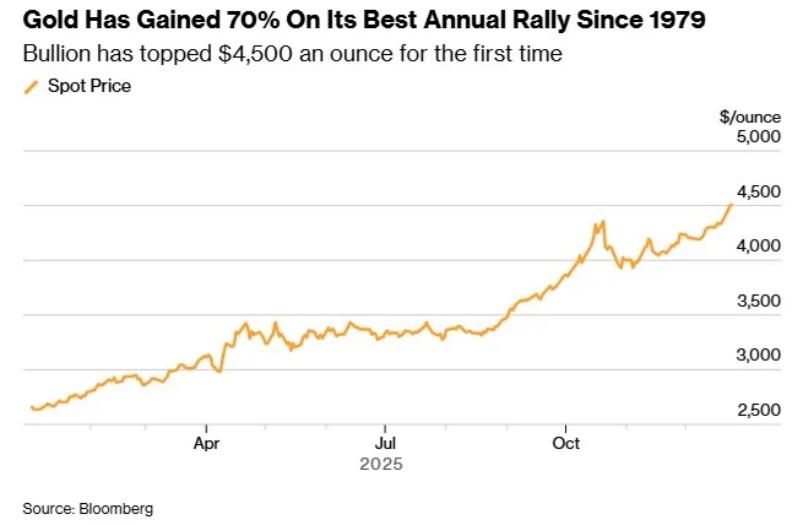
On December 24, 2025, Christmas Eve, the spot price of gold in London quietly broke through $4,500 per ounce.
Throughout the year, the gold price increased by 70%, outperforming most global assets. The price of domestic gold jewelry has long exceeded $1,000 per gram, but the consumption volume of gold jewelry has hit a record low - people are buying gold not to wear but to store.
Actually, this bull market didn't start in 2025. Since 2016, gold has been rising for ten consecutive years. It rose 13.45% in 2023, 27.39% in 2024, and accelerated in 2025, breaking through the four integer thresholds of $3,000, $3,500, $4,000, and $4,500 within a year.
Since 1970, there have been three major bull markets in the international gold price: from 1971 - 1980, 2001 - 2011, and from 2016 to the present. Each bull market follows the same script - the weakening of the U.S. dollar's credit.
This time is no exception.
By the end of the second quarter of 2025, the U.S. dollar's share in global foreign exchange reserves dropped to 56.32%, remaining below 60% for several consecutive years. Meanwhile, the share of gold in global foreign exchange reserves rose to 24% and is still increasing. Global central banks have been net buyers of gold for three consecutive years, with purchases exceeding 1,000 tons each year. The People's Bank of China has been increasing its gold reserves for 13 consecutive months, reaching 74.12 million ounces by the end of November.
"De - dollarization" has changed from a slogan to an action, and gold has become the biggest beneficiary.
Ray Dalio of Bridgewater advises investors to allocate 15% of their assets to gold, stating that "debt instruments are no longer effective means of storing wealth."
However, everything has its cycle, and gold is no exception. In the past fifty years, gold has experienced two major adjustments: from 1981 - 2000 and 2011 - 2015. Almost every bull market is subject to the "ten - year curse." Counting from 2016, 2026 is exactly the tenth year.
Will the inflection point of this bull market occur next year?
Takeout War
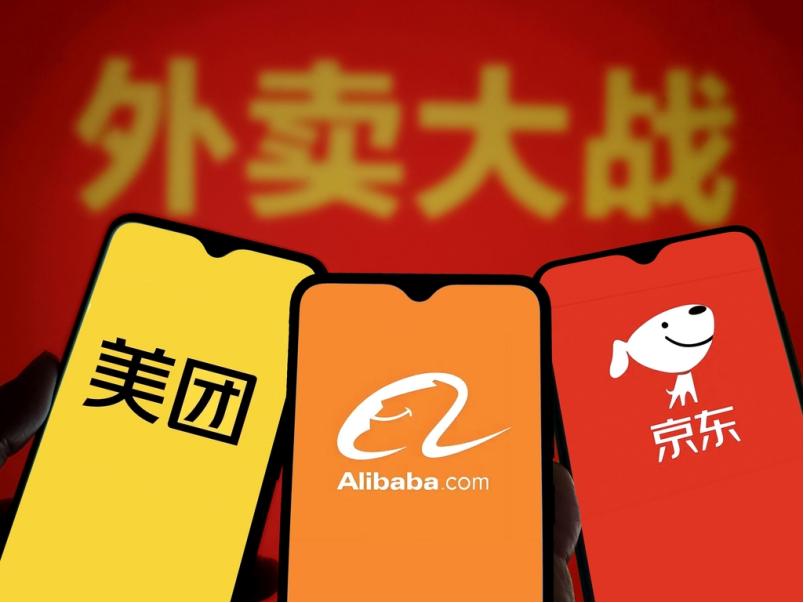
Image source: Beijing News
In February 2025, JD Takeout suddenly entered the battlefield, shouting the slogan of "zero commission for the whole year for merchants who join before May 1" and directly challenging Meituan and Ele.me.
In the following months, consumers enjoyed a "free - lunch" feast: free milk tea, $3 coffee, $6 stir - fried dishes... There were more than 2.99 million notes on Xiaohongshu about "how to get freebies from the takeout price war."
Three months after JD Takeout's launch, its daily orders exceeded 10 million. Meituan's daily orders once soared to 120 million. In May, five government departments jointly interviewed the three major platforms, demanding "fair and orderly competition."
However, subsidies are just the surface.
The real battlefield is in "instant retail" - using the takeout network to deliver all kinds of goods within 30 minutes, covering supermarkets, pharmacies, digital products, and fresh produce. Meituan Flash Sale, JD Instant Delivery, and Taobao Flash Sale are all making efforts simultaneously.
In the words of "The Three - Body Problem," this is called "dimension - reduction strike." Takeout is just the entry point, and the ultimate goal is to become China's