HarmonyOS government and enterprise applications start to answer the question of "value"
As the progress of "Digital China" enters the deep - water zone, a more fundamental question gradually emerges — after computing power and data, what will be the stable foundation to support the intelligent transformation of government and enterprise sectors in the next decade?
For a long time in the past, digitalization was equated with "moving to the cloud and utilizing data". Business systems were migrated to the cloud, and data was used to drive the efficiency improvement of local processes. This path was highly effective in the early stage, helping a large number of organizations make the crucial leap from offline to online.

However, as digital transformation deepens, this model gradually encounters bottlenecks. Data and business are "combined but not connected". The existence of various systems makes it impossible to effectively aggregate data and form overall value. With the demand for mobile office, it is "difficult to achieve both security and convenience". Intelligent capabilities mostly stay at the functional or tool level and are difficult to truly enter the core of business operations.
Especially in the government and enterprise sectors, this "ceiling effect" is further magnified. Government systems and enterprise core applications often have long operation cycles, involve many roles, and have extremely small error - tolerance spaces. They have higher requirements for underlying stability than consumer - level scenarios. When digitalization enters a new stage, the core issue becomes whether the system can operate stably in the long term.
Against the backdrop where it has become a consensus that key technologies must be independently controllable, the role of underlying capabilities is being re - examined. The market has realized that if there is no unified, trustworthy, and sustainably evolving digital foundation, the value released by the cloud and data will ultimately be limited. HarmonyOS is one of the representative solutions that have been pushed to the core scenarios of government and enterprise digitalization during this process.
From "scale construction" to "value deepening", HarmonyOS ushers in the 2.0 era of government and enterprise
If we observe the changes in the government and enterprise applications of the HarmonyOS ecosystem in the past year, a clear trend can be found. Whether it is the government service platform or the internal core systems of central and state - owned enterprises, the scope of adaptation to HarmonyOS and the density of its usage are both expanding simultaneously. According to statistics, currently covering 31 provincial - level administrative regions in China, nearly 400 government and people's livelihood applications have been fully launched on HarmonyOS. This means that a digital service network based on an independent operating system has been initially established, from national ministry platforms to county - level service windows.
Meanwhile, more than 200 core office applications of central and state - owned enterprises and thousands of internal government and enterprise systems have completed HarmonyOS adaptation, covering more than 30 key industries such as finance, energy, transportation, and manufacturing. Industry leaders such as China Telecom, State Grid, SAIC Motor, and SF Express have joined.
At the Huawei Developer Conference (HDC 2025) in 2025, Huawei disclosed that more than 100 general office platforms have adapted to HarmonyOS, the number of quick applications supported by the workbench has exceeded 50,000, and the number of covered enterprises has reached 38 million.

The participation of numerous government and enterprise organizations has pushed the HarmonyOS ecosystem into a new stage. The "1.0" stage of HarmonyOS for government and enterprises, which mainly focused on solving compatibility issues in the early stage, has basically been completed. After entering the 2.0 stage, the core proposition of HarmonyOS has also changed to whether it can create unique business value beyond traditional methods for government and enterprise customers based on the underlying capabilities of the system?
The answer focuses on whether it can systematically provide stronger security, smoother collaboration, and smarter experiences. This marks that HarmonyOS is moving from being "usable" to being "easy to use" and beginning to answer the deeper "value" question.
Three capabilities shape the "government - enterprise" value of HarmonyOS
What unique value beyond traditional paths can joining HarmonyOS bring to government and enterprise digitalization? The answer lies in the systematic and fundamental responses that the capabilities of the HarmonyOS system offer to the three core demands of government and enterprises, namely security, interconnection, and efficiency.
In today's era when mobile office has become the norm, the security of government systems is facing unprecedentedly complex challenges. Tens of millions of pieces of information and thousands of electronic documents are circulated among the fingertips of staff every day. Any data leakage may have a significant impact. If traditional security solutions are like reinforcing the wall outside the house, then the "Star Shield" security architecture of HarmonyOS is like rebuilding from the "foundation".
Take "Yuezhengyi", a platform in Guangdong Province that supports the collaborative work of 2.6 million public servants, as an example. Supported by the capabilities of the HarmonyOS system, its security and reliability have been further strengthened, and the ultimate trust issue in the transfer of government data on mobile devices has been better solved. Based on the deep integration of HarmonyOS's "Star Shield" architecture and system - level file encryption, the data transferred within the application is independently controllable throughout the whole process from generation, transmission, storage to destruction in the domestic operating system.

Currently, the HarmonyOS kernel has passed the international CC EAL6+ certification, becoming the first solution in the field of general - purpose operating system kernels to reach this security level, providing a high - level data security guarantee for government and enterprise office applications at the system level.
By raising the security level of government systems to the financial - level standard, HarmonyOS has built an impregnable defense for the construction of a digital government, which is a solid implementation of the responsibility of "national priorities" at the technical level.
Similar changes are also occurring in the internal systems of central and state - owned enterprises. From energy, finance to construction and logistics, when a large number of local state - owned enterprises are promoting the HarmonyOS adaptation of their internal office and business systems, they are not concerned about functional differences but whether they can operate under a unified security model. This convergent choice itself shows that security is changing from a "project attribute" to an "ecosystem attribute".
The efficiency bottleneck of government and enterprise digitalization often does not stem from the speed of a single application but from the "walls" between departments, systems, and devices. Data and business are fragmented in isolated islands. The distributed capabilities of HarmonyOS are trying to eliminate these boundaries from the bottom. By breaking down device barriers, it enables mobile phones, tablets, computers, and office terminals to operate collaboratively under the same operating system, allowing data and services to flow naturally in different scenarios.
The concept of "interconnection" is reshaping the way public services are provided. For example, the "Liaoshitong" application in Liaoning Province uses the Huawei Share function of HarmonyOS to achieve one - touch transfer of government services. Citizens only need to touch their mobile phones with the devices of their family members or friends to quickly share the application, which greatly reduces the threshold for obtaining digital services, especially helping the elderly cross the "digital divide".
The value brought by the capabilities of the HarmonyOS system is to provide a unified operating syntax for complex organizations, transforming collaboration from a technical problem into a process problem, thus releasing greater efficiency potential.
The "efficiency" pursued in the government and enterprise sectors has a dual connotation. One is the ultimate smoothness and stability of the system itself, which is the foundation of all experiences. The other is the extreme convenience and intelligence of service acquisition, which is the key to value improvement. HarmonyOS can make progress in both dimensions through underlying hardware collaboration and top - level AI frameworks.
Take the "Yukuai Ban" mobile government service platform in Chongqing as an example. By accessing the calendar function of HarmonyOS, users can set personal schedules related to government affairs within the application and synchronize them to the mobile phone system calendar. The system will remind users at key time nodes, reducing omissions and repeated operations, and changing from "people remembering things" to "things finding people". The "Online State Grid" of the State Grid has integrated the Xiaoyi voice assistant. With a single command "One - step access to energy consumption analysis", users can instantly obtain in - depth analysis reports of household electricity consumption, eliminating the need for multiple clicks to search.
Similar changes can also be seen in the HarmonyOS versions of local government applications such as the "Lingxi" smart people's livelihood service platform in Wuxi and the "Suzhou Zhidao" government APP in Suzhou. The service cards, live windows, voice - direct access and other capabilities brought by HarmonyOS have changed the way of accessing high - frequency services from "searching within the application" to "system - level access", making efficiency services more naturally integrated into daily life.
Work together to complete the jigsaw puzzle of Digital China
When the core capabilities of HarmonyOS in security, interconnection, and efficiency are verified in benchmark applications, the growth logic of the ecosystem has also undergone a profound transformation, and the roles of all parties involved have been reshaped — from being driven by technology supply to co - creation through in - depth integration with the industry.
Firstly, government and enterprise users are changing from "users" to "co - creators".
Take the first national "showroom" for HarmonyOS government industry applications jointly launched by Duocaibao as an example. It has encapsulated more than 60% of the general functions of government services into standardized modules, increasing the development efficiency of subsequent government applications by more than 50%. Based on the modular and standardized foundation laid by the "showroom", the cooperation model between government/enterprises and HarmonyOS has achieved a key leap from "using" to "co - creating".
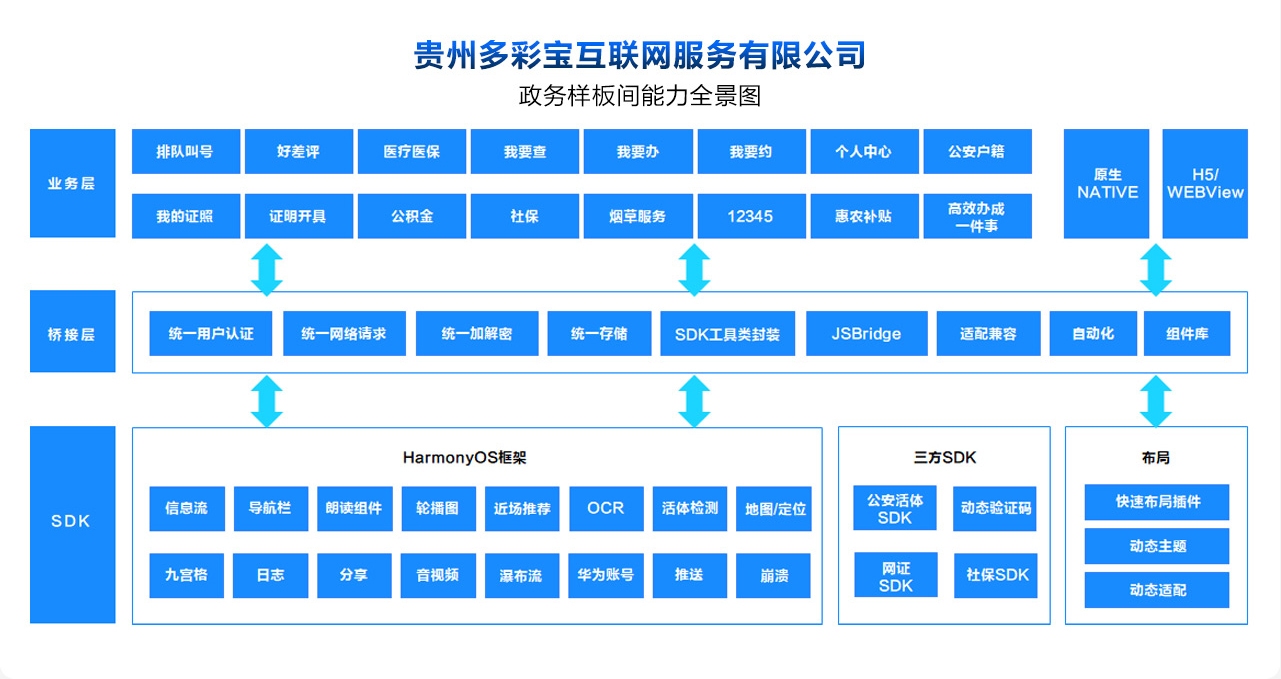
This model not only improves its own efficiency but also becomes the starting point for industry co - construction. As the capabilities of the "showroom" are continuously output and adapted to the industry, the role of HarmonyOS as a technical foundation has also quietly changed. It is no longer just a system to carry business but a platform to stimulate business innovation.
The creativity of digital transformation can be extended from the headquarters IT department to each business unit. Based on the solid and user - friendly "showroom", government applications in various regions and fields can emerge continuously like "a hundred flowers blooming", truly making technology fit specific scenarios and serve people's actual needs.
Secondly, the role of pioneer partners is changing from "practitioners" to "enablers". Government and enterprise organizations that were deeply involved in the early construction of HarmonyOS have gradually developed a set of verifiable and reusable practical paths in the process of solving their own complex digitalization problems. This change from outputting "successful results" to outputting "successful methods" is a key sign of the maturity of the ecosystem. It can greatly reduce the cognitive threshold and trial - and - error costs of latecomers, enabling advanced digital transformation experiences to spread more quickly and widely.
Thirdly, policies and the market are working together. From local governments actively completing the HarmonyOS adaptation of government office and people's livelihood APPs to many central enterprises incorporating HarmonyOS system adaptation into their group strategies, the top - level design and market demand in the government and enterprise sectors are resonating. This creates a virtuous cycle of "opening up scenarios, practical verification, and replication and promotion", making the ecological construction of HarmonyOS a broad - based practice that pools the wisdom of many and shares the development results.
From handling people's livelihood affairs on small screens to collaborative office within large groups and then to the core production scenarios of all industries, the HarmonyOS ecosystem is penetrating into the "capillary" areas of all industries. The footsteps of the pioneers have proven that embracing this ecosystem means standing at a new and more reliable starting point with greater potential, allowing precious resources to be shifted from dealing with underlying technical uncertainties to focusing on business innovation and creation.
For any government or enterprise institution facing digital transformation today, whether to join the HarmonyOS ecosystem has become a "strategic choice". Should they build the long - term future of their digitalization on a new foundation that has been jointly verified and built by the industry and represents the next - generation technology direction?
We believe that as the digital wave continues to advance, more and more far - sighted organizations will join in. This systematic migration to HarmonyOS will ultimately drive the foundation of China's digital economy from achieving extensive "connection" to achieving in - depth "integration" and comprehensive "empowerment".
When the core systems of all industries operate stably on a unified, independent, and intelligent digital foundation, a more resilient, dynamic, and people - centered Digital China will come into being.