Post-00s have a net worth of tens of billions! The 2025 AI Wealth Creation List: Over 50 billionaires have emerged.
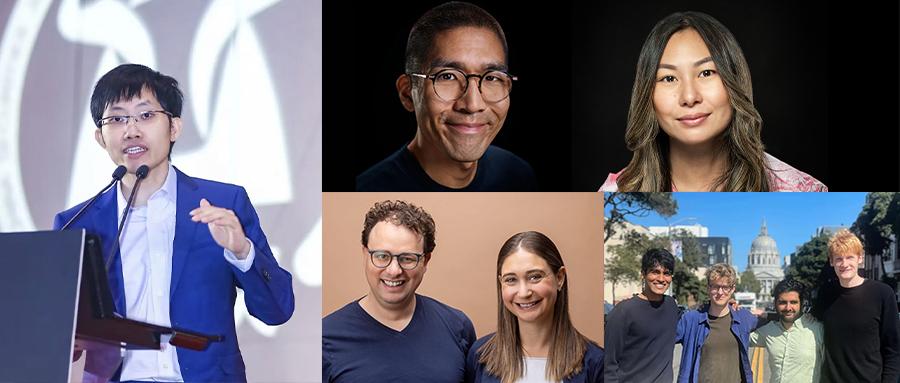
This year, AI startups have received 50% of the total global financing.
Translation | Wang Xinyi
Editor | Cheng Qian
According to a report from "Forbes" on December 26th by Zhidongxi, in 2025, AI created over 50 new billionaires across various sectors including models, infrastructure, and applications. Among them, Edwin Chen, the founder of the data infrastructure startup Surge AI, has the highest net worth, reaching $18 billion (approximately RMB 126.14 billion); Liang Wenfeng, the founder and CEO of DeepSeek, made it onto the list, ranking second with a net worth of $11.5 billion (approximately RMB 80.59 billion).
Specifically, in the field of large models, at the beginning of this year, DeepSeek kicked off the AI competition with a high - profile move. The American large - model unicorn Anthropic was equally impressive. In March, its valuation reached $61.5 billion (approximately RMB 430.98 billion), which propelled all seven co - founders of the company into the billionaire club. Apart from the underlying models, technology giants' bets on data centers have also given rise to more than a dozen billionaires in many AI infrastructure providers, such as the co - founders of the cloud computing provider CoreWeave. At the application level, AI is penetrating various industries at an unprecedented speed. The co - founders of productivity - reshaping tools and vertical industries, such as the video game company Diezhi Games, the AI robot manufacturer Orbbec, and the American AI audio generation startup ElevenLabs, have also become billionaires.
Notably, the trend of youthfulness in the wealth of the AI industry is evident. The three post - 2000 co - founders of the American AI recruitment startup Mercor each have a net worth of $2.2 billion (approximately RMB 15.42 billion), breaking the record of Mark Zuckerberg, the founder and CEO of Meta, as the youngest self - made billionaire; Edwin Chen, the 37 - year - old founder of Surge AI, became the youngest new member of the "Forbes" list of the richest Americans.
In addition, there are many Chinese faces on the list. Besides Liang Wenfeng, Lucy Guo, the co - founder of the American AI data annotation startup Scale AI, is also Chinese. Her net worth is approximately $1.4 billion (approximately RMB 9.81 billion), making her one of the youngest self - made female billionaires in the world, surpassing the American singer Taylor Swift; Edwin Chen, the youngest new member of the American rich list mentioned earlier, is also Chinese.
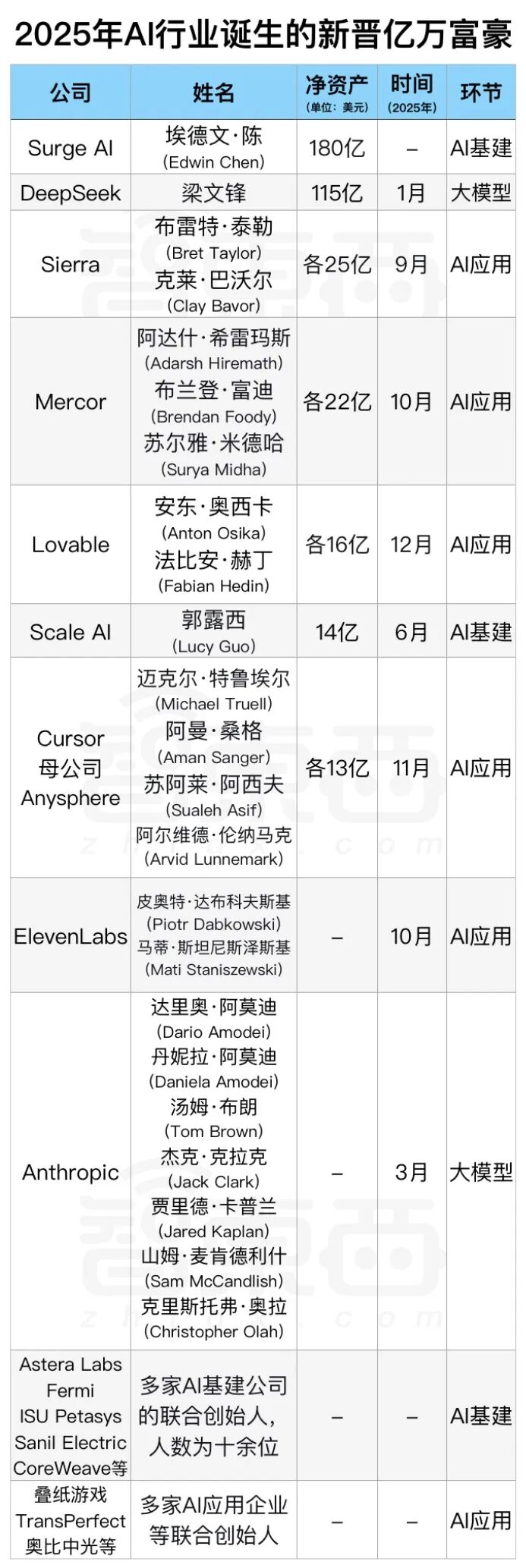
▲Newly - minted billionaires in the AI industry in 2025 (Source: Chart by Zhidongxi)
01.
Large models, AI infrastructure, and AI applications are all booming
$1.4 trillion in capital has flowed into the AI industry
According to Crunchbase, a globally renowned business information platform, investors have poured more than $200 billion (approximately RMB 1.4 trillion) into the AI field this year. AI startups have received 50% of the total global financing, a 16% increase from 2024.
In 2025, AI has reached a fever pitch. AI startups are attracting huge amounts of capital and securing large - scale financing, and the construction of data centers has also witnessed a boom. For entrepreneurs involved in the development of AI models, infrastructure, and applications, AI has become a huge wealth - creation engine.
(1) Large models
In the field of large models, in January this year, DeepSeek made a big splash at the beginning of the year. The success of its open - source model DeepSeek - R1 propelled the net worth of its founder Liang Wenfeng to nearly 100 billion. Currently, his net worth is approximately $11.5 billion (approximately RMB 80.59 billion).
In March this year, the American large - model unicorn Anthropic received a new round of financing, and its valuation reached $61.5 billion (approximately RMB 430.98 billion), which enabled all seven co - founders of the company to enter the billionaire club. In 2025, Anthropic raised $16.5 billion (approximately RMB 115.63 billion) from investors, and its valuation increased to $183 billion (approximately RMB 1.28 trillion) in September.

(2) AI infrastructure
Technology giants and AI startups are increasing their spending to build AI infrastructure. In January this year, Trump announced the construction of the "Stargate" data center project. OpenAI, SoftBank, and Oracle jointly invested $500 billion to establish a company, which kicked off the technology companies' efforts to boost AI infrastructure. Meta, Alphabet (Google's parent company), and Microsoft each pledged to invest more than $65 billion (approximately RMB 455.51 billion) this year to build AI infrastructure.
Thanks to the strong demand for data centers, more than a dozen billionaires have emerged from several companies building infrastructure for AI, including the co - founders of the American semiconductor network company Astera Labs, the data center real - estate company Fermi, the South Korean chip manufacturer ISU Petasys, the South Korean electrical transformer manufacturer Sanil Electric, and the American cloud computing provider CoreWeave.
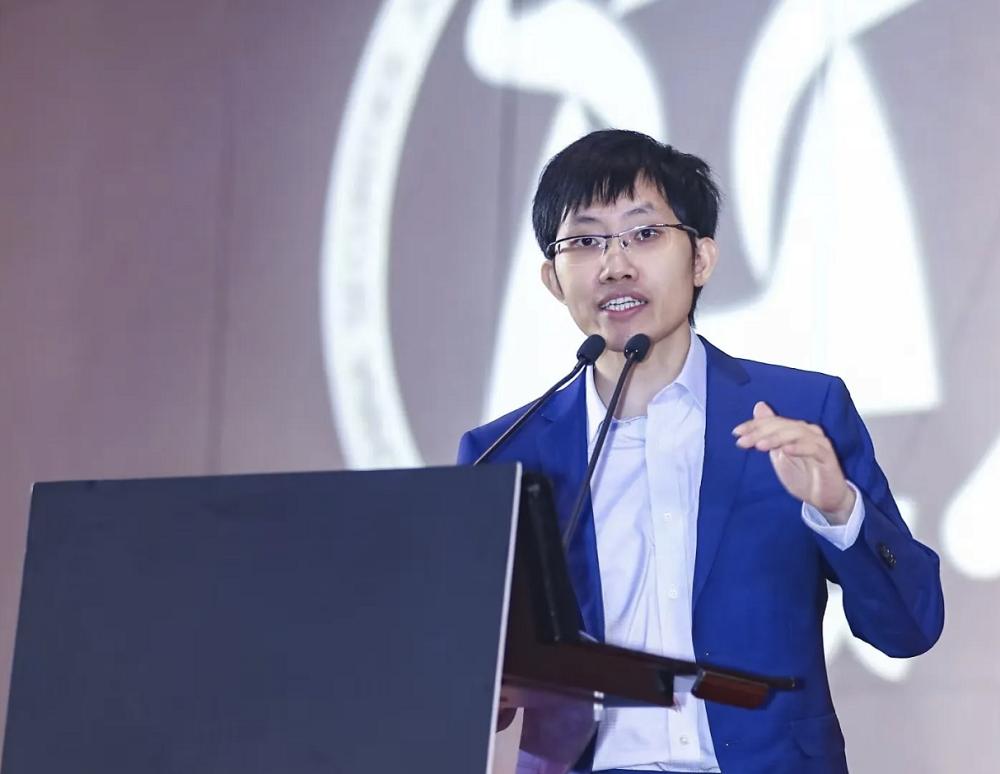
In terms of data infrastructure, a notable event this year was the acquisition of the American AI data annotation startup Scale AI by Meta. In June this year, Meta acquired a 49% stake in Scale AI for more than $14 billion (approximately RMB 98.11 billion) and poached the company's co - founder and CEO, Wang Tao. This deal pushed the valuation of Scale AI up to $29 billion (approximately RMB 203.23 billion), making Lucy Guo (who left the company in 2018 but retained her shares) one of the youngest self - made female billionaires in the world, with an estimated net worth of $1.4 billion (approximately RMB 9.81 billion).
Meta's investment in Scale AI has raised concerns among some of Scale AI's customers and competitors about its ability to remain neutral and protect customer data after Meta's investment. Therefore, this deal has actually provided development opportunities for other data annotation startups. According to "Forbes" estimates, the $1.2 billion (approximately RMB 8.41 billion) in revenue of Scale AI's competitor Surge AI last year valued the company at $24 billion (approximately RMB 168.19 billion). Edwin Chen, the founder of Surge AI, holds approximately 75% of the company's shares, worth about $18 billion (approximately RMB 126.14 billion), entering the billionaire club.
(3) AI applications
The American AI recruitment startup Mercor has also been affected by Scale AI. In October this year, after Mercor received $250 million (approximately RMB 1.75 billion) in financing, its valuation reached $10 billion (approximately RMB 70.08 billion), which made its three post - 2000 co - founders, Adarsh Hiremath, Brendan Foody, and Surya Midha, the youngest self - made billionaires in history, with each having an estimated net worth of $2.2 billion (approximately RMB 15.42 billion).
In September this year, OpenAI released its flagship video and audio model, Sora 2. The model and the AI - generated images and videos went viral on social media. Affected by this, billions of dollars have flowed into multimodal AI startups in the fields of images, videos, and audio. For example, the two co - founders of the American AI audio generation startup ElevenLabs, Piotr Dabkowski and Mati Staniszewski, became billionaires in October this year when ElevenLabs received $100 million (approximately RMB 700 million) in financing, valuing the company at $6.6 billion (approximately RMB 46.25 billion).
According to the Gallup Workplace Survey, the weekly usage rate of AI in the workplace has increased from 11% in 2023 to 23% this year. The usage rate of AI is even higher among developers. This year, Satya Nadella, the CEO of Microsoft (whose personal wealth has also exceeded $100 billion due to AI), revealed that up to 30% of Microsoft's code is generated by AI. The valuation of Anysphere, the parent company of the AI programming tool startup Cursor, reached $29 billion (approximately RMB 203.23 billion) in November, making the four co - founders of the company billionaires.
The founders of companies deeply applying AI, such as the video game company Diezhi Games, the language translation software TransPerfect, and the AI robot manufacturer Orbbec, have also made it onto the billionaire list.
02.
The highest asset is 126.1 billion, and the post - 2000 generation has joined the game
The female co - founder of Scale AI has overtaken Taylor Swift
Among the more than 50 new billionaires, some star AI startups and entrepreneurs have attracted public attention. These star companies are representative in terms of valuation, financing, and founding teams. The following are some well - known founders of AI startups who became billionaires this year, as listed by "Forbes" (ranked by wealth from high to low):
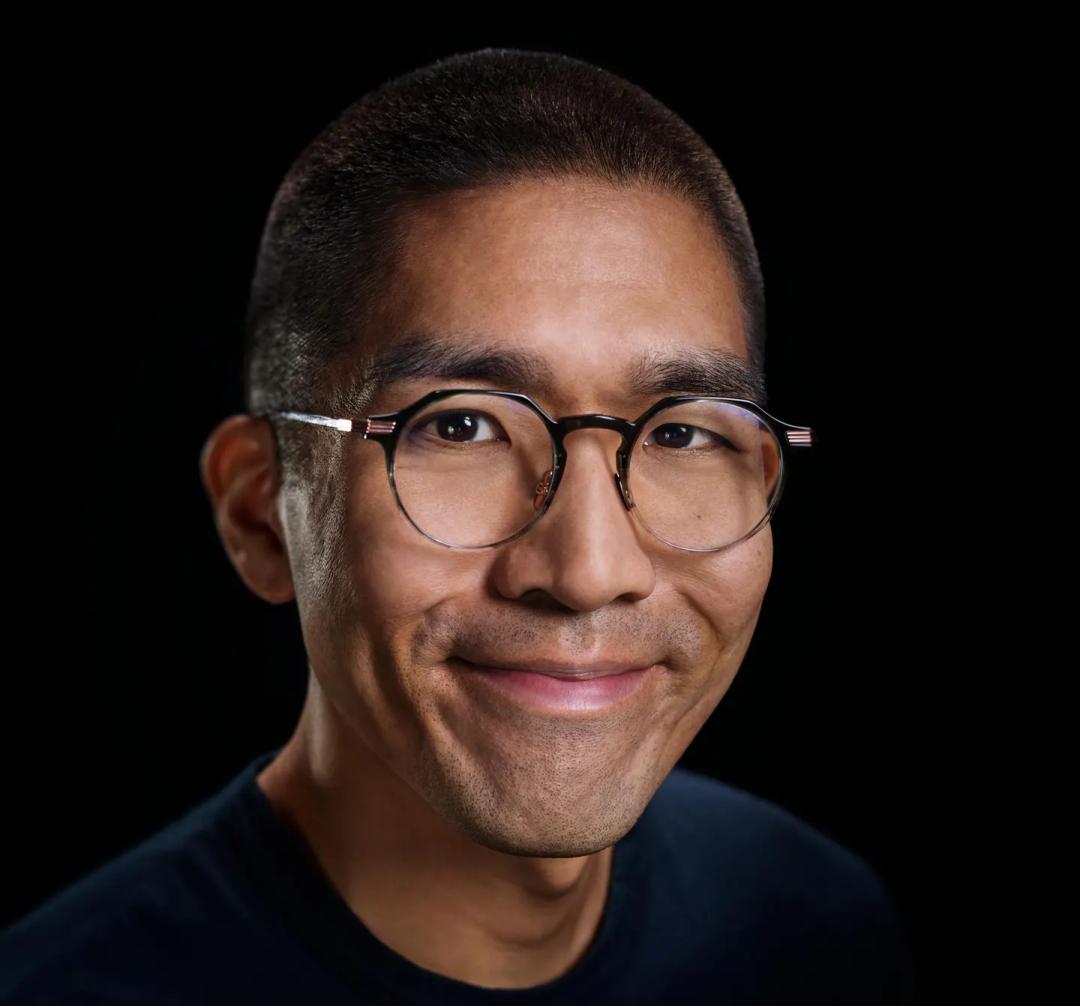
1. Surge AI: Edwin Chen
Edwin Chen, the founder of Surge AI, is 37 years old this year, and his net worth has reached $18 billion (approximately RMB 126.14 billion), with his wealth coming from Surge AI.
Edwin Chen studied linguistics and mathematics at the Massachusetts Institute of Technology (MIT). Before founding Surge AI, he worked as a machine - learning engineer at Facebook (now Meta), Dropbox, Google, and Twitter (now the X platform), developing recommendation and search algorithms and helping to collect data for training these algorithms.
Surge AI has developed rapidly in less than five years. In 2024, the company achieved revenues of $1.2 billion (approximately RMB 8.41 billion). Without the support of venture capital, relying on customers such as Google, Meta, Microsoft, and AI labs Anthropic and Mistral, as well as the company's revenues, the company's valuation has reached $24 billion (approximately RMB 168.19 billion).
It is estimated that Edwin Chen holds approximately 75% of the company's shares, worth about $18 billion (approximately RMB 126.14 billion), making him the richest new entrant and the youngest member on this year's "Forbes" list of the 400 richest Americans.
2. Sierra: Bret Taylor and Clay Bavor
The co - founders of the American conversational customer - service AI startup Sierra, Bret Taylor and Clay Bavor, became billionaires in September this year when Sierra received $3.5 billion (approximately RMB 25.23 billion) in financing, valuing the company at $10 billion (approximately RMB 70.08 billion). Currently, their net worth is $2.5 billion (approximately RMB 17.52 billion) each.
Sierra was founded in 2023 and provides a customized AI customer - service system that can connect multiple large models, supporting high - stability conversational services. It has enabled hundreds of large companies to replace human customer - service agents with AI agents, such as the American outdoor brand The North Face and the American electric - vehicle manufacturer Rivian.
According to the company's data, more than half of Sierra's customers have revenues of over $1 billion (approximately RMB 7 billion), and 20% of its customers have revenues of over $10 billion (approximately RMB 70 billion). According to "Forbes" estimates, Taylor and Bavor each own approximately 25% of the company's shares.

▲Bret Taylor on the left and Clay Bavor on the right
3. Mercor: Adarsh Hiremath, Brendan Foody, and Surya Midha
In October this year, the three post - 2000 co - founders of Mercor, Adarsh Hiremath, Brendan Foody, and Surya Midha, became the youngest self - made billionaires in history, surpassing Mark Zuckerberg, the founder and CEO of Meta, who became a billionaire at the age of 23 twenty years ago. The net worth of each of the three co - founders is $2.2 billion (approximately RMB 15.42 billion).
Mercor was founded in 2023. It is an AI - based recruitment platform that helps employers and job seekers find the right match. Its core functions include resume screening, candidate matching, AI - led interviews, and global salary management. Its customers include OpenAI, Anthropic, and Meta. "Forbes" estimates that each co