The price of tirzepatide, the so - called "king of drugs", has been cut by 70%, and the market for blood sugar control and weight loss has changed.
Text by | Hu Xiangyun
Edited by | Hai Ruojing
The newly crowned "world's best-selling drug", Tirzepatide, is set to see a significant price drop after the negotiation for the new medical insurance drug catalog in 2025.
In the recent national medical insurance catalog adjustment, multiple GLP - 1 products were included, among which was Eli Lilly's Tirzepatide, used for the treatment of adult type 2 diabetes.
As of now, the National Healthcare Security Administration has not announced the negotiation price results. However, on the social media of many endocrinologists and metabolic specialists, new prices for Tirzepatide to be implemented after January 1, 2026, have been circulated, showing a substantial year - on - year decrease. The monthly fees (4 times a month) for different dosages are as follows: 324.1 yuan (2.5mg), 551 yuan (5mg), 751.6 yuan (7.5mg), and 936.7 yuan (10mg).
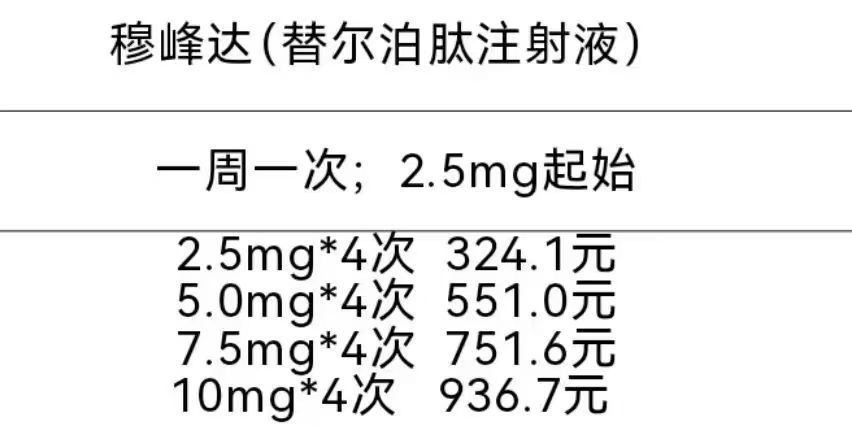
The newly circulated in - hospital prices of Tirzepatide to be implemented in 2026
36Kr contacted Eli Lilly to verify the prices, but Eli Lilly declined to comment and stated that "the official release from the healthcare security administration shall prevail."
People from two other pharmaceutical companies developing new GLP - 1 drugs said that the price data of Tirzepatide was close to the range they knew, "and it has indeed dropped a lot."
In addition, 36Kr noticed that multiple major e - commerce platforms have launched new pre - sale prices for Tirzepatide, with significant price cuts. For example, the monthly fee for the 2.5mg * 4 - dose package ranges from 450 yuan to 600 yuan, which is 60% - 70% lower than before the national negotiation. A pharmaceutical e - commerce platform even posted a slogan saying "Price cut after national medical insurance negotiation, benefiting more patients."
In the first three quarters of 2025, Tirzepatide's global sales reached as high as $24.837 billion, a year - on - year increase of 125%, successfully topping the list as the "world's best - selling drug." When such a blockbuster drug significantly reduces its price and enters the Chinese medical insurance market known for "volume growth," it is bound to reshape the domestic market landscape of similar hypoglycemic and weight - loss drugs.
Currently, 10 GLP - 1 drugs have been approved in China, and there are more domestic varieties queuing up for market launch. In 2026, the commercialization test in this field may be even more brutal.
Significant price cut, significant volume growth
On JD, Meituan, and Pinduoduo platforms, the new pre - sale prices of Tirzepatide have all dropped significantly, and they will be implemented starting from January 2026, highly consistent with the official implementation time of the national medical insurance catalog.
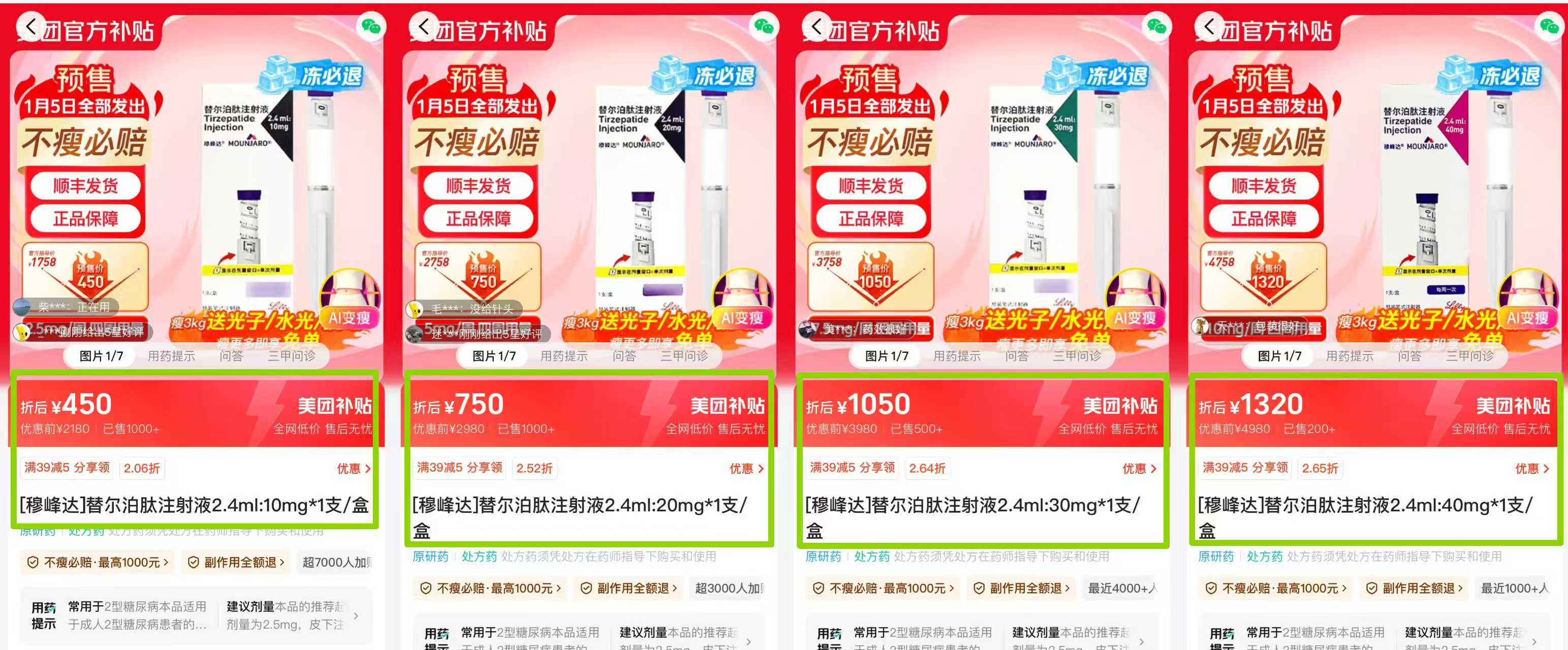
Screenshot of Tirzepatide's pre - sale price in the "Meituan official subsidy" section (Time: noon, December 25, 2025)
Figure 2: Screenshot of Tirzepatide's new pre - sale price on JD (Time: noon, December 25, 2025)
In January 2025, when Tirzepatide was first officially sold in China, the in - hospital monthly fee for the 2.5mg * 4 - dose package was about 1700 - 1800 yuan. Due to more influencing factors on the prices in out - of - hospital retail and online e - commerce channels, the monthly fee for the same dosage form was slightly higher, ranging from about 1800 to over 2000 yuan.
By comparing the two, it can be estimated that the price cut of Tirzepatide in this medical insurance negotiation may reach 70%.
It should be noted that only when treating diabetes can Tirzepatide and other GLP - 1 drugs be covered by medical insurance, which reflects the original intention of medical insurance to continuously include new and high - quality therapeutic drugs.
The weight - loss indication has a stronger consumer attribute and usually requires full self - payment. Therefore, some pharmaceutical companies may choose to set a higher price for the weight - loss indication of GLP - 1 drugs.
However, the aforementioned person involved in the development of new GLP - 1 drugs believes that although the indications and trade names are different, they are essentially the same drug, and the prices of the two indications influence each other. The price adjustment of the hypoglycemic indication is bound to be transmitted to the weight - loss indication field, thereby driving down the overall price of this category of drugs.
Tirzepatide was not the first GLP - 1 drug to enter the Chinese market, but it quickly gained market recognition and began to be popularized due to its stronger weight - loss effect. However, the high price has deterred many consumers and also allowed some domestic pharmaceutical companies to see the space for breakthrough through price strategies.
But after the adjustment of the medical insurance catalog, the price difference between Tirzepatide and similar products has suddenly narrowed.
Taking the monthly fee of the smallest dosage on e - commerce platforms as a reference, the prices of Novo Nordisk's semaglutide for hypoglycemic and weight - loss versions are about 320 yuan and 1260 yuan respectively. Among domestic varieties, Cinda Biologics' Mazdutide has not been included in the medical insurance because its approval time for the hypoglycemic indication was later than the registration time for the medical insurance adjustment. Currently, the monthly fee for the smallest dosage is about 980 yuan. For Yinnuo Pharmaceutical's long - acting hypoglycemic drug, Esuglampotide α Injection, the price cut after entering the medical insurance has not been reflected on various e - commerce channels.
With multiple advantages such as efficacy, medical insurance coverage, and price, will Tirzepatide occupy a larger market share?
Eli Lilly did not disclose the specific regional sales of the product in its financial reports, but mentioned in its October earnings conference that Tirzepatide's performance in China continued to improve in the second and third quarters of 2025. At the end of November, Daniel Legault, President of Eli Lilly China, personally led the team to participate in the national medical insurance negotiation, indicating its expectation for volume growth in the medical insurance market.
In addition, the significant price reduction of Tirzepatide is also closely related to the change in the external competitive situation. In March 2026, the core patent of semaglutide in China is about to expire, which means that a large number of generic drugs will flood the market. For example, companies like Huadong Medicine and Livzon Group, which are making rapid progress, are already in the stage of market approval review.
The combination of multiple factors will truly drive GLP - 1 drugs into an era of low - price competition. "It's faster than expected," said the aforementioned pharmaceutical company person.
What should the latecomers do?
Under the dual competitive pressures of speed and price, the elimination race for GLP - 1 drugs is accelerating.
How to improve their competitive barriers and sell drugs better in a more demanding market environment is the core proposition for GLP - 1 pharmaceutical companies still in the game.
Betting on the research and development of iterative drugs and the expansion of indications is the common strategy of most pharmaceutical companies, and this trend is intensifying.
Among the major pharmaceutical giants, some companies emphasize self - research. For example, Eli Lilly's triple - target GLP - 1 new drug, Retatrutide, has achieved a 29% weight - loss effect in clinical trials, surpassing Tirzepatide's performance in phase 3 clinical trials.
Some companies have also embarked on the path of large - scale mergers, acquisitions, and business development. In November, Pfizer acquired Metsera at a high price of billions of dollars, aiming at Metsera's long - acting monthly GLP - 1 preparation, MET - 097i. Slightly different from traditional GLP - 1 drugs, it can activate the efficacy pathway more precisely, perhaps achieving higher weight - loss efficiency and fewer side effects.
It is worth mentioning that Eli Lilly and Roche also have products with similar technological routes under research. The joint endorsement of leading multinational pharmaceutical companies may represent the industry's preliminary consensus judgment on the next - generation metabolic disease therapies.
However, the exploration of new drugs takes time. Before that, it is more crucial to sell existing drugs better. Since 2025, GLP - 1 pharmaceutical companies have collectively embraced out - of - hospital retail and online e - commerce channels, competing for scenarios and traffic, and sponsoring various "national weight - loss" and "scientific weight - loss" activities.
For example, in the middle of this year, Cinda Biologics' Mazdutide was approved for both hypoglycemic and weight - loss indications. In the one - year period from when the product's market application was accepted to its official approval, Cinda invested nearly 100 million yuan in development, marketing, and commercialization. In terms of form, it carried out relevant check - in activities on platforms like Douyin to increase product exposure.
Recently, Cinda Biologics stated in its announcement disclosing the product revenue for the third quarter that the total product revenue in the third quarter exceeded 3.3 billion yuan, a year - on - year increase of 40%. New products represented by Mazdutide are one of the driving forces for its revenue growth.
Although the competition in products and channels is becoming increasingly fierce, in terms of the total volume, the potential of the Chinese GLP - 1 drug market is still huge.
According to data from CITIC Pharmaceutical, the current penetration rate in the domestic market is only 1%, while that in the US market is as high as 10%. Therefore, the domestic GLP - 1 market has not yet entered the stage of zero - sum game. For companies with both efficacy and high - efficiency execution capabilities, there is still room to jointly expand the "cake" and share the dividends.