Dual-engine Drive of "Content + Consumption": How Can Industrial Capital Build a High-quality Large-scale Cultural and Tourism Ecological Model? | The Waning Crescent of Consumption

As the year draws to a close, perhaps because the Lunar New Year is still some time away, the last month in the CBD remains bustling. Apart from the year - end work rush, travel plans have become the most popular topic in the break room. In this article by "Last Quarter Moon", for the third time, we focus on the cultural and tourism theme. Combining the relevant information from the "2025 Co - creation Conference on the Integrated Development of Culture, Business, Tourism, Sports, and Exhibition" hosted by Beijing Daily, we continue the previous discussions on "The Economics of a Good Life" and "The Unification of the Urban - Rural Dual Structure". We will specifically analyze the business model for the in - depth integration of the cultural consumption industry in the cultural and tourism scenarios under the support of policies and industries.
This article is about 3,200 words long, and it is estimated to take 8 minutes to read.
Introduction
Since 2023, "Last Quarter Moon" has published several articles on the theme of cultural and tourism. On the one hand, starting from the end of the pandemic, the rebound of the cultural and tourism industry from the bottom is a definite growth sector. More importantly, cultural and tourism is one of the few cross - border industries that deeply integrate the cultural and consumption sectors. From PUGC content production and cross - platform dissemination, to offline services and experiences, and then to related products and transactions. Compared with the highly competitive consumption industry, the cultural and tourism industry naturally has emotional value and self - spreading highlights. And compared with the traditional content industry with limited ceilings, the new - generation cultural and tourism industry that can make good use of the high - quality supply chain, e - commerce, and chain operation capabilities of the consumption industry can greatly expand the depth and breadth of the industry, becoming one of the better solutions for local governments to promote the construction of a sustainable industrial ecosystem for the economy. In 2025, this topic has attracted more attention from local governments, cultural and tourism investment platforms, and industrial investment platforms. We are also fortunate to have contacted various institutions with diverse backgrounds and have more project reserves and industrial attempts from the perspective of investment institutions on this topic. As the year - end tweet, this article will discuss the following topics.
01
The common pain point is high popularity and traffic, but low per - capita consumption
Tags related to cultural and tourism, whether they are high - quality variety shows, documentaries, and TV dramas with local promotion attributes, or UGC short videos and graphic content about punch - in experiences, beautiful scenery, delicious food, and historical figures, are all important supporting content and traffic guarantees on various content platforms. The popular destinations on Xiaohongshu, concerts, and even region - limited products are like travel guides, attracting the attention and traffic of young people. Related to this is the positive data performance of the tourism - related industries. According to the data on the domestic tourism market in the first three quarters of 2025 released on the website of the Ministry of Culture and Tourism, the number of domestic tourist trips reached 4.998 billion, a year - on - year increase of 18%. The increase in 2024 compared with the previous year was even more significant.
However, at the same time, the logic of large - scale scenic spots with heavy assets and heavy operations has also exposed problems. Many scenic spots are facing the severe situation of "increasing revenue but not profit" or even "both revenue and profit declining". The reception capacity of natural and cultural heritage scenic spots is naturally limited, and their replicability is weak. For relatively mature listed scenic - spot companies, the space for performance improvement is already limited.
Table: Performance of some listed cultural and tourism companies in the first three quarters of 2025

In the tourism statistics of the National Day holiday disclosed in many places, we can clearly see the problems exposed by the per - capita consumption figures. Especially for niche and emerging destinations with original ecological features, if the realization and trading links are still undertaken by individual handicraftsmen and villagers - based business services, not only is the possibility of branding and industrialization of relevant business entities low, and they cannot be included in the regulatory system, but it also causes problems such as traffic congestion, uneven product and service quality, and poor tourist experiences. When the popularity is high, it may benefit the transportation and hotel industries. When the popularity fades, it may lead to the inability to recover a large amount of commercial space, homestay tourism real estate, and pre - investment in fixed assets. Many unfinished ancient cities and towns come from this situation.
02
The policy support is direct and powerful, and the direction of promoting the economy is very clear
The importance of the cultural and tourism industry has been significantly enhanced from the 14th Five - Year Plan to the 15th Five - Year Plan. First, the strategic positioning of the cultural and tourism industry has been upgraded from a carrier of "soft power" to a "strategic pillar industry" for stimulating domestic demand and economic growth. The goal of "accelerating the construction of a world - class tourism power" has been clearly put forward.
Second, the requirements for the supply of the cultural and tourism industry have been improved. The state pays more attention to quality upgrading and incremental creation. The policy clearly requires "enriching the supply of high - quality tourism products" and introduces the concept of "new - quality productivity", which means that traditional simple resource integration is no longer enough. It is necessary to create new consumption scenarios and product forms through technological empowerment.
Third, there has been an evolution in the opening - up pattern. The cultural and tourism industry has been upgraded to an important part of service trade. The policy clearly proposes to "improve the facilitation level of inbound tourism", marking the expansion of the policy focus from "cultural output" to "real inbound consumption services".
On December 18th, Beijing Daily hosted the 2025 Co - creation Conference on the Integrated Development of Culture, Business, Tourism, Sports, and Exhibition. We were fortunate to be the only representative of an investment institution to discuss topics such as innovation in the integration mechanism, creation of popular projects, and the path of capital assistance with relevant government departments, industry associations, university experts, and excellent enterprises. The theme of the discussion was the promotion of urban development through the multi - format integration of the culture, business, tourism, sports, and exhibition industries.
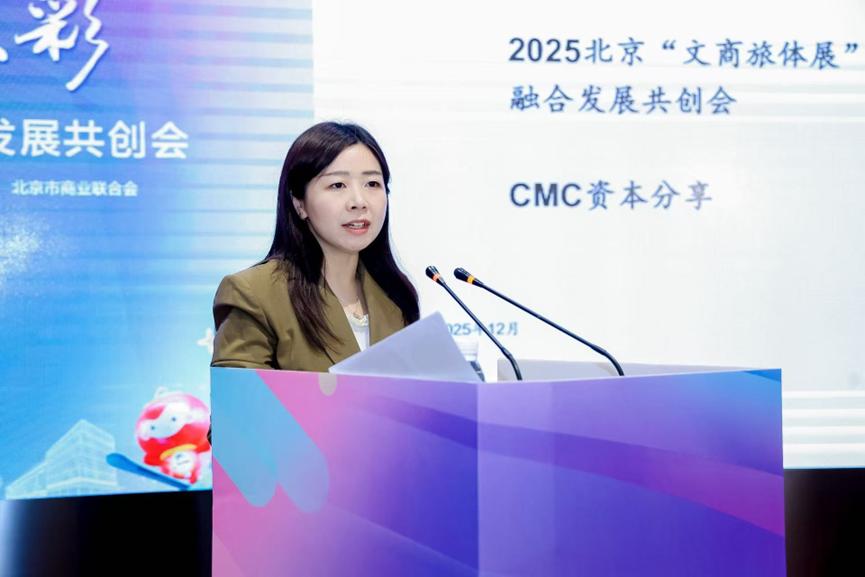
Picture: Zhang Lin, Managing Director of CMC Capital, attended the "2025 Co - creation Conference on the Integrated Development of Culture, Business, Tourism, Sports, and Exhibition" and gave a speech.
Taking Beijing as an example, the content supply in areas such as radio and television, sports events, theaters and museums, as well as emerging trendy art IPs and immersive venues is extremely rich. How to achieve greater industrial width and depth with limited production capacity, establish a deeper connection with the business and civilian systems, and promote the cultural and tourism traffic to have a stronger consumption - driving force for the city is a deeper - level topic behind the number of tourists. In the discussion, we proposed that the current cultural and tourism IPs have entered a "new stage driven by value". Their essence has been upgraded from a simple tourism logo to a "cultural life form" rooted in local culture, with high recognition and deep emotional connection.

Its core value is mainly reflected in three dimensions: First, the value of cultural empowerment, that is, activating traditional culture, inheriting history in a modern way of expression, taking the reproduction of the Red Chamber dim sum by Xianghe Pastry Shop as an example. Second, the value of brand differentiation, aiming to establish a unique brand image in the homogeneous competition and improve the project's recognition, taking the Shanghai - style space aesthetics coffee brand M Stand as an example. Third, the value of industrial driving, which can effectively empower derivative consumption such as cultural and creative products and catering, thereby driving the overall growth of the regional economy, taking the popular business form of Nai'erbao in commercial centers as an example.

03
The solution for promoting industrial investment in cultural and tourism
Industrial investment funds are one of the effective tools to guide the implementation of policies. Attracting investment and local support are the two major themes of many industrial funds. Through preferential policy subsidies and attracting mature enterprises to set up regional R & D centers or even relocate their headquarters, or guiding managers to deeply explore local large - scale enterprises and assist them in listing on the capital market as soon as possible. However, in the relatively special cultural and tourism industry, simple investment attraction and support can only implement individual heavy - asset or heavy - operation projects. They cannot provide satisfactory answers in terms of driving the local industrial ecosystem through in - depth integration and constructing upstream - downstream industrial linkages, not to mention the investment recovery period of heavy - asset projects and the future endogenous extensibility issues.
We believe that the cultural and tourism industry has entered the 2.0 stage with a more grand narrative logic, that is, the large - scale cultural and tourism model of the in - depth integration of the cultural industry and consumption scenarios. A sustainable and healthy cultural, business, and tourism format is based on the dual judgment logics of the cultural industry and the consumption industry. On the cultural side, professional content creators should continuously update and iterate the spiritual core based on the local historical, social, and cultural scenarios on the basis of the main - theme narrative, through the presentation of on - site physical objects and virtual forms, and continuous interaction and growth with social media dissemination and UGC content. On the consumption side, its products, services, and experiences should be diverse, vivid, and of high quality, using the consumer demand perception ability, supply chain ability, and operation ability that have been refined to perfection in the consumption industry to achieve secondary connection with experiencers and brand power precipitation in multiple ways, both online and offline.
Under the large - scale cultural and tourism model of the in - depth integration of culture and consumption, investment institutions need to use their information and resource platform attributes to jointly build a high - quality cultural consumption and tourism industrial ecosystem under the policy guidance with local governments. From a market - oriented perspective, they should do a good job in the continuous dissemination and promotion of the main - theme narrative from the perspective of young people and through social media. With the continuous update of high - quality content on top platforms and short - video platforms, they should enhance the style and attractiveness of the destination nationwide and even globally. Combining the design, production, operation, and chain management capabilities of high - quality domestic and foreign products and service providers, they should make up for the short - board and magnify the long - board of local supply and services. Under the demonstration of benchmark cases, they should make good use of the leverage effect of capital to achieve the rapid replication of excellent models and the capitalization process.
The capital cycle of content - based and brand - based investments is shorter, and the capital scale is smaller. It is more suitable for the current demand of the cultural and tourism industry to upgrade from "from scratch" to "better and more excellent" on the infrastructure side. However, it also has higher requirements for cross - industry cognition, resource mobilization, operation ability, and overall plan design. As an industrial investor with 15 years of experience in the cultural industry, CMC Capital will continue to be committed to promoting new investment opportunities in the cultural, business, and tourism industries brought about by the in - depth integration of content and consumption in the new year through its media content, brand consumption, AI technology, and cross - industry resource integration ability of "cultural and tourism IP +".
This article is from the WeChat official account"CMC Capital", author: Last Quarter Moon. Republished with permission from 36Kr.