The Rise of Modern Data Warehouses: A Twenty-Year Journey Through Eight Eras
How enterprises evolved from manually constructed sales reports to PB-scale multi-tenant platforms with thousands of consumers and how it will develop in the next decade.
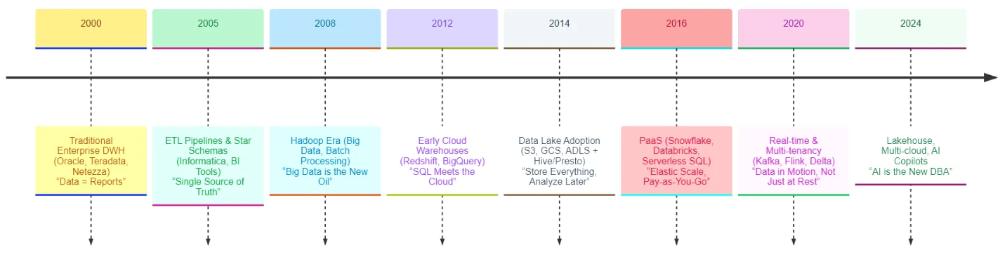
Twenty years ago, "data warehousing" was almost equivalent to extracting, transforming, and loading (ETL) data into Oracle or a relational database management system (RDBMS). Storage space was measured in gigabytes (GB). Reports were delivered monthly or weekly. Most enterprises had fewer than a dozen dashboards, and analysts were often the gatekeepers of SQL.
Fast forward to today:
Google BigQuery can query exabyte (EB)-scale data.
Netflix uses Apache Iceberg to manage billions of streaming events per day.
Uber uses Apache Hudi to manage over 150 PB of data.
This is not just a technical issue—it's the story of how data has become the core product of modern business.
The First Era: 2005–2010 · Direct Tables → "Just Generate Reports"
💡 "Data is a cost center, not an asset."
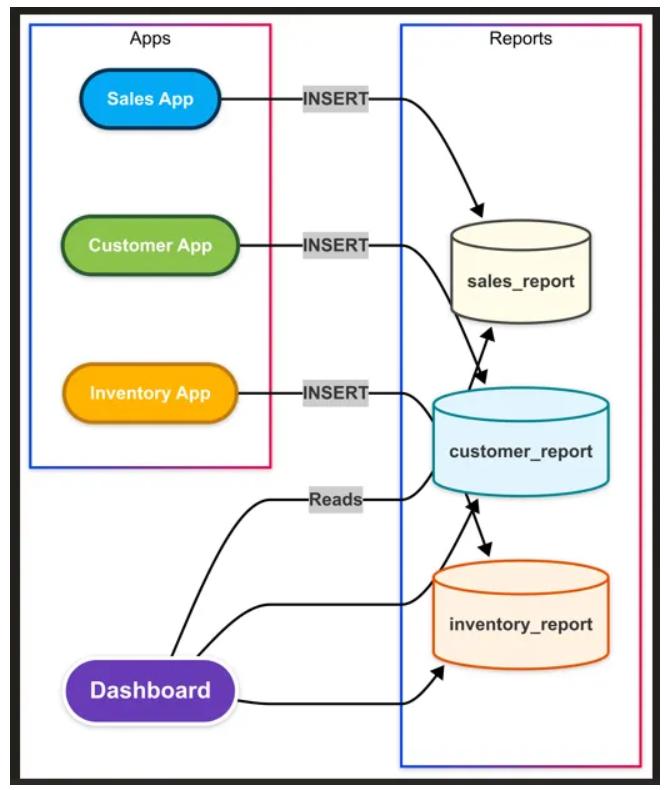
Applications wrote directly to reporting tables (sales_report, customer_report, inventory_report). Reports were typically hard-coded SQL scripts that ran on a schedule via cron jobs. Spreadsheets were manually exported and emailed as the "single source of truth." Applications wrote directly to reporting tables. Dashboards queried these tables directly.
This approach worked fine until someone asked: 👉 "What is our revenue by customer segment, considering inventory availability?"
Solving this problem usually required manually joining data in Excel—sometimes taking weeks.
Gartner's 2008 Magic Quadrant for Business Intelligence report described the adoption of data warehousing/business intelligence as "limited to a few executives." Fewer than 10% of employees in most companies had access to any data warehouse data.
Breakthrough: Google's Dremel (2010) demonstrated that SQL could process trillions of rows of data in seconds. This gave rise to BigQuery, revolutionizing expectations about data processing from batch reporting to interactive analysis.
The Second Era: 2011–2015 · Cloud Warehouses Go Mainstream
💡 "Elasticity is the new scalability."
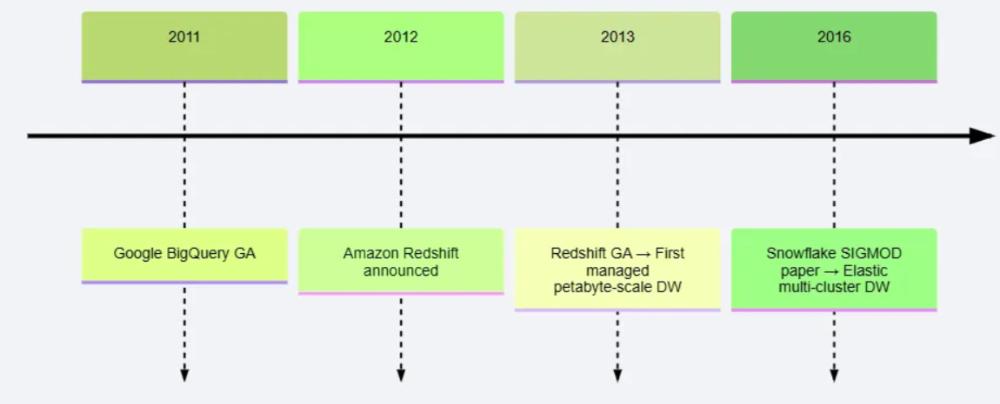
Three major innovations:
BigQuery (officially launched in 2011) → The first serverless, pay-per-query data warehouse.
Amazon Redshift (officially launched in 2013) → The first affordable PB-scale data warehouse. At launch, it was priced at approximately $1,000 per TB per year, nearly 20 times cheaper than Teradata.
Snowflake (launched in 2016) → A multi-cluster shared data architecture that separates storage and compute.
The launch of Redshift triggered one of the largest migrations in data history—within three years, thousands of Oracle/Teradata customers migrated to AWS.
Impact: Sales, customer, and inventory data could be centralized in a cloud-native warehouse for the first time. Scaling no longer meant buying new hardware; it meant starting a cluster in minutes.
The Third Era: 2015–2018 · Spaghetti Pipelines → Normalized Raw Zones
💡 "There is either one source of truth or none."
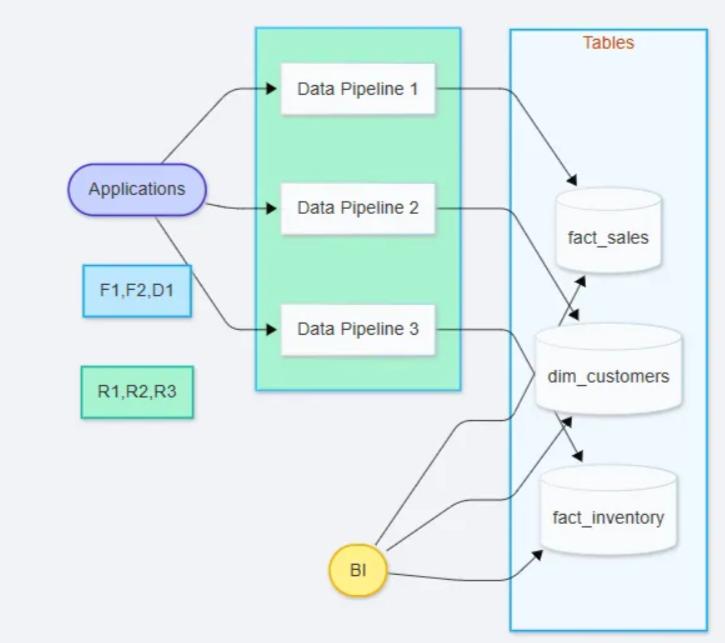
As adoption increased, the number of pipelines exploded:
The finance department needed a finance_sales solution.
Recruitment marketers needed a campaign_customers solution.
Recruitment operators needed an inventory_ops solution.
Soon, applications were writing to multiple redundant data sources. Governance mechanisms broke down.
Solution: Normalized raw content + curated content zones.
Raw: sales_raw, customers_raw, inventory_raw.
Curated: fact_sales, dim_customers, fact_inventory.
Tools like Presto (Facebook, 2013) supported federated queries across data sources. By 2018, Facebook was running over 30,000 Presto queries per day to support product analytics and advertising reporting.
Case Study: During this period, Airbnb migrated from MySQL dumps to a Hive-based data warehouse and later to Minerva to enforce metric consistency.
Technical Milestone: Presto (developed by Facebook) became the first fast federated SQL engine. It allowed queries on data in Hive, MySQL, and Cassandra without migrating the data.
The Fourth Era: 2016–2020 · Lakehouse
💡 "Bring acid to the swamp."
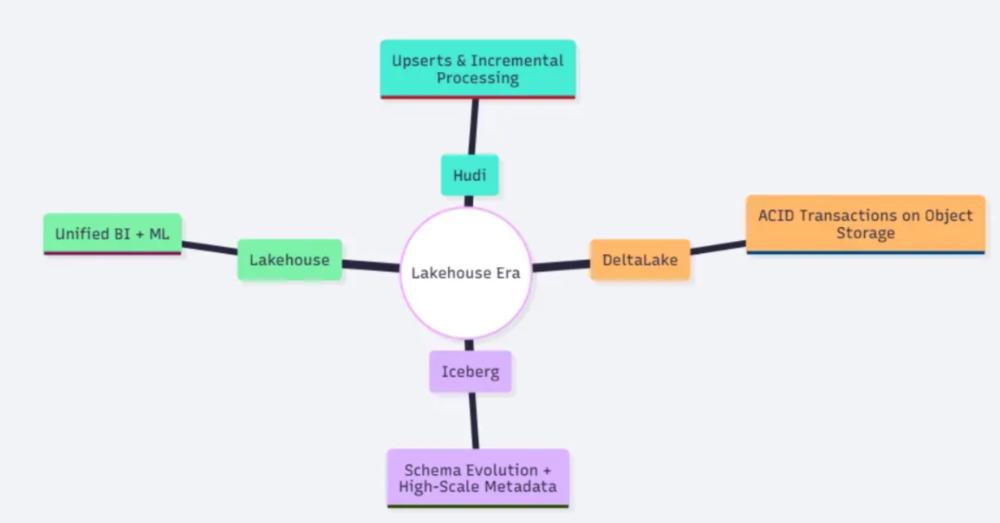
Data lakes (HDFS, S3, GCS) exploded in growth—but without governance, they became data swamps.
Solution: Table formats + ACID layers.
Apache Hudi (2016, Uber) → Incremental inserts, CDC, time-variant data. Supports estimated time of arrival predictions for Uber Eats.
Delta Lake (2020, Databricks) → ACID transactions, schema evolution.
Apache Iceberg (Netflix) → Scalable metadata, hidden partitioning. Netflix uses it to process billions of events per day.
By 2019, Uber's Hudi pipelines were ingesting hundreds of billions of rows of data per day and managing over 150 PB of storage.
Significance: These three technologies created the Lakehouse. Business intelligence teams can run dashboards, while machine learning engineers can train models using the same consistent set of data.
The Fifth Era: 2018–2022 · Real-Time Warehousing
💡 "If it's not updated in real-time, it's already outdated."
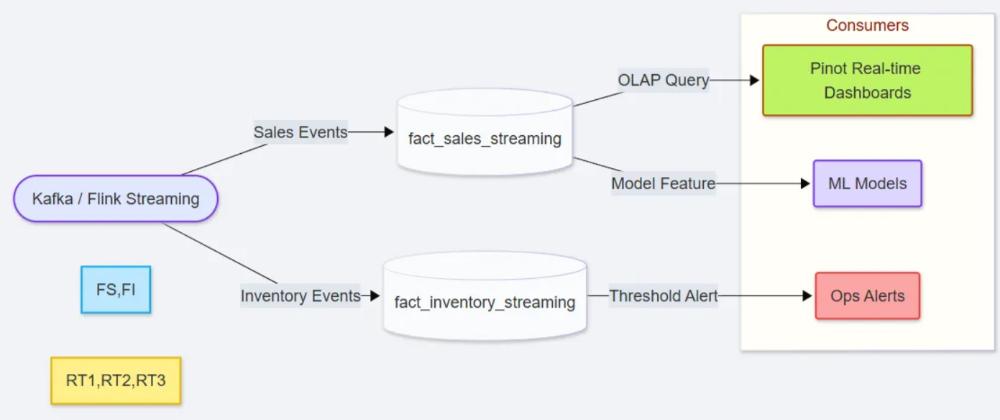
Batch ETL wasn't enough for Uber, Netflix, and LinkedIn:
Uber AthenaX → Flink-based streaming SQL. Used for dynamic pricing and fraud detection.
Apache Pinot (LinkedIn → Uber) → Sub-second OLAP. LinkedIn uses it to display "Who viewed your profile", and Uber uses it to provide real-time operational dashboards.
Impact:
Real-time detection of out-of-stock inventory.
Dynamic adjustment of promotional campaigns.
Real-time tagging of customer churn.
Netflix's real-time infrastructure (Mantis + Iceberg) processes tens of billions of events per day to adjust recommendations.
The Sixth Era: 2018–2024 · Metadata, Semantics, and Governance
💡 "Data without context is noise."
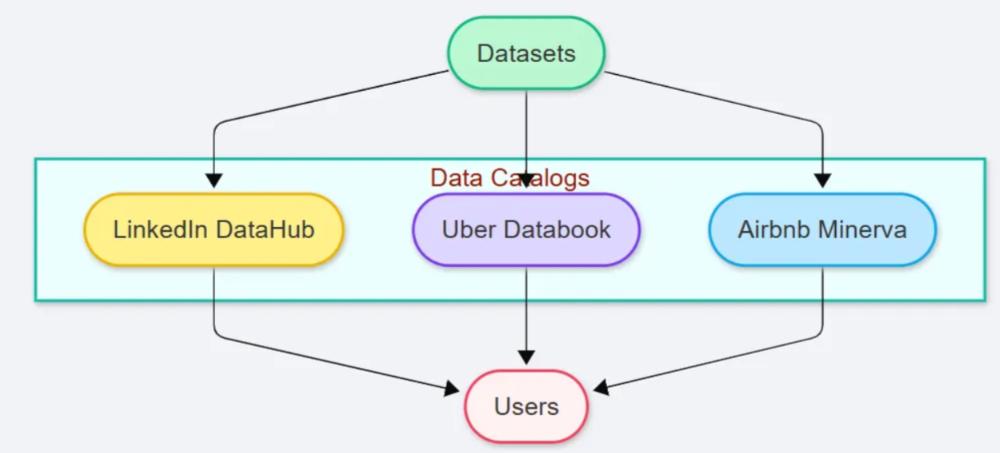
PB-scale data warehouses introduced new problems: Data discovery, trust, and governance.
Uber Databook → A metadata platform with over 10,000 datasets.
LinkedIn DataHub → Open-source metadata + lineage, now adopted by companies such as Expedia and Saxo Bank.
Airbnb Minerva → A unified metrics layer that saves analysts thousands of hours of work per quarter.
Gartner estimates that by 2023, 60–70% of enterprises will have multiple conflicting metric definitions ("two versions of revenue"), wasting billions of dollars due to poor decision-making.
The Seventh Era: 2022–2025 · Cross-Cloud Architectures
💡 "Your data is everywhere, so your data warehouse must be too."
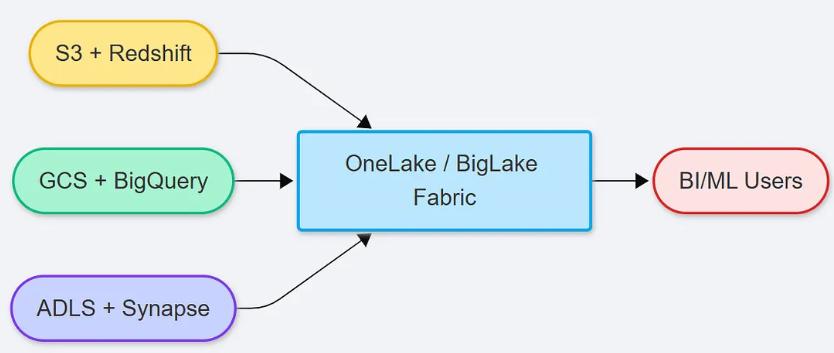
Enterprises now operate in multi-cloud + hybrid-cloud environments.
Google BigLake (2022) → A unified governance/security layer for BigQuery + open tables
Microsoft OneLake (2023, Fabric) → "One logical data lake" for all Fabric services.
The Eighth Era: 2025–2035 · What's Next
💡 "Your warehouse will think for you."
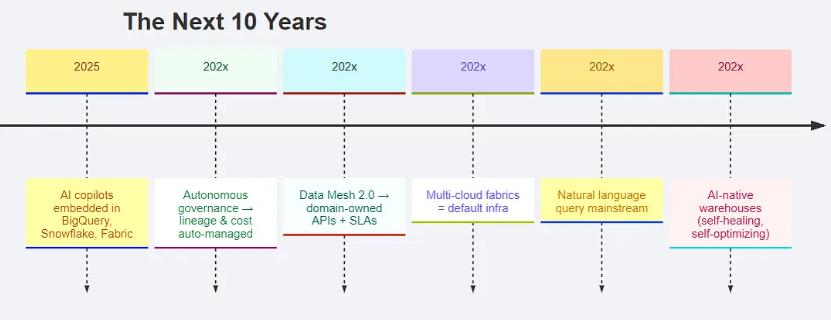
Forecasts based on current trends:
1. AI-Native Warehouses
In use: BigQuery AI, Snowflake Cortex, Microsoft Fabric Copilot.
By 2030, over 50% of queries will be automatically generated by AI copilots (Gartner).
2. Autonomous Governance
Standards like OpenLineage + AI monitoring for anomalies in lineage, cost, and schema drift.
3. Data Mesh 2.0
Domains (sales, customers, inventory) become data product APIs with service level agreements (SLAs).
4. Natural Language Interfaces
"Show inventory risk in the Asia-Pacific region for the next quarter" → LLM converts to SQL → Copilot validates via lineage and metrics.
5. Cross-Cloud Architectures by Default
Cross-cloud replication in Google BigLake, Microsoft OneLake, and Snowflake → A true "architectural" infrastructure.
Nine. Summary of Key Points
2000s → Direct tables, fragile but simple.
2010s → Cloud warehouses + raw zones democratized analytics.
Late 2010s → Lakehouse + streaming unified batch processing + real-time.
2020s → Metadata, semantics, governance, and cross-cloud architectures.
Next decade → AI-native, autonomous, controlled, fabric-based warehouses.
Ten. What Architects, Analysts, and Leaders Should Learn
Make transformative designs every five years → Architectural evolution should outpace technical debt repayment.
Normalized raw zones are non-negotiable → Crucial for auditing, replay, and compliance.
Semantic consistency is more important than compute speed → The cost of metric drift is higher than storage costs.
Stream processing-first mindset → Batch-only processing is an outdated practice.
Metadata + lineage = The most important task → Discovery and trust are more important than ingestion speed.
Cross-cloud architectures will dominate → Data is global, and governance must be too.
AI copilots will become warehouse users → Design your warehouse to serve both humans and machines.
Invest in observability → Treat data pipelines as software products (SLOs, SLAs, alerts).
Data as a product → Domains must own sales, customer, and inventory datasets and have contracts.