How often is it appropriate for an ordinary person to replace their mobile phone?
Is the phone you're using to scroll through WeChat and Douyin almost three years old?
Although it seems like everyone is buying new iPhones and flagship phones.
In fact, most Chinese people still stick to using phones they bought three or four years ago and are reluctant to replace them.
In 2025, the average phone replacement cycle for Chinese users was nearly 33 months, almost 40% longer than in 2020.
So, it's not uncommon to still be using a phone from three years ago, or even a Mate 30, iPhone 12, or Xiaomi 10 that was purchased when 5G first became available.
The Chinese phone market is entering a "holdout era." In this special era, we've witnessed many things that were previously unimaginable.
For example, could you have imagined that Huawei and Apple would start competing on price?
In late November, when the Mate 80 series was released, Huawei actually cut prices.
The standard version saw an 800-yuan price cut, and the Pro version a 500-yuan cut, making it even cheaper than the starting price of the Mate 40 five years ago.
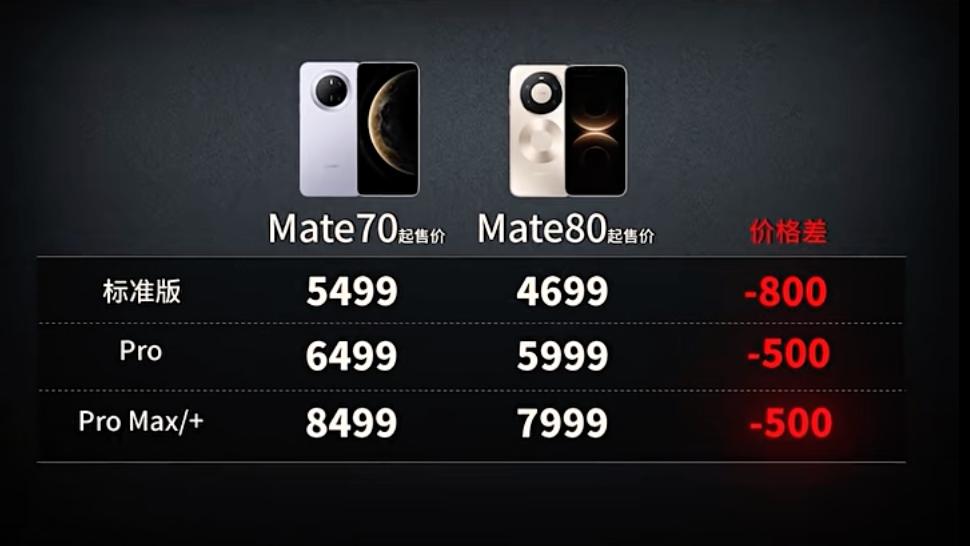
Is the world going crazy? The Mate is even cheaper than the high - end version of the Redmi K90!
Before that, Apple had already shown a determination to compete on price.
In May, the price of the iPhone 16 Pro was reduced. After national subsidies, the 128GB version dropped to 5,499 yuan.
The standard version of the iPhone 17, released in September, was described as "squeezing every last drop." With an official price of 5,999 yuan for the 256GB version falling within the national subsidy range, its outstanding cost - effectiveness drove its first - week sales in China to soar by 140% compared to the previous year.
During the Double Eleven shopping festival, iPhone sales increased by 37% year - on - year, while the combined sales of other brands decreased by 5%.
Even more surprisingly, Xiaomi, which originally built its reputation on cost - effectiveness, has become this year's most innovative flagship phone brand with its phone's rear screen, disrupting the "duopoly" in the high - end phone market and turning it into a "three - way battle."
In 2024, during the flagship phone release cycle, the Baidu search indices of Xiaomi, OPPO, and vivo were at least comparable, if not on par.
However, in 2025, OPPO and vivo are no longer in the same league as Xiaomi. Xiaomi's popularity skyrocketed even before the release when it announced the "name change to 17," remained high for nearly half a month, and reached another peak at the official release.
From cars to phones, Xiaomi has become a unique player in domestic brand marketing through the packaging of Lei Jun's personal IP.
You may scoff at this, but the fact is that domestic phone brands have reached a point where they must focus on marketing.
In 2025, the most prominent feature of domestic flagship phones is that they all look more and more like iPhones, with a unified rectangular frame design.
By comparing the hardware data of Xiaomi, OPPO, and vivo's flagship phones from this year and last year, we can see that there haven't been significant changes in core hardware such as processors, screens, and camera sensors. The most notable improvement seems to be in battery capacity.
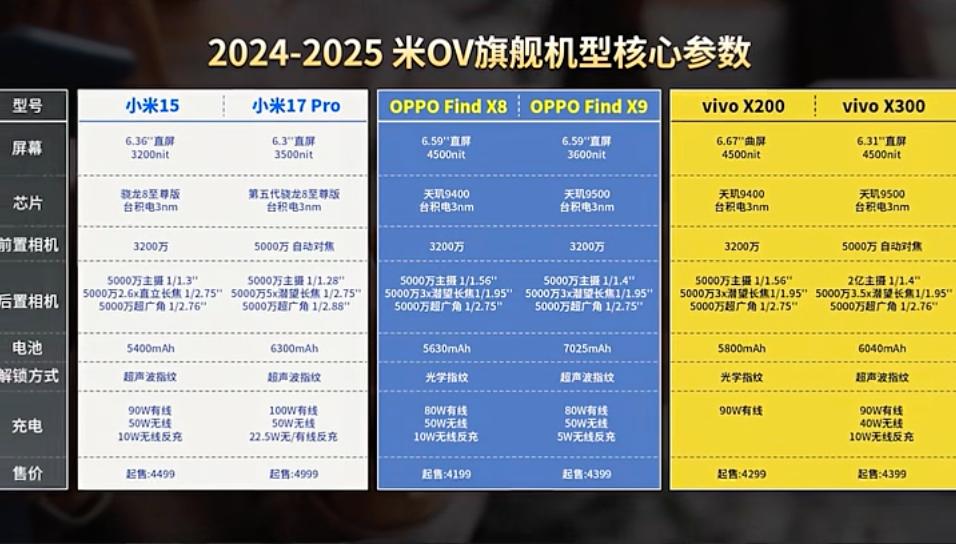
After the homogenization of hardware and design, the most memorable innovation in this year's flagship phones might really be the rear screen of the Xiaomi 17 Pro.
Compared to its practicality, isn't the real significance of this rear screen a clever marketing strategy?
Now, a real problem for all brands is that if they don't learn marketing from Xiaomi, the presence of their flagship models may become weaker and weaker.
At the same time, losing the high - end phone market is something no domestic brand can afford, as the situation for mid - range phones is becoming increasingly difficult.
For many years, domestic brands valued but didn't rely solely on the high - end market because the mid - and low - end markets were their mainstay and the major source of sales. However, this situation is changing rapidly in 2025.
Generally, the sales distribution of a product category across different price segments should form a pyramid or spindle shape from low to high.
However, in the first half of 2025, the phone market took on a strange dumbbell - like shape, with a narrow middle and wide ends. In particular, the market share of phones priced between 3,000 and 4,000 yuan is shrinking rapidly.
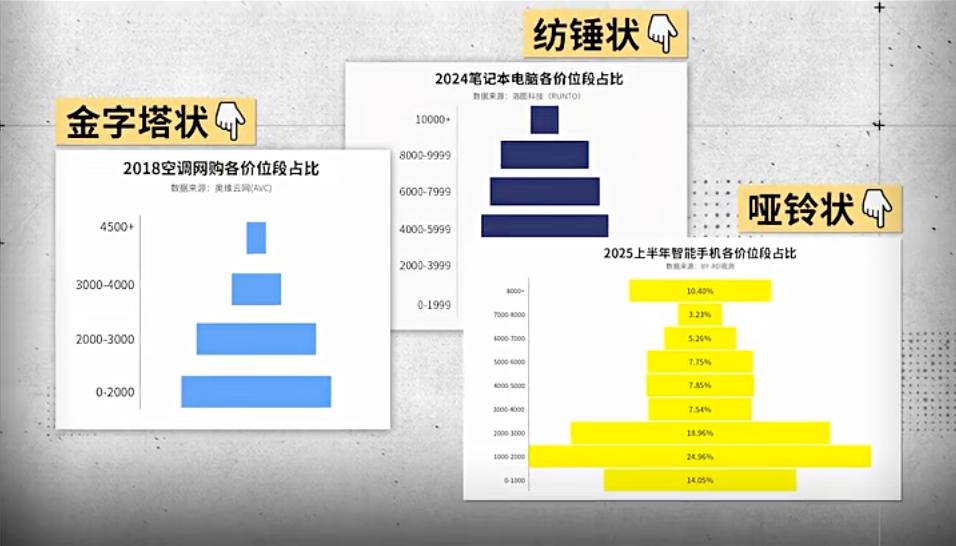
The consumers in this price range are mostly young people. The poor sales of phones priced around 3,000 yuan are mainly due to the fact that consumers are generally less willing to replace their phones, as mentioned earlier.
In particular, in previous years, domestic brands competed fiercely on hardware in the mid - range phones priced at 2,000 - 3,000 yuan, packing in a lot of high - end features. As a result, these phones don't experience significant slowdowns even after two or three years of use.
In addition to the longer replacement cycle, another possibility is that more and more young people are buying phones in the second - hand market.
From 2020 to 2024, while the annual phone shipments were declining, the second - hand phone market showed an opposite trend.
Some analysts believe that in 2025, the national second - hand phone trading volume may have exceeded 100 million units.
Among them, the iPhone is the eternal king in the second - hand market. Given a budget of around 3,000 yuan, would you choose a new domestic mid - range phone or an older iPhone Pro?
Facing the somewhat sluggish mid - range phone market, domestic phone brands and suppliers have come up with various solutions.
In 2025, Qualcomm provided the "Snapdragon 8 Gen 5" processor for mid - range phones and always promoted it as having "flagship - level performance" during marketing.
However, if you look closely, you'll find that the Qualcomm processors used in real flagship models like the Xiaomi 17 have the word "Ultra" in their names, while those in mid - range phones don't.
Behind this subtlety is the effort of brands and suppliers to maintain the sales of mid - range phones.
After all, in the context of the chaotic competition in the high - end phone market in 2025, the mid - range phone market has become a must - win territory for domestic brands with no room for retreat.
In 2026, the phone market will definitely become even more chaotic.
With the global memory price soaring, domestic phone brands, which have already pushed prices to the limit, will have no more room to compete on price.
Only Apple and Huawei, which previously had relatively high profit margins, may still have the ability to cut prices.
When these two brands have the space to further reduce prices and promote sales in 2026, other brands may even be forced to raise prices. As a result, it's very likely that some brands will strategically withdraw from the high - end phone market.
For example, it wouldn't be too surprising if Honor, which is already showing signs of falling behind, completely abandons models priced above 5,000 yuan next year.
In addition, influenced by Xiaomi's success, other brands will focus more on marketing. We boldly predict that at least one brand will try the rear - screen design.
Finally, we've also noticed that in 2025, major phone manufacturers are trying to shed the label of "phone manufacturer."
Xiaomi not only entered the automotive industry but also released new AI glasses this year. Vivo launched the vivo Vision, aiming to compete with the Vision Pro. OPPO announced at the end of the year that a team led by Liu Zuohu is working on a pocket camera project.
The "holdout year" of 2025 is over. Will 2026 be better?
This article is from the WeChat official account "Yiou New Consumption" (ID: EO - Consumer). Author: Song Shuxin. Republished by 36Kr with permission.