The Song of Ice and Fire in the Silicon Valley AI Layoff Wave
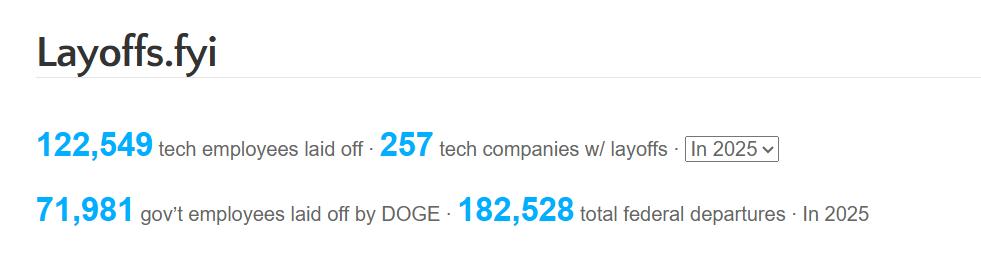
In 2025, the layoff storm in Silicon Valley was fiercer than ever. Data from the independent layoff tracking website Layoffs.fyi shows that global technology companies have laid off over 120,000 employees, and the vast majority of them are from tech giants with strong financial performance and record - high profits.
Microsoft laid off more than 15,000 employees throughout the year. Cloud service provider Amazon announced in October that it would cut 14,000 corporate positions. Apple, once known for its job stability, also joined the layoff wave.

Strangely enough, these companies are not in trouble. On the contrary, their financial reports are booming: the annualized revenue of Microsoft Azure's AI business has exceeded $13 billion, a year - on - year increase of nearly 175%. Although Amazon AWS does not list its generative AI services separately, the strong demand for them has driven its overall Q3 revenue to $33 billion, a 20% year - on - year increase. While laying off a large number of employees, these companies are achieving record - high performance. This combination of ice and fire is reshaping our understanding of the tech industry.
So, what exactly caused this wave of layoffs? What key signals are revealed behind the large - scale job changes?
Amidst the Layoff Freeze, AI Burns Against the Odds
Before 2022, the word "layoff" was a distant concept for many in Silicon Valley, a term associated with traditional industries. Tech companies were the engines of growth and synonymous with never laying off employees. However, since the end of 2022, tech giants such as Meta, Google, and Microsoft have successively launched large - scale layoffs. People began to realize that the tech industry is not immune to the economic cycle.
According to data from the independent tracking website Layoffs.fyi, as of December 2025, the global tech industry has announced 120,000 layoffs this year, involving more than 1,300 companies. Behind this number are countless moments of despair.
Microsoft laid off 6,000 positions at once in May (3% of its global employees), with a total of more than 15,000 layoffs throughout the year. Amazon announced 14,000 layoffs in October, and the total number is expected to reach 30,000. Meta laid off 5% of its underperforming employees at the beginning of 2025, and in the fall, it was reported that about 600 employees in its AI infrastructure department would be laid off.
However, the layoffs in 2025 are fundamentally different from those in the past. Looking behind the layoff wave, we can find several unique phenomena:
First, the AI business has not been affected. Instead, it has become the core engine of profitability.
The revenue of Microsoft Azure's AI services increased by 175% year - on - year. Relying on AI applications in advertising recommendation and content ecosystem, Meta achieved a 22% revenue increase and a 36% profit increase. It can be seen that layoffs are not a last - ditch effort when a company faces losses, but a strategic decision when profits are rising and stocks are soaring.
Second, layoffs and recruitment are carried out simultaneously, and the talent structure is being drastically restructured.
Tech companies generally launched "Voluntary Exit Programs", offering generous severance packages to encourage non - core employees to leave. At the same time, they are scrambling for scarce talents such as AI algorithm engineers, large - model training experts, and inference optimization architects around the world. The speed of personnel flow is unprecedented: a laid - off front - end engineer may see the positions in their former department being re - allocated to two LLM fine - tuning experts within three months. This dual - track strategy of laying off and recruiting at the same time marks that enterprises are shifting from labor - intensive innovation to intelligent capital - intensive innovation.
Third, the scope of layoffs is wide and continuous, and middle - level managers are the hardest hit.
Different from previous layoffs that focused on junior positions or marginal business lines, this round of layoffs is precisely targeted at a large number of middle - level technical supervisors, product managers, regional sales managers, and operation coordinators. These positions are often responsible for information transmission and process coordination. However, with the popularization of automated tools such as intelligent project management, automatic weekly report generation, and AI customer insight systems, their value has been rapidly diluted. It is worth noting that these layoffs are highly continuous. Different from the past, when companies entered a stable period after a one - time large - scale layoff, many tech companies in 2025 evaluated their organizational efficiency almost every quarter, and some positions were cut.
It can be seen that the layoffs in 2025 are no longer a passive reaction to the economic downturn, but an active and institutionalized organizational behavior.
The Employment Gap Caused by Intelligent Differentiation
A seemingly contradictory phenomenon is playing out in Silicon Valley: company profits are rising steadily, but the number of layoffs is reaching new highs.
Why do companies lay off more employees when they earn more?
The answer is simple: AI is no longer just an auxiliary tool. It has been deeply integrated into the work process itself.
According to statistics from media such as the Los Angeles Times, in the United States alone, more than 50,000 layoff announcements clearly listed "artificial intelligence" as one of the reasons.
In the past, enterprise growth highly relied on the "human - sea" tactic. When revenue doubled, the team size usually expanded synchronously. When new product lines were added, the organizational structure became more complex. However, now, growth can be achieved without expanding the workforce, but by increasing the intelligent density (that is, the AI computing power, data insight, and automation ability that each employee can access). A product manager can manage the product matrix that used to be handled by three teams with the help of AI tools. A sales analyst can complete the manual report integration that used to take a week in one day with the help of a generative BI system. Behind the leap in efficiency is the disappearance of a large number of intermediate - link positions.
Therefore, the wide scope and long duration of this round of layoffs are not due to the traditional decline in performance or cash - flow crisis, but a structural adjustment driven by technology.
Enterprises no longer ask "How many people do we need?" but "How many people can we replace with intelligence?"
Rather than maintaining a large, inefficient, and hierarchical human - resource system, enterprises prefer to concentrate resources on more powerful AI infrastructure. The billions of dollars in costs saved from layoffs are quickly flowing into NVIDIA's data - center orders, AWS's inference instance expansion, and the trillion - token training plans for internal large models, for more efficient resource reallocation.
But a new question arises: if AI is so powerful, why do these companies still urgently recruit new talents at high salaries on platforms such as LinkedIn and Greenhouse while laying off a large number of employees?
The answer also lies in the evolutionary logic of AI itself.
AI is not a static solution but a high - speed iterative arena. The leading large model today may be surpassed by the inference optimization or context - length breakthrough of competitors in three months. Therefore, while tech giants are laying off positions that can be automated, they are scrambling for top - notch talents who can design, train, fine - tune, deploy, and monitor AI systems. Meta offered a million - dollar annual salary to recruit Llama inference optimization experts and a $200 million compensation package to the former head of Apple's AI department. OpenAI poached the core architect of Google Gemini with a ten - million - dollar equity package and also recruited a large number of people from Apple's hardware team.
Thus, a clear employment gap caused by intelligent differentiation is emerging: on one side are the tasks that can be standardized and automated, and the practitioners in these fields face structural unemployment. On the other side are the roles that create new value in collaboration with AI, and the demand for them is surging, and their bargaining power is increasing.
In the future workplace, the dividing line will no longer be "whether to use AI" but "whether to be able to master AI".
The Birth of a New Organizational Form
What Silicon Valley is experiencing in 2025 is not a simple economic adjustment or technological iteration, but a transformation of the organizational form in the digital age, which is like a song of ice and fire.
The ice represents the decline of jobs and organizational forms that cannot adapt to the intelligent era. The fire represents the new productivity and organizational form born from the deep integration of AI and human wisdom.
The new organization does not come out of thin air. It has three distinct characteristics that have emerged from practice:
1. Reconstruction of the organizational structure: from a hierarchical system to a dynamic task network.
The traditional hierarchical system is being deconstructed, and a dynamic grid structure centered on specific tasks is emerging. Teams are no longer fixed by functions but are quickly assembled around a clear goal, consisting of human experts and AI agents. For example, the launch of a new product feature may be completed by a product manager, two algorithm engineers, a UX designer, and an AI agent that can automatically generate prototypes, test cases, and user - feedback analysis. The team is assembled when the project starts and disbanded when the task is completed. Human resources are no longer a fixed cost but a schedulable intelligent resource node.

2. Management automation: AI agents replace traditional middle - level managers.
AI is breaking down the information - transmission chain in traditional hierarchical organizations. In the past, the value of middle - level managers was to convey information up and down. Now, AI can obtain first - line data in real - time, automatically generate decision - making suggestions, and directly trigger execution actions. AI management agents are starting to take on routine management tasks such as task assignment, progress tracking, and performance evaluation.
3. Human - machine collaboration has become the new work language.
Prompt engineering is no longer the exclusive skill of technical personnel. It has become a basic quality for all positions. Marketers need to learn to accurately describe the target audience in natural language to generate high - conversion copywriting. HR personnel need to use structured instructions to let AI screen out candidates with the highest cultural fit. Engineers need to design interpretable and debuggable AI workflows, not just write code. Routine operations are handed over to AI, and humans focus on complex tasks such as ethical trade - offs and creative thinking.
This evolution is cruel because it brings real unemployment and anxiety. But it is also irresistible because it points to higher efficiency, greater innovation, and a broader future.
Everyone in this workplace trend should realize that the comfort zone is disappearing at an accelerating pace. Stability no longer comes from the position itself but from the ability to continuously evolve.

Regardless of your position, you need to take three proactive steps:
The first step is to accept. Acknowledge that AI is not a threat but a new colleague, a new tool, and a new lever. Resistance will only make you fall behind in collaboration. The second step is to learn. Master basic prompt engineering, be familiar with mainstream AI workflows, and understand how data drives decision - making, and gradually build the ability to communicate with AI. The third step is to reconstruct. Re - examine your core value, find the part that cannot be replaced by AI, and continuously strengthen it to form your core competitiveness in the workplace.
In the era of human - machine collaboration, if you don't move forward, you'll fall behind. Only those who can quickly master the new language of human - machine collaboration and re - position their unique value in the era of machine intelligence can gain a foothold in the employment gap caused by intelligent differentiation.
This article is from the WeChat public account "Brain Pole" (ID: unity007), author: Shan Hu. It is published by 36Kr with authorization.