"AI Manhattan Project": How the Tech Right Will Create a Tech Republic
On November 24, 2025, US President Donald Trump signed an executive order, officially launching a national - level program called "The Genesis Mission". This mission aims to integrate the super - computing capabilities of national laboratories with the wisdom of top scientists, and use the power of artificial intelligence to drive scientific breakthroughs at an unprecedented speed.
In simple terms, this is an undisguised challenge - the United States is going to mobilize the entire nation's strength to create an AI that can independently promote scientific discoveries.
In fact, it's nothing new for the United States to conduct research on a national scale. More than eighty years ago, Vannevar Bush impressed President Franklin D. Roosevelt with a brief proposal, giving birth to the "Manhattan Project" that gathered global scientific elites. That technological project driven by national will not only produced the atomic bomb but also shaped the US research system for nearly a century thereafter - from the systematic management of national laboratories, long - term investment in university research, to the post - war global technological order dominated by the United States.
Today, when artificial intelligence is regarded as the "strategic singularity" that will determine the nation's fortune for the next century, the United States has once again reached a similar turning point. The launch of "The Genesis Mission" announces that the United States has officially entered a new era of the "AI Manhattan Project".
What's more intriguing is that it's not the traditional Washington establishment but a group of "tech right - wingers" from Silicon Valley with strong ideological tendencies - a large network composed of the "PayPal Mafia" and Elon Musk, among others - that is driving this era's shift.
From the Manhattan Project to The Genesis Mission, from the "Science General" Vannevar Bush to the Silicon Valley accelerationists, this historical thread is quietly closing. A new era of "big science" is approaching.
What kind of future will it shape?
Since the Beginning of World War II: The Origin of the US "National - Scale Research" System
In 1939, as the flames of war ignited in Europe, Nazi Germany's technological strength caught the world's attention. On August 2, physicist Albert Einstein and Hungarian scientist Leo Szilard jointly wrote a letter to US President Franklin D. Roosevelt, warning that the Nazis might be developing a "new and extremely powerful bomb". This letter alerted the United States and sowed the seeds for the plan to build the atomic bomb.
In the summer of 1940, while Nazi Germany was achieving successive victories in Europe, Vannevar Bush, an engineer from the Massachusetts Institute of Technology, one of the leaders of nuclear research at that time and later known as the "Science General", walked into President Roosevelt's Oval Office with a half - page proposal. He argued that only the military with the highest priority could produce nuclear materials before the end of the war.
By then, Roosevelt had already studied Einstein's letter in his White House office and was still undecided. Just 15 minutes after receiving Bush's suggestion, Roosevelt agreed to establish the National Defense Research Committee (later upgraded to the Office of Scientific Research and Development, OSRD) as proposed. The government would provide huge funds to recruit the best scientists.

Still from Oppenheimer
This meant that the US federal government, instead of adopting a laissez - faire strategy, began to deeply intervene in scientific research.
On December 7, 1941, the Pearl Harbor incident occurred, and the United States officially entered the war. The sense of urgency in the war forced the US government to speed up and officially approved the atomic bomb development plan. In June 1942, the US Army Corps of Engineers established a special project group codenamed "Manhattan Engineer District", led by General Leslie Groves, with scientist J. Robert Oppenheimer in charge of the technical leadership. From then on, this plan was officially named the "Manhattan Project".
The Manhattan Project was astonishingly large - scale and gathered the top scientists in the Western world (excluding Nazi Germany) at that time. In the "Manhattan" engineering management area, the number of scientists was unimaginable. In some departments, there were even more people with doctoral degrees than ordinary staff, and many of them were Nobel laureates.
Oppenheimer, Fermi, Bohr, Feynman, Teller... These names are well - known today, but they lived incognito in the desert of Los Alamos back then. For the sake of secrecy, they were isolated from their families, their correspondence was censored, and they couldn't even mention their location. Their only task was to break through the limits of nuclear fission and build the most powerful weapon in human history in the shortest possible time.
At its peak, the Manhattan Project employed 539,000 people and cost a total of $2.5 billion. This was unparalleled by any previous weapon experiment.
President Roosevelt gave this project "special priority over all other actions". As the architect of this system, Vannevar Bush led the Office of Scientific Research and Development (OSRD), which effectively coordinated the top scientific research forces across the country and even the entire Western world during the war. The research model of "cross - domain, cross - institutional, and cross - departmental collaboration", which we are now accustomed to, was first verified in the Manhattan Project.
The "military - research integration" model of the Manhattan Project achieved remarkable success. It not only helped the United States win World War II but also brought endless benefits to the post - war United States.
Four years later, in winter, as the war pressure eased and the Allied victory was in sight, Roosevelt once again sought Bush's advice on whether the national - scale research system should be retained in peacetime. Bush responded with a report, "Science: The Endless Frontier", which is regarded as the cornerstone of US science policy. It advocated that the government should continue to support scientific research, especially basic research.
With government funding, research freedom, and a long - term investment mechanism, a number of universities and research centers quickly emerged. Universities such as the Massachusetts Institute of Technology, Stanford University, and the University of California system gradually became global hubs of knowledge innovation with the help of policies and funds. Before World War II, the scientific center was still in Europe, but after the war, the research focus gradually shifted to the United States, eventually forming a global research order dominated by the United States.
If World War II completely rewrote the global geopolitical pattern, then the "Manhattan Project" and Vannevar Bush, who proposed and implemented it, laid the technological path for the United States for nearly a century since World War II.
Many science - history scholars believe that the real source of the United States' technological advantage since World War II is not the arms race after the mid - 20th century, nor the legendary startup culture in Silicon Valley, but the systematic logic of "scientific research subject to the government and serving the war" established by the Manhattan Project. It not only gave the United States an edge in the nuclear age but also allowed it to maintain its lead in the subsequent Cold War era, information age, and biotechnology era.
The Rise of the "New Manhattan Project": AI Becomes the "Nuclear Weapon" of the New Century
If the physicists of the last century opened the door to the atomic bomb in the desert of Los Alamos, and the great achievements of the Manhattan Project became the peak crystallization of technology and war will under the US national system in the 20th century, then in the 21st century, a "New Manhattan Project" of a similar nature, larger scale, and deeper influence is rising.
Only this time, the goal is no longer the atomic bomb but artificial intelligence - what Washington strategists regard as the "digital nuclear weapon" that will determine the nation's fortune for the next century.
On November 24, 2025, a seemingly technical executive order shocked the global tech community: Former President Donald Trump signed an executive order, officially launching a national - level AI research project codenamed "Genesis Mission".
The document states at the beginning that the urgency and ambition of this mission "are comparable to the Manhattan Project, which was crucial to our victory during World War II". This statement tears off the gentle veil of "commercial competition" in the AI field, revealing its ambitious military core. This is a clear historical comparison - the United States is trying to forge the strategic weapon of the 21st century, artificial intelligence, with the same determination and organizational approach as it used to build the atomic bomb.
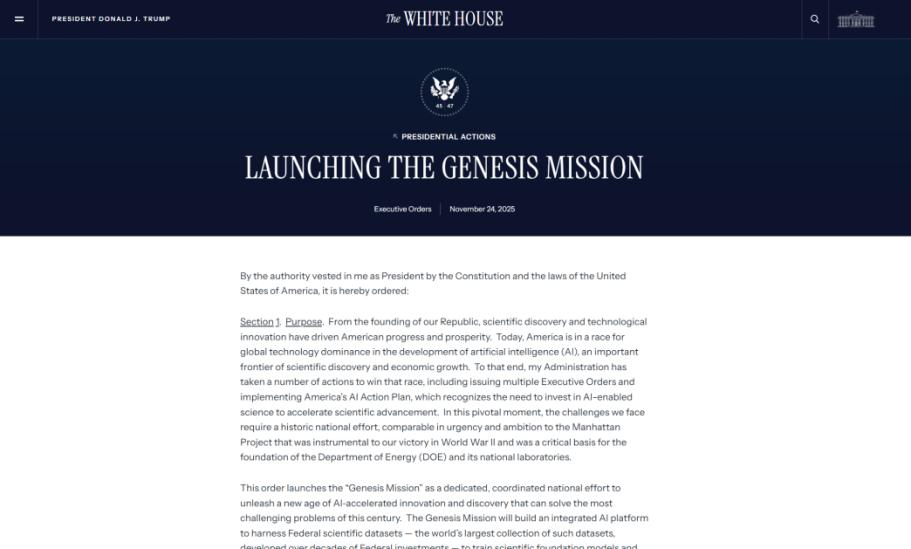
The White House launches "Genesis Mission" (Source: White House official website)
What was the core logic of the Manhattan Project? It was to highly concentrate scattered intellectual resources, industrial production capacity, and military goals to achieve a technological singularity breakthrough in a very short time. Its success didn't lie in fragmented technological innovations but in the direct command of the research system by national will - establishing a closed but efficient "big science" collaboration mechanism, breaking down academic silos, and connecting the entire chain from theory to weapons. Its logic was very straightforward: concentrate resources to accomplish major tasks and remove all obstacles.
Today, "The Genesis Mission" is replicating this logic. Trump intends to concentrate the core competitiveness of the US scientific community to build a national - level super - infrastructure. The most eye - catching part of this order is the instruction for US national laboratories - those scientific research holy places that once gave birth to the atomic bomb and the prototype of the Internet - to fully shift to AI technology research and development. The 17 national laboratories under the Department of Energy will be mobilized as a whole, integrating about 40,000 scientists and engineers. They plan to connect the world's top supercomputers, artificial intelligence systems, next - generation quantum devices, and the United States' most advanced scientific instruments.
Its technological core is to build the "US Science and Security Platform", which will classify and integrate public scientific research data, classified data in specific fields, and national security - sensitive data, and train dedicated AI models for basic scientific research. The goal is to achieve "full - process automation from the proposal of scientific hypotheses to experimental simulation and verification". The scientific data sets accumulated by the federal government over decades, from climate models to gene maps, from material properties to nuclear reaction parameters, will all be used to train a new generation of scientific models.
"Genesis" is taken from the beginning of the Bible, symbolizing "creating the world from nothing". The mission assigned to it by the Trump administration is to build an unprecedented "AI god of science" under government leadership. Once completed, this will be the most advanced, complex, and powerful scientific instrument in the world. Although it won't directly participate in the battlefield, it can define the technological boundaries of future wars.
It's worth noting that the "Genesis" plan didn't come out of nowhere. It is the concrete implementation of the "US AI Action Plan" in July 2025 and the inevitable result of the profound shift in US science and technology policy in the past five years.
Since 2020, the United States has continuously intensified its technological containment of China: entity lists, chip bans, investment reviews, talent blockades... But Trump is no longer satisfied with these defensive measures. The current actions are a more systematic and large - scale offensive strategy.
The "Genesis Mission" also clearly lists six areas as priority directions: advanced manufacturing, biotechnology, critical materials, nuclear fission and fusion energy, quantum information science, semiconductors and microelectronics. All of these areas are the main battlefields in the Sino - US technological game.
In the current situation where Sino - US technological competition is at a white - hot stage, the United States is attempting to rebuild its national technological sovereignty through AI, the ultimate carrier.
Who is Driving this "Genesis"? Silicon Valley Hawks and Tech Accelerationism
If "The Genesis Mission" is the Manhattan Project of the 21st century, then its "Oppenheimer" is not a general from the Pentagon or a politician from Capitol Hill, but a group of billionaires from Silicon Valley who believe in technological salvationism, namely the tech right - wingers.
In this trend, Alexander Karp, the CEO of Palantir, is the most philosophically conscious spokesperson.
Karp's identity is full of contradictions: He holds a Doctor of Law from Stanford University and a Doctor of Social Theory from the University of Frankfurt, yet he heads a software company deeply embedded in the Pentagon's combat system. He often quotes Kant and Weber in congressional hearings while developing AI models for the US military to predict the actions of insurgents.
In the book The Techno - Republic co - written by him and his colleague Nicholas Zamiska, this concern is systematically expressed. They point out that Silicon Valley "has lost its way", leading hundreds of thousands of top technical talents to engage in trivial research and development such as optimizing advertising click - through rates or short - video recommendation algorithms, while ignoring truly urgent challenges such as national security, energy transformation, and basic scientific research.

The Techno - Republic: Hard Power, Soft Beliefs, and the Future of the West by Alexander Karp and Nicholas Zamiska
The rise of artificial intelligence has finally sounded the alarm. Karp points out that AI is not just a tool but the first real challenge to humanity's creative status. If the private sector is allowed to dominate its development, the result will only be "non - creative destruction", with grand narratives deconstructed, common beliefs collapsing, and society falling apart.
At that time, facing an opponent also promoting AI development with national will, the United States will have no chance of winning.
Therefore, he repeatedly calls on the tech community to regain the sense of responsibility from the era of the Manhattan Project. This concept has gone beyond slogans and been translated into concrete political actions.
Palantir itself is a testing ground. As early as 2011, Palantir, with its powerful data integration ability, participated in the operation to kill Osama bin Laden. During the Russia - Ukraine conflict, the accurate strikes and repeated surprise attacks of Ukrainian drones were strongly supported by Palantir's Gotham data system... Its Gotham and Foundry platforms have been deployed in the US military's Joint All - Domain Command and Control system, the Department of Homeland Security's border monitoring network, the Centers for Disease Control and Prevention's epidemic response model, and even the intelligence fusion system on trans - national battlefields.
Karp makes no secret of his stance. In his view, tech companies should not be neutral technology suppliers but firm supporters of the values of the United States and its allies. Therefore, what he promotes is not a tech utopia detached from the nation but a community where technology is realigned with national missions.
More importantly, he is not alone. In recent years, the tech elites in Silicon Valley in the United States have increasingly embraced right - wing ideas, showing a "right - turn" tendency in aspects such as corporate structure and capital trends.
The core of this group is a close - knit circle called the "PayPal Mafia", which includes many well - known names: Peter Thiel, Elon Musk, David Sacks, Keith Rabois... They jointly founded PayPal and then ventured into venture capital, social media, space exploration, and defense technology fields respectively. Now, they have formed a network spanning capital, technology, and power, deeply involved in the core of Washington's power like never before, converting personal wealth and value propositions into political capital.
Peter Thiel, the spiritual leader of the "PayPal Mafia" and a core figure of the tech right - wing, bet on Trump as early as 2016 and then became the political mentor and biggest financial backer of J.D. Vance. According to NBC statistics, at least ten high - ranking officials in Trump's second - term administration were Thiel's former employees, investment partners, or foundation staff.
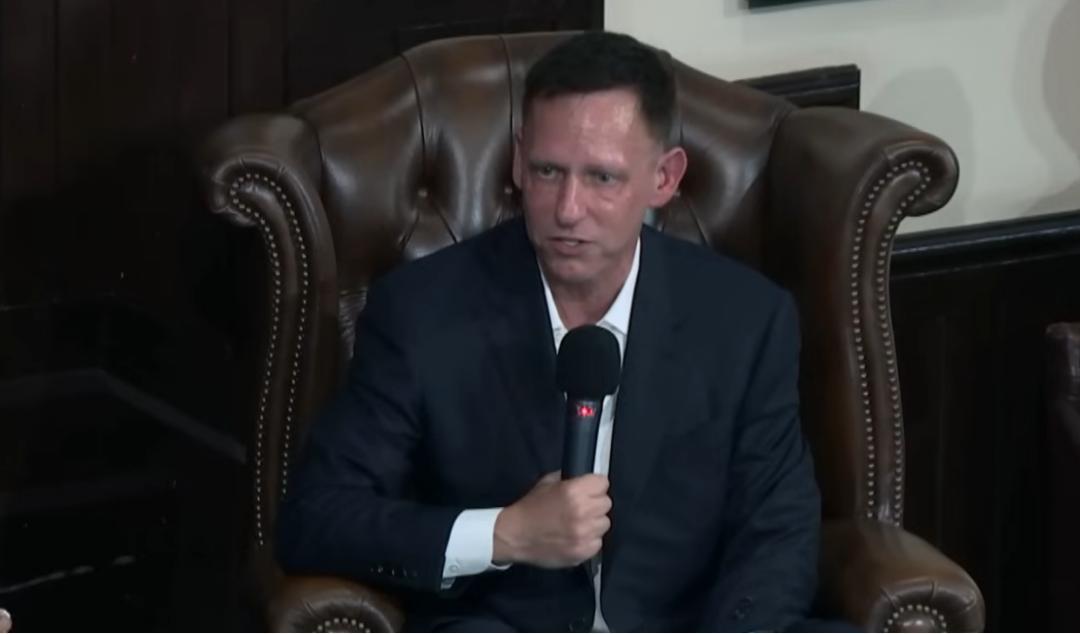
Peter Th