The "national team" takes action, and the recyclable Long March 12A rocket makes its maiden flight.

At 10:00 on December 23rd, the Long March 12A Y1 carrier rocket was launched from the Dongfeng Commercial Space Innovation Experimental Area, and a simultaneous attempt was made to vertically recover the first - stage rocket.
The launch successfully achieved the goal of the second - stage entering orbit. The second stage of the carrier rocket entered the predetermined orbit, but the first stage failed to be successfully recovered. The specific reasons are being further analyzed and investigated. As China's second liquid - oxygen methane carrier rocket to attempt recovery on its first flight, this mission has accumulated valuable data and practical experience for subsequent iterations and optimizations of related technologies.
As a new - generation medium - sized liquid carrier rocket in China, the Long March 12A is a recoverable configuration under the unified technical system of the Long March 12 series. It is designed to meet the high - frequency launch requirements of low - orbit satellite constellations and focuses on enhancing the first - stage recovery capability. Its first flight not only means the debut of this new configuration but also marks a crucial step for the national space system in the direction of "engineering application of orbit - capable recoverable carrier rockets".
Zhao Jincai, a former expert in the general system of carrier rockets at the Eighth Academy of China Aerospace Science and Technology Corporation, told Tencent Technology: "This is a deep integration of the overall system of the national team and the engine technology of commercial aerospace. The overall design is undertaken by the Eighth Academy of Aerospace, while the engine system comes from a commercial aerospace enterprise. This is an important model innovation in the history of China's carrier rocket development, reflecting the combination of the 'national system + market mechanism'."
In the key technical direction of recoverable carrier rockets, commercial aerospace is also intensively carrying out engineering verification. On December 3rd, the Zhuque - 3 developed by a commercial aerospace company completed the first systematic flight verification of the "orbit - entry + first - stage recovery process" for China's large - scale liquid carrier rockets. Although the first - stage recovery in this mission failed to achieve the planned soft landing, most of the key links of the orbit - entry capability and recovery process had been verified.
Against the background of the pre - planning research for the 15th Five - Year Plan being launched and the continuous increase in the demand for large - scale low - orbit satellite constellation networking in China, the first flight of the Long March 12A is an important exploration for the national team and commercial aerospace to jointly promote the recoverable technology route.
01 About the Long March 12A
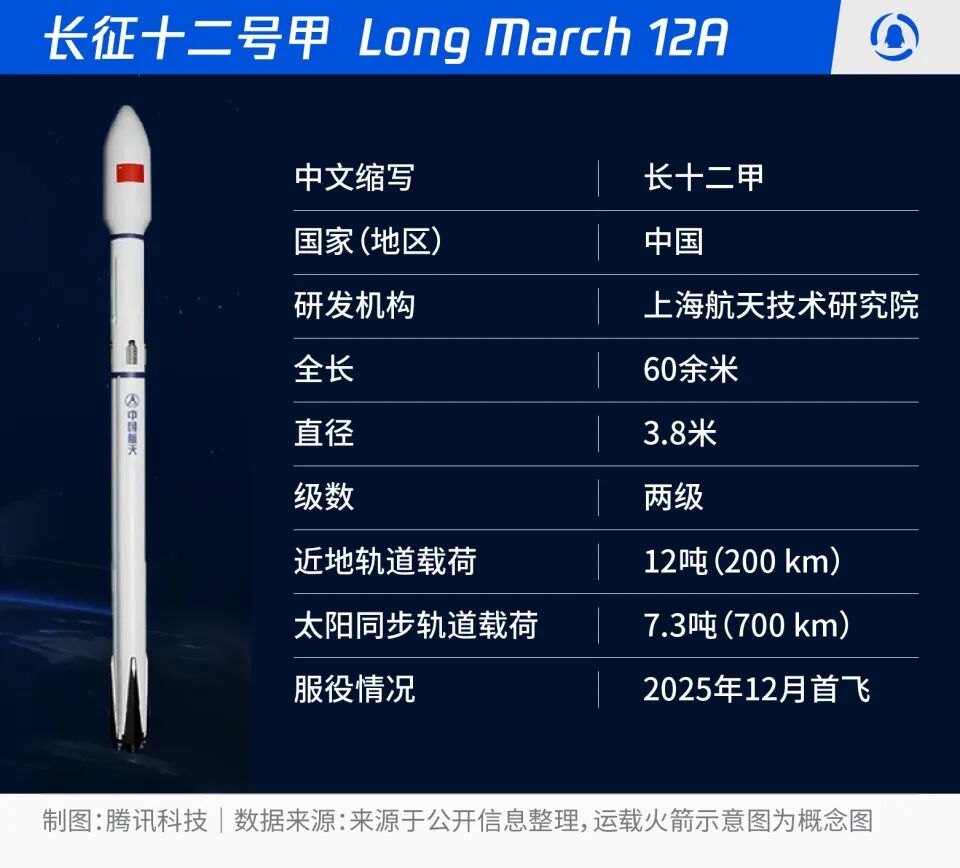
According to the data, the Long March 12A is a two - stage rocket, about 60 meters long, with a rocket body diameter of about 3.8 meters and a take - off mass of 433 tons. It can be equipped with fairings with diameters of 4.2 meters and 5.2 meters. The first stage is equipped with 7 parallel liquid - oxygen methane engines (the "Longyun" engine), and the second stage is equipped with 1 vacuum - version YF - 209V liquid - oxygen methane engine.
In terms of carrying capacity: the carrying capacity in a low - Earth orbit (LEO) at an altitude of 200 kilometers is 12 tons, and the carrying capacity in a sun - synchronous orbit (SSO) at an altitude of 700 kilometers is 7.3 tons.
The technical route of the Long March 12A is not a "radical" subversive innovation but a forward - looking layout based on China's mature disposable liquid carrier rocket engineering system.
First of all, the Long March 12A uses liquid - oxygen methane propellant. Methane engines have the advantages of no carbon deposition, easy maintenance, and being suitable for rapid reuse, but their engineering application experience is relatively limited. This technical route is more forward - looking, but it also requires more flight verification to prove its reliability.
China's Long March series of carrier rockets have gone through the process of evolving from traditional disposable rockets to a new generation of "green rockets" and then to reusable ones. Zhao Jincai, a former expert in the general system of carrier rockets at the Eighth Academy of China Aerospace Science and Technology Corporation, told Tencent Technology: "In the early days, the Long March 2, 3, and 4 series focused on reliable orbit entry and used propellant systems with relatively high safety and environmental constraints. At the beginning of this century, the project of a new generation of carrier rockets was launched, shifting to clean propellants such as liquid hydrogen and liquid oxygen, and liquid oxygen and kerosene to build a complete spectrum of carrying capacities. With the breakthrough of liquid - oxygen methane engines, reusability has gradually entered the engineering stage, and the Long March 12A has become an important node in this evolution."
In terms of pre - design, sufficient space is reserved for reuse. The technology of recoverable rockets involves several key difficulties: re - entry control, power throttling, differential control, and landing - phase stability.
This pre - design means that the rocket is designed for reuse from the very beginning, rather than being modified and retrofitted after the basic model is finalized. For example, strength margins are reserved in the structural design, navigation algorithm modules required for recovery are integrated into the control system, and the power system has the ability of deep variable thrust. These designs may not be fully demonstrated in the first - flight stage, but they pave the way for subsequent technical verification.
02 Difficulties and Challenges of the First Flight
From a global perspective, SpaceX's Falcon 9 has also gone through a similar technical evolution process. The earliest versions of the Falcon 9, v1.0 and v1.1, made multiple attempts at sea and land recovery between 2013 and 2015, but all failed. It was not until December 21, 2015, that the full - thrust version of the Falcon 9 successfully achieved the first - stage rocket land recovery for the first time. It took SpaceX about three more years from the first successful recovery to the normalization of reuse in 2018. This process shows that the maturity of recoverable technology requires a large amount of flight data accumulation and continuous improvement.
Zhao Jincai said that the main difficulty in the development of the Long March 12A lies in transforming it from a "one - time flyer" to a "multi - use rocket". There are several aspects to this:
First of all, although liquid - oxygen methane engines are cleaner and more suitable for repeated ignition, they still require a large amount of engineering verification to work stably at different altitudes and weights;
Secondly, during the recovery process, the rocket needs to maintain precise control in complex states such as high - speed re - entry, deceleration, and vertical descent, which places near - limit requirements on the flight control system.
At the same time, the rocket body structure needs to be stronger without being too heavy, otherwise, it will affect the carrying capacity.
In addition, with the coordinated promotion of the national team and commercial aerospace, the challenges in technology, engineering, and system are superimposed, making this a highly complex systematic project.
The Long March 12A is one of the few rocket models in China that adopted a new final assembly station during the development stage. The new station system emphasizes digitization, modularity, and high consistency, aiming to improve scalability and manufacturing quality. Traditional rocket final assembly mainly relies on manual experience and multiple rounds of offline testing, while the new station introduces means such as three - dimensional digital assembly, full - process digital tracking of the manufacturing process, multi - level automated testing, and modular final assembly strategies.
03 China's Recoverable Rockets Form a "Complementary Pattern"
In China's space system, the development of recoverable rockets shows a situation where the national team and commercial aerospace are advancing side by side. This diversified exploration pattern not only reflects the technical route choices of different entities but also reflects their respective mission orientations and development strategies.
National Team: Prioritize Stability and Systematized Construction
Currently, the national space system's layout in the field of recoverable rockets includes models such as the Long March 8 and the Long March 12A. The Long March 8 has carried out preliminary technical verification for the first - stage recovery test, and the Long March 12A is a new platform targeting the medium - capacity market. The common feature of these models is the emphasis on the construction of systematic capabilities, pursuing long - term technical accumulation and engineering foundation.
The development of national - team rockets follows a strict quality management system and a phased verification process. From the scheme demonstration, prototype development to the production of the final model, each stage has clear technical indicators and acceptance standards. Although this systematic development model has a longer cycle, it can ensure the high reliability of the rocket to meet the needs of important national tasks.
The Long March 12A undertakes the launch requirements of medium - sized tasks, promotes the modernization of the manufacturing system, and provides platform - based support for subsequent recoverable verifications. The first flight is just the first step in this process, and there will be more tests and technical verifications in the future.
Commercial Aerospace: Rapid Iteration Attempts
On December 3rd, the Zhuque - 3 Y1 carrier rocket developed by LandSpace had its first flight, and the second - stage rocket successfully entered the predetermined orbit. This was China's first attempt at recovering an orbit - capable rocket.
The Zhuque - 3 also uses liquid - oxygen methane propellant and a stainless - steel rocket body structure, with a more forward - looking technical route. The stainless - steel rocket body can significantly reduce manufacturing costs and shorten the production cycle, and its high - temperature resistance makes it more suitable for multiple re - entries into the atmosphere. The non - carbon - deposition characteristic of the liquid - oxygen methane engine theoretically allows for rapid reuse without off - rocket inspection after recovery.
The advantages of commercial aerospace enterprises lie in short decision - making chains, fast response speeds, and strong fault - tolerance capabilities. Although the risks are relatively high, they can obtain actual - combat data more quickly. Even though the recovery was unsuccessful this time, the team has accumulated flight data for key links, providing first - hand information for subsequent improvements.
In addition to the Zhuque - 3, according to public data, many commercial aerospace companies, such as Tianbing Technology's Tianlong - 3 and CAS Space's Lijian - 2, are intensively preparing for the first flights of their reusable rockets. These models cover different capacity levels and technical routes, demonstrating the innovative vitality of China's commercial aerospace.
Formation of the Complementary Pattern
The exploration of recoverable rockets by the national team and commercial aerospace is not a simple competitive relationship but has formed a complementary development pattern. The national team undertakes important national tasks, pursuing high reliability and systematic capabilities, and its technical accumulation provides basic support for the entire industry. Commercial aerospace targets market demand, pursuing cost - effectiveness and rapid response, and its flexible mechanism can accelerate technological iteration.
Zhao Jincai said: "This dual - track system helps to form a healthy competition and cooperation relationship. The technological breakthroughs of the national team can provide references for commercial aerospace, and the innovative explorations of commercial aerospace can also provide new ideas for the national team." For example, in fields such as satellite constellation networking and commercial launch services, both can give full play to their advantages and jointly promote the progress of China's space technology.
04 The Core Launch Base in the Constellation Era
The significance of the first flight of the Long March 12A far exceeds that of a single rocket launch. It marks that China's national space system has entered the engineering practice stage from the concept exploration stage in recoverable rocket technology, laying the foundation for the future construction of low - cost and high - frequency launch capabilities.
In the global rocket market, medium - sized carrying capacity is the key range in the satellite constellation era. Whether it is a communication constellation, a remote - sensing constellation, or a navigation enhancement system, most of their networking relies on medium - sized carrying capacity. The Long March 12A is positioned in this range, which is beneficial for improving the gradient structure of China's launch system.
From the perspective of actual demand, low - orbit satellite networking has entered the era of tens of thousands of satellites. Such a large - scale networking task poses unprecedented challenges to launch capabilities in terms of cost, frequency, and rhythm control. Traditional disposable rockets are difficult to support the long - term high - density networking demand in terms of economy and launch rhythm, and recoverable rockets have almost become the only feasible engineering path.
In this context, the subsequent maturity of the Long March 12A not only concerns the success or failure of a single rocket model but also directly affects China's launch efficiency, network - replenishment ability, and overall cost curve in the future satellite Internet main battlefield. Its strategic significance has risen to the core support level of the national - level space infrastructure capacity.
This article is from the WeChat official account "Tencent Technology", author: Li Hailun. Republished by 36Kr with authorization.