Does the world still exist when you close your eyes? The ultimate answer from a century of quantum mechanics: It all depends on your "imagination".
In 1925, the 23-year-old German physicist Werner Heisenberg set foot on an island in the North Sea of Germany - Helgoland.
There, the air was filled with the smell of sea salt.
It was on this remote island that he did what seemed "absurd" at that time.
He abandoned the intuitive image of "electrons orbiting the nucleus like planets" and instead used a set of abstract mathematical "matrices" to describe the atomic world. This invisible and intangible form soon became the first cornerstone of quantum mechanics: matrix mechanics.
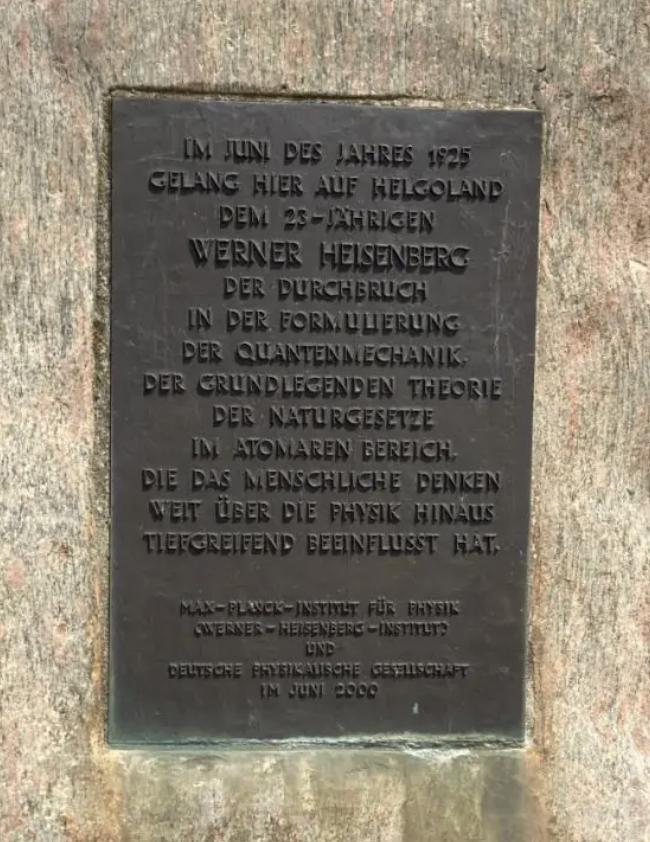
For this reason, the Max Planck Institute erected a memorial plaque on the island.
Not long after, Schrödinger also came up with his own "wave equation". He described electrons with waves and rephrased "where the electron is" as "the probability of the electron appearing somewhere".
For the same set of experiments, on one side was the matrix and on the other was the wave. They seemed to illuminate the same fog from different sides.
Soon, the calculation results sketched an unsettling picture:
At the atomic scale, some physical quantities simply cannot be precisely measured simultaneously;
The values of some other quantities actually depend on "how you measure them".
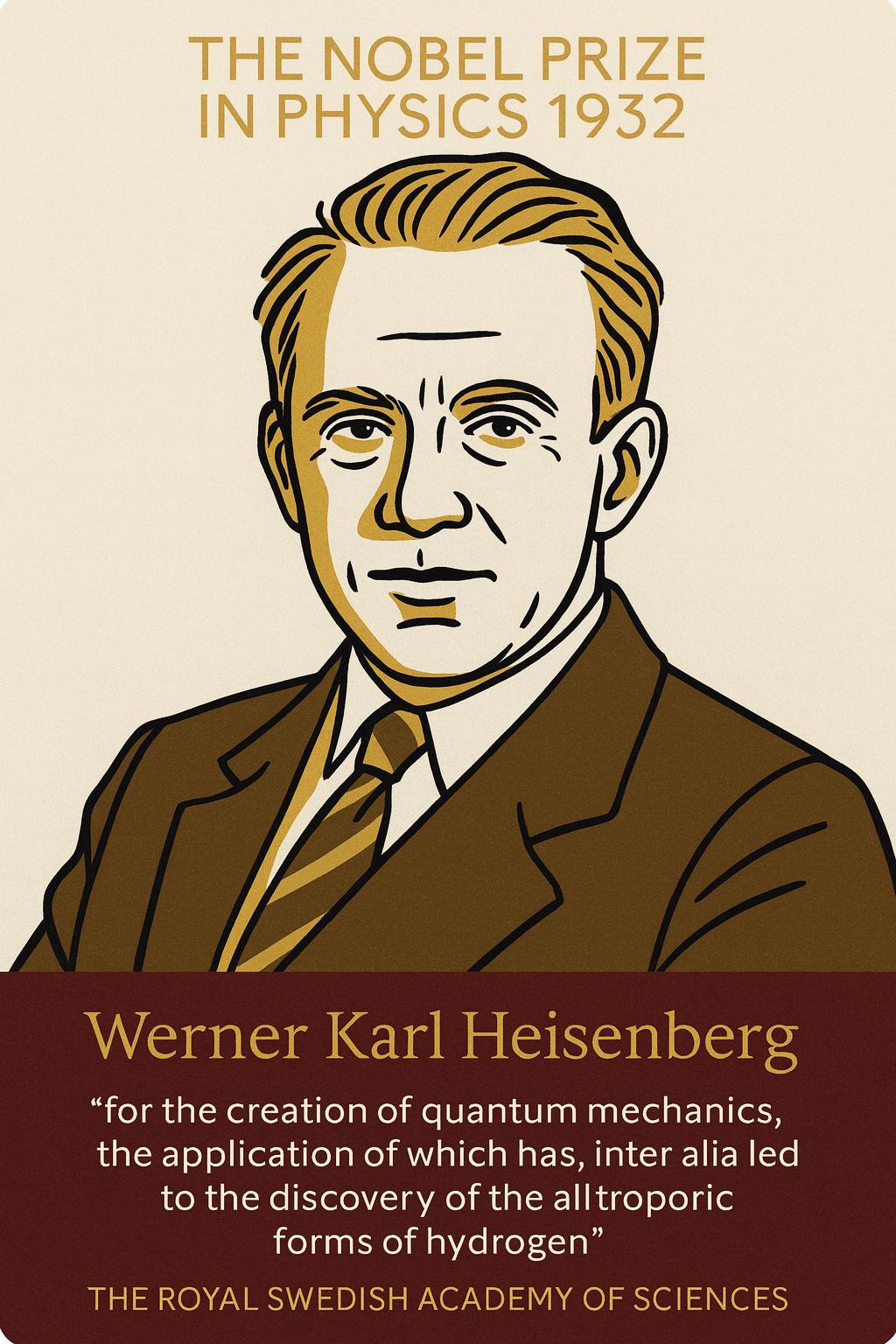
After winning the Nobel Prize in Physics in 1932, Heisenberg wrote a sentence that has been quoted countless times since:
"What we observe is not nature itself, but nature exposed to our method of questioning."
Now, we finally seem to be seriously asking: How "literal" is this sentence exactly?
From Helgoland, ask again: What is reality?
A hundred years later, in 2025, more than 300 of the world's top physicists boarded this island again.
They came to celebrate the "centenary birthday" of quantum mechanics.
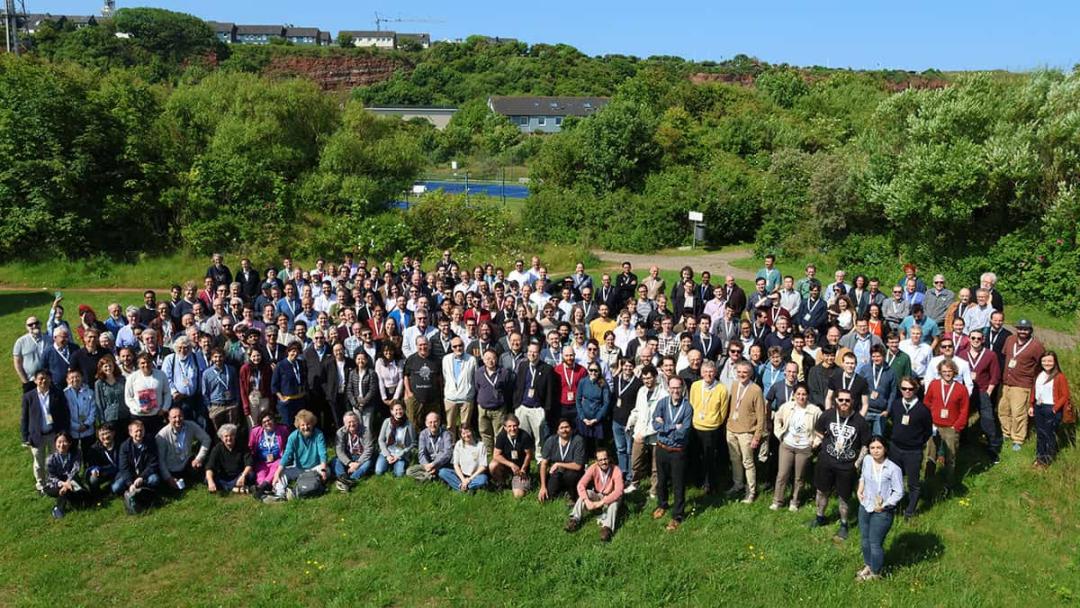
The venue was not large, and two people stood out in particular: Carlo Rovelli and Chris Fuchs.
One had curly hair, wore a dark sweater, and spoke with a strong Italian accent; the other had a strong American accent, spoke quickly, and made big gestures.
What they were arguing about was a problem that quantum mechanics has not truly solved in a hundred years: What kind of world is being described behind these equations?
This is the so-called "interpretation problem of quantum mechanics".
Everyone agrees on the equations, and they have been verified by experiments time and time again. The real controversy lies in:
When we say "wave function", "superposition state", and "collapse",
Are we really talking about "what the world is like", or just "how much we can know about the world"?
The most common statements can be roughly summarized in a rather crude way:
Copenhagen interpretation: Regard "measurement" as one of the basic premises of the theory.
Don't ask who is measuring, and don't explain why the collapse occurs.
The slogan is: Shut up and calculate.
Many-worlds interpretation: Simply say that there is no collapse.
Every possible result will occur in different branch universes. You just happen to be in one of the branches.
Hidden variable theory (such as Bohmian mechanics): Want to uphold strict determinism, so introduce invisible "hidden variables". The price is to accept some kind of "action at a distance" - things far away can instantly affect each other.
On the surface, this is a dispute over the "philosophical tastes" of several groups of physicists. But it actually concerns a very real problem:
Can we, and how, apply quantum mechanics to the "macroscopic world". For example, systems like you, me, and the whole laboratory?
To push this problem to the extreme, the American physicist Eugene Wigner designed a famous thought experiment in 1961: "Wigner's friend".
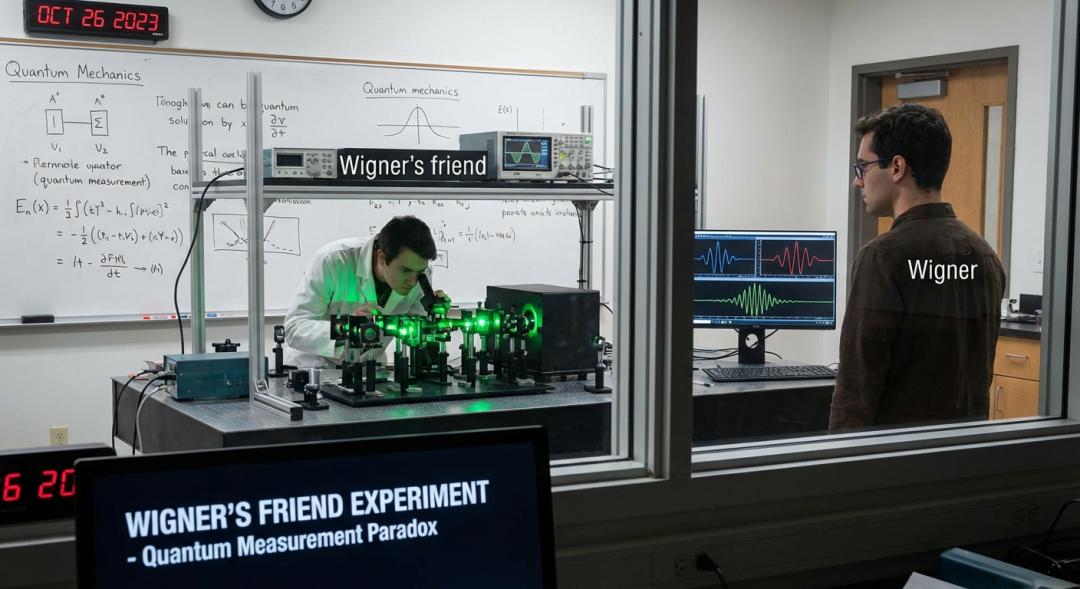
Wigner's friend: Whose reality counts?
Imagine a laboratory that is completely soundproof, lightproof, and isolated from the world.
Your friend Gimena is inside, measuring an atom in a superposition state of "being here and there at the same time".
She presses the button - instantly, she "sees" the atom on the left. For her, the world is determined: the atom is on the left.
And you - Wigner, standing outside the laboratory, see nothing. According to quantum mechanics, you must describe the entire laboratory, including the instruments, the atom, and even Gimena herself, as a huge quantum system.
In your eyes, Gimena has not "really" completed the measurement; she and the atom are still in a superposition state of "she sees left" and "she sees right".
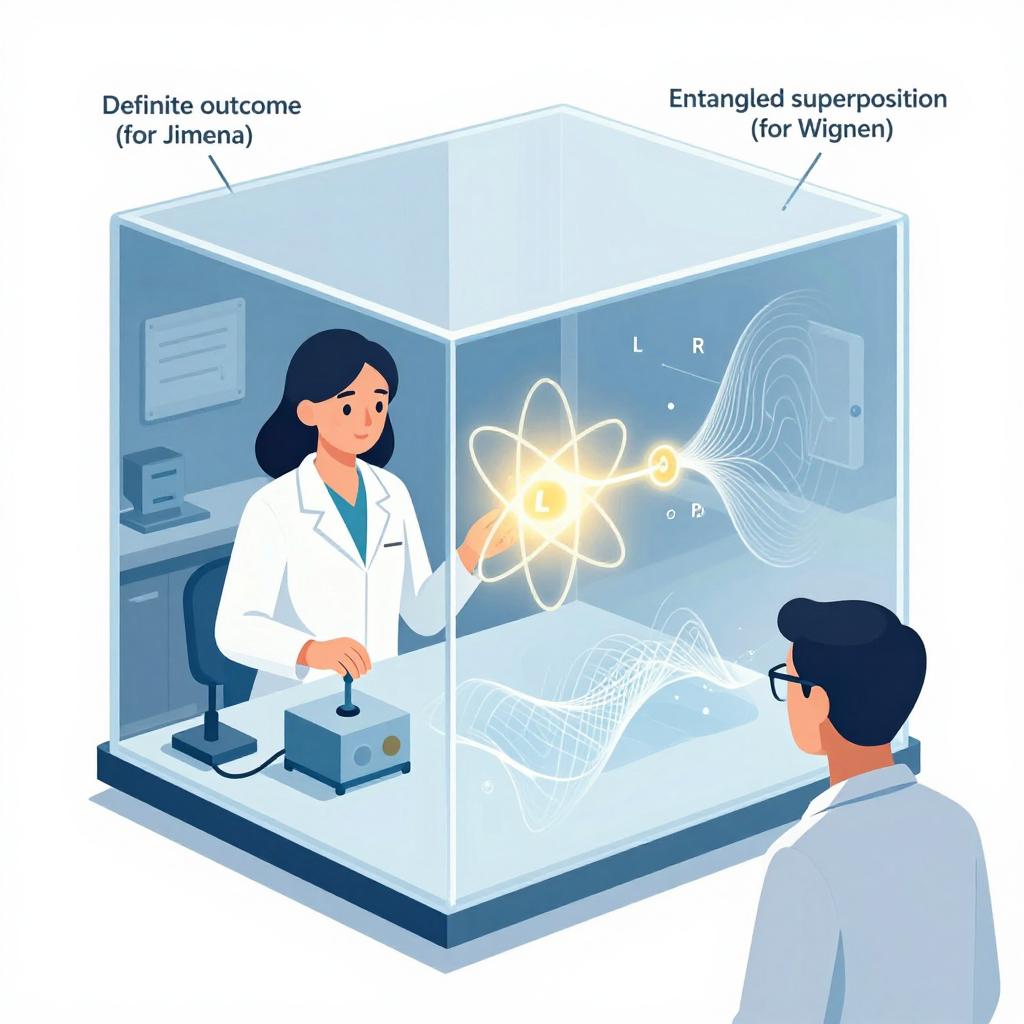
The problem is, Gimena says, "I saw it with my own eyes!"
You say, "No, you haven't 'collapsed' yet."
Whose reality is more "real"? If both are right, then "the fact" is no longer unique.
RQM: The world is woven by relationships
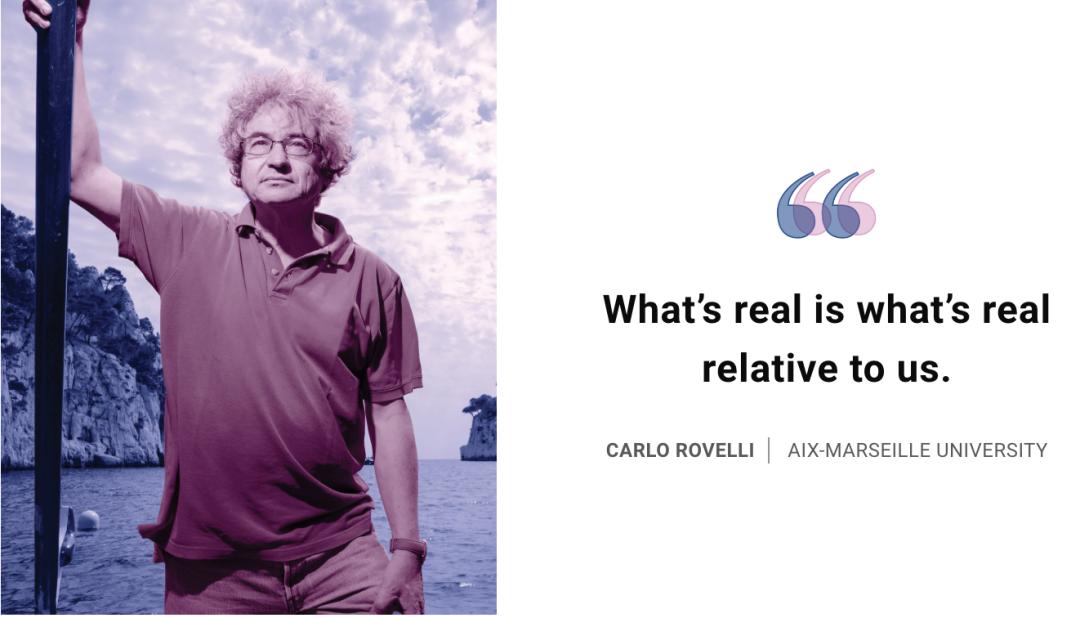
For the above problem, Carlo Rovelli's answer is "Relational quantum mechanics" (RQM).
In this interpretation of Wigner's friend, a relational fact is established between Gimena and the atom. For her, the atom is on the left. Another set of relational facts is established between Wigner and the laboratory system. For him, the system is in an entangled superposition. Both descriptions are real.
Relational quantum mechanics points out that physics should not pursue the cosmic wave function from a "God's perspective", but should describe the observable properties of A relative to B. The world is woven by countless local perspectives, without a unified narrative.
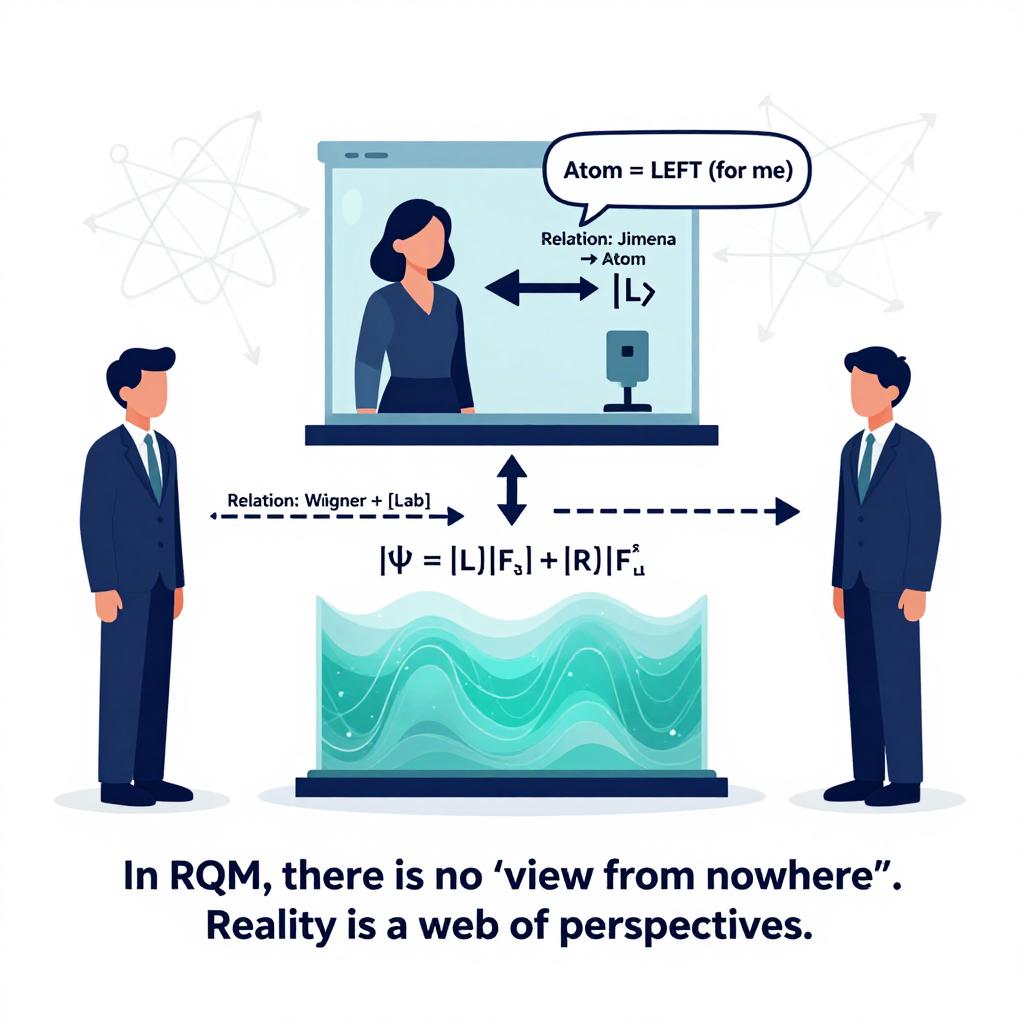
In relational quantum mechanics, reality does not exist in isolated entities but is born from the interactions between things.
A stone, because of the sunlight reflected from its surface and the fossils sealed inside, already "carries" a vast amount of information about the world. Carlo Rovelli said, "I am real relative to a stone" - the shadow you cast is the "relational fact" established between you and the stone.
Reality is not independently existing inside something, but is born from interactions.
QBism: The wave function is a "personal user manual"
On the other side of the debate is the subjective Bayesianism (QBism) proposed by Chris Fuchs.

What QBism does is even more radical:
It directly rewrites the wave function from "the objective state of the world" into a personal probability user manual.
This interpretation holds that the quantum state is not an objective description of the world, but a mathematical encoding of an agent's inner beliefs. Quantum mechanics will indicate to you what the future measurement results will be.
Regarding Wigner's friend, subjective Bayesianism believes that Gimena's wave function is the encoding of her beliefs about the future behavior of the atom, which is updated as she obtains the results. Wigner's wave function outside the house is the encoding of his beliefs about the future behavior of the entire laboratory (including Gimena), which has not been updated yet. The two descriptions are the expectations of different agents, not the state of the same objective entity.

The essence of subjective Bayesianism is to give the experiencing subject an irreplaceable central position far beyond any physical system. It makes the wave function not the state of the world, but a "user manual" for the observer to interact with the world.
All roads lead to Rome: Quantum mechanics embraces the observer again
Interestingly, the two sides of this debate are not trying to defeat each other, but are trying to incorporate the observer into the description of quantum phenomena.
Carlo Rovelli, the advocate of relational quantum mechanics, said, "QBism and relational quantum mechanics are extremely, extremely similar... To me, they are the same thing."
Chris Fuchs, the supporter of subjective Bayesianism, believes that the misunderstanding stems from the fact that both sides' arguments are still in the "poetic stage" and lack precision.
Compared with the most traditional Copenhagen interpretation that does not consider the observer, both relational quantum mechanics and subjective Bayesianism emphasize the special status of the observer. The return of the observer is just as the founder of quantum mechanics, Heisenberg, once said, "What we observe is not nature itself, but nature's response to our way of questioning."
A survey of more than 1,100 scientists by the journal Nature in 2025 showed that although the "Copenhagen interpretation" still led with a 47% vote, the relational and informational frameworks (such as RQM + QBism) had won 21% support, and the support rate was significantly higher among doctoral students and young researchers.
Michel Devoret, the winner of the 2025 Nobel Prize in Physics and the inventor of macroscopic quantum effects, also publicly admitted that Fuchs' reconstruction of quantum equations based on QBism directly inspired the quantum experiment he designed.

In addition, researchers simulated the "Wigner - friend" system with three pairs of entangled photons, and the results indeed showed observer dependence.
Further empirical tests will be carried out by artificial intelligence agents running on large - scale quantum computers. As "observers" with increasing complexity, they will judge in a completely isolated and controlled environment whether reality really depends on macroscopic observers as described by subjective Bayesianism.
Reality: Whose business is it between whom?
Markus Müller from the Vienna Institute of Quantum Optics and Quantum Information made the following wonderful analogy about why quantum mechanics re - introduces humans as observers:
1. The time dilation in relativity (which GPS must calibrate) is "irrelevant" in daily life, but it is the cornerstone for understanding the universe.
Similarly, the "relational" and "non - absolute" nature of reality may be the indispensable meta - rules for future physics, especially in its new fields of integration with consciousness, information, and even AI.
At the end of the conference, standing in the sea breeze on Helgoland, Rovelli said half - sentimentally and half - relieved, "Relational quantum mechanics dispels a kind of anxiety because I can't reach the ultimate reality. For me, reality is the reality relative to us."
Fuchs then added with a touch of mysticism, smiling, "If quantum mechanics is telling us that what I do in it makes sense... then, that's already enough to make life worth living."
For quantum mechanics, this may be a new starting point:
Reality is not a line written in the universe's instruction manual, but a story jointly written between each observer and the world.
The three schematic diagrams in this article were drawn by Z - image.
Reference materials:
https://www.science.org/content/article/100 - years - quantum - mechanics - redefining - reality - us - center
https://