AI version of street games, reviving the Chinese street vibe
Artificial Intelligence (AI) always seems to have an air of sophistication. However, the most appealing aspect of a great technology lies in its ability to integrate into the mundane details of everyday life.
Currently, AI is transforming the street stalls in China. From AI perfume blending, AI bracelets, AI billiards, AI chess to AI haircuts, a series of down - to - earth applications are emerging. Whether these AI - powered street stalls will have long - term success remains uncertain, but they have undoubtedly added a unique charm to the streets.
AI Sweeps Through Street Stalls
"Curious about the perfect perfume for you? Come and scan the QR code."
In front of a small booth at the Beijing National Convention Center, a long queue had formed. People were waiting for a young man at the end of the queue to squeeze drops of perfume from a dozen or so bottles for blending.
On the other side of the queue, people took out their phones and scanned the QR code to enter a mini - program. All they needed to do was enter their names and MBTI personalities, and a "perfume formula" tailored to them would be generated. There was a large sign beside it that read AI Perfume Blending.

A young woman scanned the QR code and got her perfume formula. While waiting in the queue for her perfume to be made, she was curious, "What on earth does my personalized perfume smell like?"
The booth owner was sitting beside the stall. She said that her traditional perfume business was quite large in the Jiangsu, Zhejiang, and Shanghai regions, but she had always been thinking about how to make her perfumes more "personalized." "It seems that AI can just play a role here," the owner said.
Actually, there's nothing too complicated behind the mini - program that people scan. The owner embedded a Wenxin large - language model in it. After people enter their names and MBTI personalities, the large - language model can give relevant answers.
"Whether it's accurate or not, at least it's more interesting than just buying a bottle of perfume directly. If you try to blend perfume by yourself, it's both confusing and time - consuming," said the young woman in the queue.
The booth owner said, "Currently, AI perfume blending is only used at some fair exhibitions for trial. Our traditional business is still selling on e - commerce platforms. But the queue is always quite long, which shows that there is a certain demand from customers."
Actually, if you observe the streets carefully, you'll find that AI is gradually changing the street scenes in China.
At the Panjiayuan Antique Market in Beijing, "AI Bracelets" are selling like hotcakes.
Some regular visitors to the market have started using DeepSeek to help them match a traditional Chinese bracelet while strolling around. All they need to do is enter their budget and tell it "use red sandalwood as the main string," and the large - language model can generate a table showing how to match the beads and the market prices.
What's more interesting is that some vendors also want to ride on the wave of AI. The self - media blogger Feng Ge saw a booth at Panjiayuan with a sign that read, "Ordinary bracelet beads, extraordinary AI technology."
Each bracelet displayed by the booth owner has a special bead with a chip inside. Visitors just need to touch it with their phone's NFC (Near Field Communication) function, and it can send them their daily luck based on their names and locations.
If these are no longer surprising, AI Billiards and AI Chess are a bit more "technologically advanced."
In Guangdong, a business model called the "Pioneer of AI Self - service Billiards" has been widely promoted by its owners.
The so - called "AI Billiards" involves installing a projector and a camera above the billiard table. Through algorithm recognition, the "path for the ball to go into the pocket" is projected onto the table. Beginners can practice their billiards skills along this path.
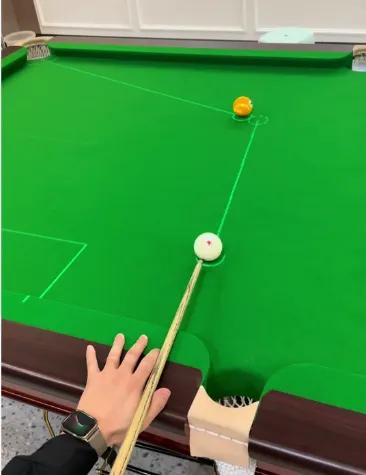
Photo | AI has drawn the path for you to score a goal
If you're past the age of playing billiards and have entered the "chess - playing stage," instead of interfering in the street chess games of the old men, you can find "AI Chess" on the streets in Guangdong, as a South Korean self - media blogger discovered.
An AI in the form of a robotic arm plays chess with you. It costs 5 yuan per game for adults, and it's free for children. It's said that AI Gomoku has also emerged, which might be suitable for parent - child families.
There's also AI Haircut. With the newly launched Qianwen large - language model, users just need to click on "video call," and Qianwen can recommend a hairstyle based on their head shape. Some barbershops had already made small - scale attempts before the launch of Qianwen. Finally, you don't have to endure a random haircut from the barber.
Behind the Street Stalls: AI's Breakthrough in Application Scenarios
Is it easy to start a street - stall business with AI elements?
The owner of the AI bracelets at Panjiayuan said that more than 10,000 AI bracelets with NFC function have been sold, probably riding on the wave of the bracelet trend in recent years.
AI Chess only costs 5 yuan per game, so the customer unit price is not high. Its success depends on the frequency of street chess games and how long people's curiosity about it can last.
According to public information, AI Billiards starts at 40 - 50 yuan per hour, which is much more expensive than traditional billiards. In some places, traditional billiards only cost 9.9 yuan per hour, so the two types of billiard tables are competing in the market.
Given this level of revenue, what kind of investment does an ordinary entrepreneur with no technical background need to make?
Based on the market situation, the following business models have emerged for AI street stalls.
The first is the AI product franchise model. Startup cost: Hundreds of thousands or more.
From a macro perspective, China already has many large - scale foundational models with over 100 billion parameters. Thanks to this infrastructure, they have provided a fertile ground for small and medium - sized vertical models, allowing many new terminal business models to flourish.
AI Billiards is backed by an AI startup company in Guangdong. The company has developed an "intelligent billiard table analysis system," which can be called a "billiards large - language model."
The specific principle is to capture the movement trajectory of the billiard balls through cameras and sensors, and then calculate with the AI large - language model to generate a "solution for the ball to go into the pocket."
Some KTVs have developed a system that can be called a "singing large - language model." By analyzing the voices of many singers, it forms a model and changes the game rules in traditional KTV rooms through evaluation, scoring, and battles.
For these vertical large - language models, the technology developers have built the technical backend and then packaged consumer products such as "AI KTV" or "AI intelligent billiard tables" at the terminal for franchise. Entrepreneurs need to join the franchise to enter the market.
The entry threshold starts at hundreds of thousands of yuan, which is a certain barrier. Whether they can make money depends on factors such as location, business management ability, and how long consumers' curiosity lasts.
The second is to buy hardware + retail. Startup cost: Less than ten thousand yuan.
For AI Chess, its AI intelligent hardware - the AI chess robot is already on sale on e - commerce platforms. The price of a single AI chess robot ranges from 500 to over 2,000 yuan. This means that the upfront investment for street - stall entrepreneurs is controllable, which is a low - cost startup. However, whether they can make money still depends on whether the passers - by on the street have enough interest.
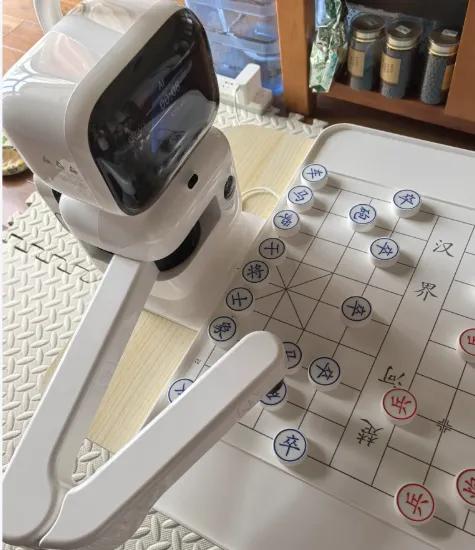
Photo | AI Chess Robot
The third is the self - development model for entrepreneurs. The emergence of a large number of user - friendly AI development tools has supported entrepreneurs with no technical background, reducing startup costs and increasing efficiency. Startup cost: Relatively low, eliminating the need for upfront development.
AI is a productivity tool, generally divided into two types. One is for professional developers, such as Tongyi Lingma launched by Alibaba and Claude Code launched by Anthropic; the other is to provide AI productivity tools for ordinary people without coding experience, such as Coze launched by ByteDance.
AI perfume blending, seemingly just a mini - program, belongs to the user - friendly development category.
In the past, if you hired a professional developer to create a template, the annual fee could be a few thousand yuan for a cheaper option, or 20,000 yuan for a more expensive one. Custom - made development would also cost around 20,000 - 30,000 yuan. After the mini - program is developed, if you want to provide personalized answers to users, the development difficulty and cost will increase.
The person in charge of AI perfume blending found a user - friendly AI development program in the market. She said that she doesn't know how to code at all. She just described her requirements in plain language, and the Miaoda AI application tool helped her create a mini - program. It can also generate personalized answers through the natural language model, not only realizing her idea but also significantly reducing the development cost.
There are many such application tools, such as JD Cloud's JoyBuilder, ByteDance's Coze, and Alibaba's Dify. They have significantly reduced the upfront cost of starting an AI street - stall business, allowing entrepreneurs to start using them right away. This is also a technology application route that many large companies are taking.
Agent Infra: The Infrastructure Behind the Street - Stall Economy
The street - stall economy in the AI era emphasizes the user experience.
When playing chess with AI, will it play randomly without following the rules or stop working halfway? Will AI Haircut recommend a strange hairstyle? This requires AI technology to reduce hallucinations and maintain system stability.
This involves the deep - level infrastructure of AI.
From an industry development perspective, the emergence of various AI - powered street stalls is due to the fact that China has rapidly completed the infrastructure construction of large - scale AI models in the past three years. Now, it's entering the next stage of AI - AI Agent Infrastructure (Agent Infra) and the era of intelligent agent applications.
Take the "Miaoda" application tool used in AI perfume blending as an example. It seems like a chaotic AI application, and it's hard for the public to understand how it can create a mini - program for AI perfume blending just based on the entrepreneur's description. In fact, there are multiple agents working behind the scenes.
It's reported that more than a dozen intelligent agents are involved in the AI development tool, including demand analysis agents, development execution agents, testing and optimization agents, etc. Thanks to the collaboration of these agents, the personalized AI mini - program for perfume blending can be quickly developed without the participation of professional programmers.
Another example is the popular digital human live - streaming, which is a form of "rural economy." Anyone can create a digital human model at a negligible cost by simply saying a few words and making some gestures in front of fruit trees or farmland, and then conduct "automated" daily live - streaming.
Behind these digital humans, there are also many intelligent agents working, such as warming - up agents, interaction agents, field - control agents, and operation agents. It's as if the agents are taking over the work of real - life anchors and field - control staff.
It can be said that without the development of intelligent agents, it would be difficult for the AI - powered street - stall economy to flourish.
It's worth noting that in order to make these intelligent agents run more smoothly, large companies have been focusing on Agent infrastructure, that is, developing Agent Infra this year.
Alibaba Cloud has launched Wuying AgentBay, and Tencent Cloud has launched Agent Runtime. The purpose of these infrastructures is to make the operation of agents more stable and cost - effective. Their construction purpose is different from that of AI infrastructure, which provides computing power and algorithms. Instead, they aim to make the operation of agents more stable.
Without these Agent Infra, the AI - powered street - stall economy in China might easily face problems on the streets.
Overall, when AI empowers street stalls, the essence of this business lies not in "high - tech dominance" but in "quiet integration." As a netizen said, the most vibrant form of AI is to quietly offer a more useful "new abacus" to the street - stall vendors.
This article is from the WeChat official account "Zhengu Research Lab" (ID: zhengulab), written by Gong Zheng and edited by Lianshu. It is published by 36Kr with permission.