Connecting with Magic Stone to access the GPU computing power platform, AI brings brain-computer interfaces closer.
Tianqiao and Chrissy Chen Institute for Brain Science (TCCI) established the Peak Intelligence Laboratory, released the brain-inspired spiking large model "Shunxi 1.0", and connected with Moore Threads Technology to integrate the domestic GPU computing power platform.
"The human brain supports the complex operation of hundreds of billions of neurons with a power consumption of only about 20 watts, providing an ultimate example of energy efficiency for AI. Drawing on the mechanism of the human brain will be the key to breaking through the three core challenges of low power consumption, long sequences, and generalizability."
During the forum themed "From Brain-Computer Interface to Brain-Computer Symbiosis", when being interviewed by media such as Star Market Daily, Li Guoqi, a researcher at the Institute of Automation of the Chinese Academy of Sciences, elaborated on the next development direction of the integration of AI and brain-computer interfaces in this way.
At this conference, Luo Qianqian, the founder of TCCI, announced the establishment of the Peak Intelligence Laboratory by TCCI. The first domestic brain-inspired spiking large model "Shunxi 1.0", developed by Li Guoqi's team, also made its debut simultaneously. The model completed training and inference on the domestic GPU computing power platform and collaborated with Moore Threads Technology, a domestic GPU enterprise, to connect the full-stack research chain from the brain-inspired basic model, domestic computing power platform to brain-inspired chips.
Integrating the Domestic GPU Computing Power Platform
"Shunxi 1.0" is regarded as a key breakthrough in the integration of brain-inspired computing and large models in China. Developed by Li Guoqi's team, it is the first domestic brain-inspired spiking large model. Different from the current mainstream large models based on the Transformer architecture, the brain-inspired model draws on the mechanism of the human brain to transmit and process information in the form of spikes, attempting to fundamentally solve problems such as high energy consumption, long sequence modeling, and limited generalization ability.
Li Guoqi introduced to media such as Star Market Daily that a key ability of discovery-based intelligence is neural dynamics. The human brain supports the complex operation of hundreds of billions of neurons with a power consumption of only about 20 watts, providing an ultimate example of energy efficiency for AI. Different from the current mainstream AI model that relies on the scale law to stack parameters, the Peak Intelligence Laboratory advocates drawing on the human brain, the most delicate intelligent carrier in nature, and focuses on researching brain-inspired large models with neural dynamics characteristics. It deeply couples computational characteristics such as spike communication and spatio-temporal dynamic coding with the fine structure of dendritic neurons to build a "whole-brain architecture" that has both strong perception and profound memory and thinking abilities, achieving two-way empowerment from brain science driving AI to AI feeding back to brain science.
In terms of performance indicators, the 7B open-source model of Shunxi 1.0 only uses about 2% of the pre-training data of mainstream large models and achieves about 90% of the performance of Alibaba's Tongyi Qianwen 7B model in multiple benchmark tests. More importantly, the entire process of training and inference of this model runs on the domestic computing power platform without relying on overseas GPU systems.
This is particularly important in the current global computing power landscape. Taking GPT-3 as an example, training its 175 billion parameter model requires about 1000 GPUs, with an energy consumption of up to 300,000 watts. However, the human brain has a much higher order of magnitude of neural connections but only consumes about 20 watts of energy. How to improve model capabilities under limited computing power and energy consumption constraints has become a real bottleneck in the evolution of large models. Brain-inspired computing is regarded by the industry as a possible direction for "next-generation AI".
In this process, Shunxi 1.0 chose to conduct in-depth collaboration with Moore Threads Technology, a domestic GPU enterprise. By adapting to the domestic GPU computing power platform, the research team not only completed model training but also further connected the full-stack research chain of "domestic brain-inspired basic model - domestic GPU computing power platform - brain-inspired chips", laying the foundation for the subsequent collaborative design of larger-scale brain-inspired models and dedicated chips.
It is reported that Shunxi 1.0 has open-sourced the weights of its 7B model and simultaneously released the test report of the 76B version and Chinese and English technical papers. The research team believes that brain-inspired models have natural advantages in low-power inference, complex temporal sequence modeling, and cross-task generalization, and are expected to achieve application breakthroughs in more scenarios in the future.
Accelerating the Application of Brain-Computer Interfaces in Shanghai
If the brain-inspired large model solves the underlying problems of "computing power and intelligent form", then the clinical implementation of brain-computer interfaces directly tests the ability of technology to transform the real world.
In Shanghai, application cases of brain-computer interfaces are gradually emerging from the laboratory. Brain Tiger Technology is one of the representative enterprises. Its independently developed first domestic and second international fully implanted, fully wireless, and fully functional ("three fulls") brain-computer interface product recently completed its first clinical trial at Huashan Hospital Affiliated to Fudan University.
At Huashan Hospital, a patient who had been completely paralyzed below the shoulders for 8 years successfully had the product implanted. During post-operative training, the patient could complete operations such as cursor control, web browsing, precise clicking, and video playback through "thoughts", achieving efficient information interaction with the outside world.
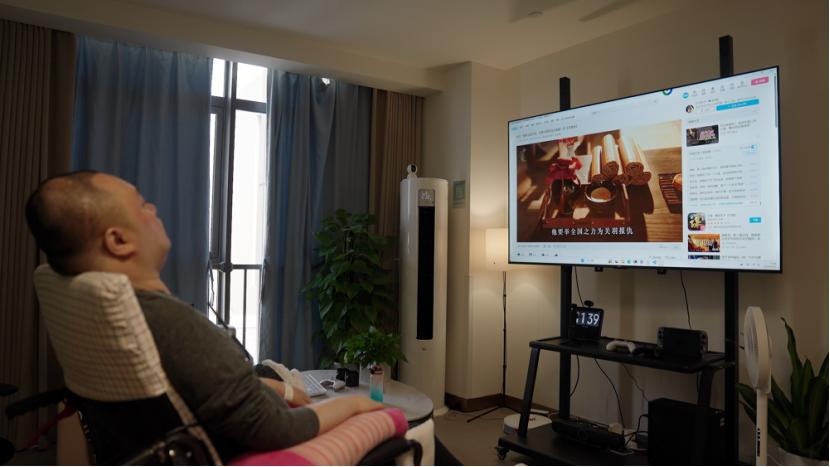
A clinical subject of Brain Tiger Technology's fully implanted brain-computer interface achieved "thought control" and smoothly completed web browsing, precise clicking, and video playback.
"Fully implanted, fully wireless, and fully functional" are regarded as the keys for brain-computer interfaces to move towards long-term clinical applications. When being interviewed by media such as Star Market Daily, Tao Hu, the founder and chief scientist of Brain Tiger Technology, said that full implantation means that all electrodes, chips, and batteries are placed inside the body, avoiding the risk of infection caused by external interfaces; full wirelessness enables patients to be free from being "tethered" by devices in daily life through wireless power supply and communication; full functionality covers the complete closed-loop of EEG acquisition, processing, communication, and energy management.
It is worth noting that the system implants the battery module under the skin of the chest rather than in the head area. This design follows the mature clinical path of deep brain stimulation (DBS), keeping the heating and power consumption units away from the brain, improving the system's safety, and facilitating subsequent maintenance and upgrades.
According to clinical data, the patient's brain control decoding rate has reached 5.2 BPS, approaching the international top level. More importantly, the system has obvious advantages in safety and functional scalability, providing room for subsequent language decoding, complex interaction, and even linkage with large models and robot systems.
With the accelerating convergence of artificial intelligence, neuroscience, and clinical medicine, the brain-computer interface industry is entering a stage of parallel exploration of technical routes and accelerated verification of application scenarios, with fierce competition within the industry. In this process, Shanghai is accelerating the promotion of brain-computer interfaces from the laboratory to real clinical scenarios, and the pace of application implementation has significantly accelerated.
When being interviewed by a reporter from Star Market Daily, Mao Ying pointed out that the development of brain-computer interfaces is changing the relationship between "medicine - research - industry". In the past, medical innovation mostly followed a one-way path from the laboratory to the clinic. Now, clinical problems are driving research and industry in the opposite direction. "Doctors in white coats can communicate face-to-face with engineers and algorithm scientists, directly translating real clinical needs into technological improvements. This is the key to improving conversion efficiency."
In Mao Ying's view, artificial intelligence and brain-computer interfaces are not simply a tool relationship but a two-way shaping: on the one hand, AI improves the ability to interpret, predict, and generalize EEG signals; on the other hand, the understanding of the brain's mechanism is also forcing the AI architecture to evolve towards lower energy consumption and higher efficiency.
This article is from the WeChat official account "Star Market Daily", author: Zhang Yangyang. Republished by 36Kr with permission.