Year-end Review of Robots: Coexistence of Opportunities and Challenges
As 2025 draws to a close, "Embodied Intelligence" has been voted into the second place on the list of the top ten buzzwords of the year. Looking back on this year, from the stunning yangge performance of humanoid robots at the Spring Festival Gala, to the first mention of "Embodied Intelligence" in the Government Work Report, and then to the concentrated debut of new-generation robots from various companies at the end of the year and their entry into real-world scenarios, "Embodied Intelligence" is constantly breaking our imagination and creating more and more possibilities. Next, let's take a look at the development of Embodied Intelligence in 2025 from the aspects of policy, technology, capital, and application. Where has it reached? And where is it going?
I. National and local governments work together to drive Embodied Intelligence into the "high-speed lane"
National level
In March, "Embodied Intelligence" and "Intelligent Robots" were mentioned for the first time in the 2025 Government Work Report.
In April, a series of national standards for humanoid robot technology requirements were officially approved for establishment, covering multiple technical requirements such as environmental perception, decision-making and planning, motion control, and operation.
At the end of November, Li Chao, the deputy director of the Policy Research Office of the National Development and Reform Commission and the spokesperson of the commission, said that a sound entry and exit mechanism for the Embodied Intelligence industry will be established. Li Chao also pointed out that China's Embodied Intelligence industry is developing by leaps and bounds at a growth rate of over 50%, and its market scale will reach 100 billion yuan by 2030.
Local level
Represented by Beijing, Shanghai, Guangzhou, and Shenzhen, many places have introduced relevant policies to support the development of Embodied Intelligence. For example, Beijing plans to break through more than a hundred key technologies, cultivate no less than 50 core enterprises in the upstream and downstream of the industrial chain, and cultivate an industrial cluster worth hundreds of billions of yuan by the end of 2027. Currently, in Zhangjiang Robot Valley in Shanghai alone, more than 90 leading enterprises such as Zhiyuan, Fourier, and Kepler have gathered, and the country's first heterogeneous humanoid robot training ground has been launched, forming an industrial cluster with coordinated software and hardware.
II. The capitalization of the track accelerates, driving the industry to run faster
In the primary market, the financing of domestic Embodied Intelligence enterprises is characterized by "explosive scale and layout of software and hardware". According to Kaiyuan Securities, as of October 2025, the total financing amount in the field of Embodied Intelligence has exceeded 50 billion yuan, a growth of over 400% compared with the whole year of 2024, and there have been more than 200 financing events. The intensity of capital investment is growing at a high speed.
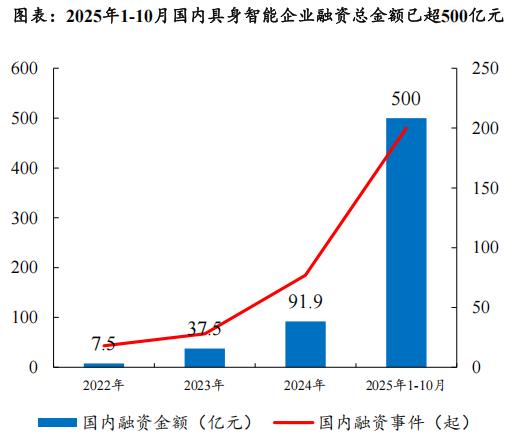
(Image source: Kaiyuan Securities Research Institute)
In the secondary market, the capitalization actions of leading enterprises continue to accelerate. Yushu Technology has recently completed IPO counseling, Zhiyuan Robotics has completed shareholding reform, and Leju Robotics is in the process of IPO counseling.
III. Embodied Intelligence enters the commercialization pilot phase, and industrial manufacturing may be the primary breakthrough point
The future applications of Embodied Intelligence have boundless imagination space.
According to the research of EqualOcean Intelligence, in the industrial application stage, humanoid robots are expected to be commercialized in niche markets first, such as factory production, security inspection, logistics and distribution, and service industry guidance. In the medium term, they will gradually mature into general-purpose robots and enter the household service market. In the more distant future, humanoid robots are expected to be applied in the aerospace field.
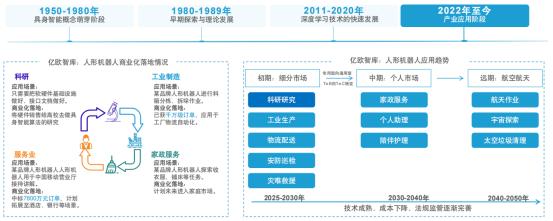
(Image source: EqualOcean Intelligence)
But at present, the application of humanoid robots in real scenarios still exposes some problems, such as insufficient adaptability to multiple tasks, safety and natural interaction issues in human-robot collaboration, and problems with cost and return on investment cycle. Therefore, before humanoid robots overcome the above difficulties, in the intelligent manufacturing system, humanoid robots mainly perform auxiliary work.
Regarding this situation, Yao Maoqing, the president of the Embodied Business Department of Zhiyuan Robotics, said bluntly that the core goal of humanoid robots entering real scenarios at present is to obtain high-quality real-machine data, which is also the key to Zhiyuan's technical path.
Guo Yandong, the founder and CEO of Zhifang, also publicly stated that the competition in the next three years will be about the "closed-loop in real scenarios". The company whose robots can be deployed and work in more real commercial scenarios and continuously feed back operation data to the model and hardware for iterative optimization will build an insurmountable moat.
IV. The industrial chain is long, but key technologies still face challenges
The Embodied Intelligence industrial chain has a typical "pyramid" structure, consisting of upstream core components and key technologies, midstream system integration and software development, and downstream application scenarios.
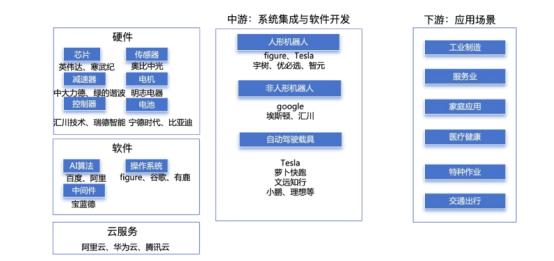
(Image source: Digital Economy Research Institute of Shanghai University of Finance and Economics)
The upstream is the link with the highest technical barriers. Core components include reducers, controllers, sensors, and AI chips, accounting for up to 70% of the cost. The midstream is responsible for the design, production, and system integration of robot bodies, and needs to provide customized solutions according to the needs of end industries. The downstream covers diverse scenarios such as industrial manufacturing, medical and health, household services, transportation, and special operations.
From the perspective of the entire industry, the huge demand for computing resources is the main challenge currently faced by Embodied Intelligence. Secondly, the lack of data quality and diversity is an important issue in the development of Embodied Intelligence. Thirdly, the interpretability and security of models are the cornerstones of trust in the development of Embodied Intelligence. Finally, there is no standardization for Embodied Intelligence hardware, and there are challenges in the integration of the "cerebellum" motion control and the "body".
This article is from the WeChat public account "Caixin Press", author: Niu Jia, published by 36Kr with permission.