Is Li Xiang choosing the wrong "route" to save Li Auto?
Ideal urgently needs a new story.
On the evening of December 3rd, Li Auto's AI glasses, Livis, were officially unveiled.
The smart glasses market seems to be booming, but there aren't many players entering as automobile manufacturers. Xingji Meizu, although involved in automobile - related businesses, isn't as pure a player in the automotive field as Li Auto. Xiaomi has also launched AI glasses, but Xiaomi itself has a rich portfolio of hardware products and has experience in creating hit products in the smart hardware sector.
Fan Haoyu, the senior vice - president of the product department at Li Auto, said at the press conference that Li Auto's AI glasses, Livis, are a natural extension of the car and the most powerful accessory for Li Auto.
This can be generally understood as the reason why Li Auto decided to make a pair of smart glasses. To build momentum for the new product, Li Auto even actively bought trending topics on social platforms like Sina Weibo, indicating its emphasis on this AI glasses product.

Beyond the official statements, Yiou believes that there are deeper reasons for Li Auto to enter the smart glasses market.
Firstly, the year - on - year sales of new energy vehicles have declined, and it seems that Li Auto's cars are not selling well. In the past, as a leading brand in the new energy vehicle industry, Li Auto had an impressive sales growth rate. Especially in the past two years, Li Auto led the industry in terms of delivery volume.
In 2023, Li Auto delivered a cumulative total of 376,000 vehicles, a year - on - year increase of 182.2%. In the same year, the sales volumes of NIO, XPeng, and Leapmotor were approximately 160,000, 141,200, and 144,000 respectively. In comparison, Li Auto's annual sales ranked first among new - force car manufacturers.
At that time, Li Xiang, the chairman and CEO of Li Auto, said that this was the first time in history that a Chinese new - force car manufacturer had crossed the 300,000 - vehicle delivery mark.
However, unfortunately, since this year, Li Auto's market performance has been less than ideal. Especially in the third quarter, Li Auto delivered 93,000 vehicles, compared with 153,000 in the same period last year, a year - on - year decrease of 39.0%.
Secondly, the growth rate of the core business has slowed down, and the performance has declined significantly. On November 26th, Li Auto released its latest financial report. In the third quarter, vehicle sales revenue was 25.9 billion yuan, compared with 41.3 billion yuan in the same period last year, a year - on - year decrease of 37.4%. The gross profit margin also declined. In the third quarter, the vehicle gross profit margin was 15.5%, a decrease of 5.4 percentage points compared with 20.9% in the same period last year.
Overall, Li Auto's revenue in the third quarter was approximately 27.4 billion yuan, a year - on - year decline of 36.1%. The net profit turned from profit to loss, with a net loss of 624 million yuan.
Compared with last year's overall performance of 144.5 billion yuan in revenue and 8 billion yuan in net profit, Li Auto's performance has made a "sudden stop", and the performance pressure is obvious.
Thirdly, the market value has shrunk, and the stock price has continued to fall. Amid the poor performance of the automobile business and the decline in performance, Li Auto's performance in the secondary market is also far from satisfactory. At the close on December 3rd, the Hong Kong - listed stock closed at HK$69.75, breaking through the HK$70 mark. Calculated from the high of HK$105.3 in late September, in just over two months, the stock price has fallen by more than 33%, and the market value has shrunk to 149.3 billion yuan.
Judging from the stock price trend, Li Auto has been in a continuous downward trend, and there are no signs of a stop and rebound so far.
For Li Auto, finding a new trend and telling a new story is an urgent matter.
Since the second half of 2024, the smart glasses market has heated up rapidly, and the industry's popularity has remained high in 2025. Especially in the past two months, the market has once again seen a dense launch of new products, and many products have been unveiled one after another.
On October 14th, Guangli Technology released the SollaWave AI smart audio swimming goggles.
On October 16th, Yingmu Technology released the AI smart glasses INMO GO3.
On October 23rd, TCL Thunderbird Innovation released the Air 4 series.
On October 27th, Fourth Paradigm Phancy released a new generation of AI shooting glasses.
On October 28th, Leyard released the Leyard AR Glasses.
On October 30th, Gudong Intelligence upgraded several smart glasses such as the Star 1S.
On November 12th, Yiwen Technology launched the second - generation Even G2 smart glasses.
On November 13th, Rokid jointly released a co - branded AI glasses with BOLON.
On November 14th, Libai Glasses released the LIPO Libai smart glasses that understand your mood.
On November 18th, Xiaodu Technology released the Xiaodu AI Glasses Pro.
On November 27th, Alibaba released the Quark AI Glasses S1 and G1 series.
On December 1st, XREAL unveiled the AR glasses XREAL 1S.
What is questionable for Li Auto is whether a car manufacturer can catch up with the trend of smart glasses?
Smart glasses, "small as they are, have all the essential parts", involving many aspects such as optical display, chips, battery life, AI, and hardware design. Judging from the performance of previous players, it seems "quite easy" to assemble a pair of smart glasses by integrating industrial chain resources, but it is extremely difficult to polish a pair of smart glasses that are comfortable to wear, easy to use, good - looking, and easy to sell.
Or, in Li Xiang's view, is it much easier to launch a pair of glasses than a new car? At least, the cycle is much shorter?
According to the official introduction of Li Auto, the newly released Livis can be naturally connected to Li Auto's cars, enabling the glasses to control the car. For example, you can open the trunk by waking up "Li Auto's assistant".
Li Auto's AI glasses, Livis, are AI shooting glasses. In terms of shooting, they have 12 million pixels, a 105° ultra - wide - angle lens, an equivalent focal length of 19.4mm, support 4K photo shooting and 1K video recording at 30 frames per second, and the snapshot speed is 0.7 seconds.
In terms of audio, Li Auto's AI glasses, Livis, support the headrest audio function. After connecting to the car, they can play audio, with a maximum output of 110dB.
In terms of appearance design, the frame shape is "round at the top and square at the bottom", with a surrounding design. The distance between the temples is 137mm. The whole series has a semi - transparent texture, using materials such as glossy and matte, and supports colors such as classic black, tech gray, and olive green.
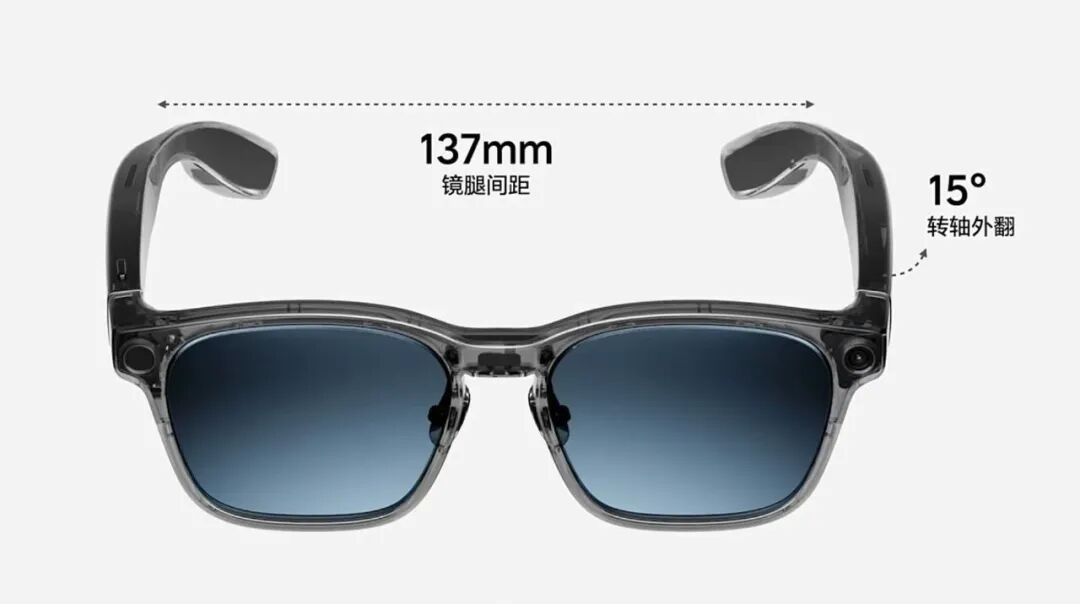
In terms of charging, it doesn't use the Type - C charging method. Instead, it uses a power bank and a wireless - charging glasses case. It weighs 36 grams, with a typical battery life of 18 hours in working condition and 78 hours in standby mode.
In addition, Li Auto's AI glasses, Livis, debut the self - developed Deep Research function, with a dialogue response time of 0.8 seconds, which is faster.
To enhance the competitiveness of the AI glasses Livis, Li Auto also cooperated with Zeiss, the global leader in optics. Zeiss provides glasses - fitting and store - channel services for Livis.
In terms of price, Li Auto's AI glasses, Livis, are priced from 1,999 yuan. After receiving government subsidies for orders placed before December 31st, the actual price starts from 1,699 yuan. The whole series comes standard with Zeiss lenses.
At first glance, the configuration of Li Auto's AI glasses, Livis, seems quite good. However, it should be noted that the official claims and the actual effects are two different things. In fact, there are obviously many areas for improvement in Li Auto's AI glasses, Livis.
For example, in terms of chips, most of the current smart glasses products on the market choose the system - on - a - chip Qualcomm AR1 or adopt the dual - chip architecture of Qualcomm and BES. This is the mainstream choice among current players. In addition, a very small number of brands choose products such as UNISOC.
However, Li Auto's AI glasses, Livis, choose the BES2800 chip from BES as the main control chip, and are also equipped with an ISP chip from Hangzhou Yanjimu Microelectronics to support imaging. Judging from the chip selection, Li Auto's AI glasses, Livis, have abandoned Qualcomm and seem to have taken a path that goes against the market mainstream.

Li Auto said that the consideration behind this is to be "fast", and they also adjusted the baseline of the BES chip. However, making modifications without changing the core will also greatly affect the actual usage effect.
In the past, some "stubborn" domestic brands abandoned Qualcomm and chose other chips for various reasons, and were eventually "slapped in the face" by the market. Based on this, it's not difficult to predict the outcome of Li Auto's AI glasses, Livis.
According to the preliminary consensus in the industry, smart glasses are very likely to become independent consumer products in the future and may even replace mobile phones. Therefore, the reason why the industry is "so lively" is that people believe that the future of smart glasses is "bright".
From this, we can tell that the reason why Li Xiang may have chosen a wrong "path" reflects that Li Auto may still lack a real understanding of smart glasses and hasn't figured out how to make a good pair of smart glasses. Li Auto's AI glasses, Livis, are far from mature, and the hasty entry is just to catch up with the industry trend.
Currently, smart glasses haven't really entered consumers' lives, and upstream and downstream manufacturers are working together to promote the healthy development of the industry.
From the perspective of the industry, Li Auto's act of pushing an immature product into the market will, to a large extent, mislead and damage the outside world's perception of smart glasses and dampen the confidence of investors and consumers in the smart glasses industry.
For Li Auto, although the slow - down in performance is "extremely stressful", the correct decision should be made at the root. As a car manufacturer, Li Auto's "foundation" is new energy vehicles.
It's understandable to explore new businesses, but the primary prerequisite is to have a correct understanding of new products, respect industry rules, and respect consumers.
This article is from the WeChat official account "Yiou.com" (ID: i - yiou), written by Wang Yuanlei, and published by 36Kr with authorization.