Do 70% of people in Northeast China want to buy electric vehicles? Only 40% actually do.
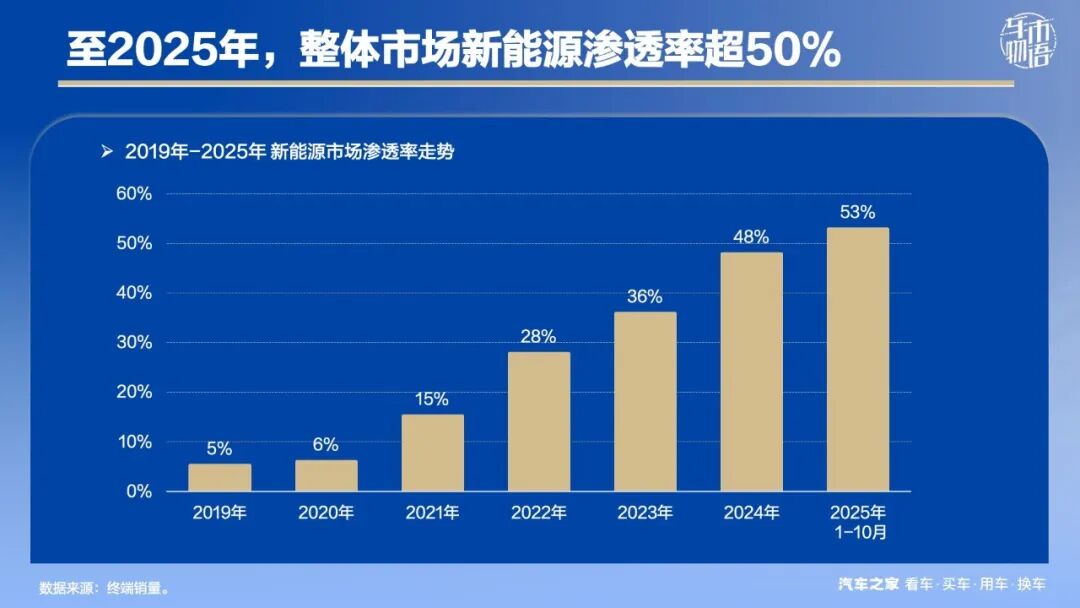
From January to October 2025, the penetration rate of the new energy vehicle market exceeded the 50% mark, reaching a new milestone. According to Cui Dongshu, the secretary - general of the Passenger Car Association, in 2026, the sales volume and ownership of new energy vehicles will continue to reach new highs, and the penetration rate of new energy vehicles is expected to exceed 60%. According to the "Energy - Saving and New Energy Vehicle Technology Roadmap 3.0", by 2040, the penetration rate of new energy vehicles in China will reach over 80%.
In the near future, can every family in China own an electric vehicle? People in Northeast China say it's really not possible. In the cold winter, the average temperature drops to between - 10°C and - 20°C. It's a place where people don't even dare to let their noses run or their eyes tear up when walking outside. Won't electric vehicles just break down in minutes? How can people in Northeast China fall in love with electric vehicles? It's a tough question.
The overall penetration rate of the new energy vehicle market is growing strongly,
but the fuel - powered vehicle market still dominates in three regions
According to terminal sales data, the penetration rate of the new energy vehicle market was only 6% in 2020. It started to enter a period of rapid growth in 2021, with the penetration rate increasing by 9 percentage points year - on - year. Subsequently, it maintained a high - speed growth of about 10 percentage points every year.
From January to October 2025, the new energy vehicle market exceeded the 50% mark for the first time, but the growth rate also began to slow down, with only a 6 - percentage - point increase compared with the same period in 2024.
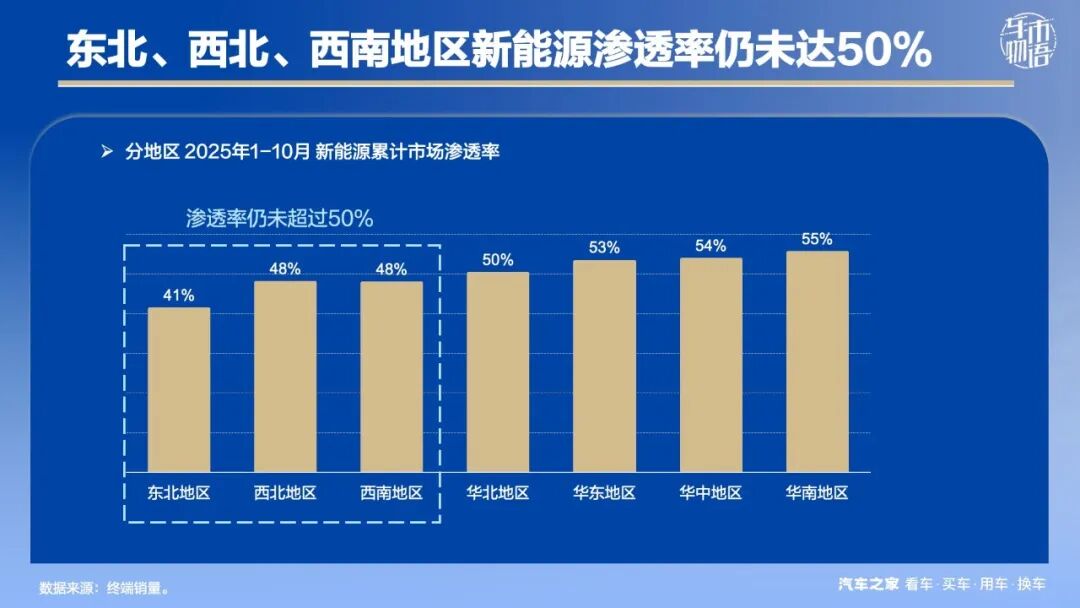
Looking at different regions, not all sub - markets have achieved a 50% penetration rate of new energy vehicles. The Northeast, Northwest, and Southwest regions are still dominated by fuel - powered vehicles. By January - October 2025, the penetration rate of new energy vehicles in these regions had not exceeded 50%. In particular, the penetration rate in the Northeast region was the lowest, at 41%.
Of course, considering the environmental conditions, a 41% penetration rate is actually not low, and consumers still have a strong enthusiasm for purchasing new energy vehicles.
To increase market share,
the plug - in and range - extended sub - markets are the best breakthrough points
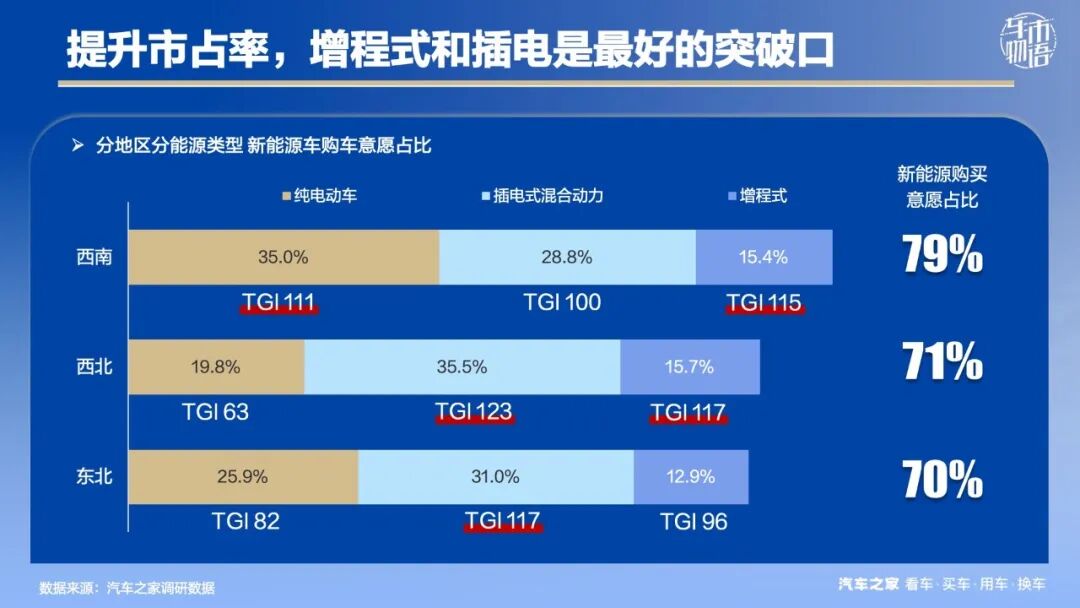
Do potential car buyers in the Southwest, Northwest, and Northeast regions really not want to buy new energy vehicles? Not really. According to research data from Autohome, the proportion of people willing to buy new energy vehicles in these three regions all exceeds 70%. The proportion in the Southwest region is the highest, approaching 80%, far exceeding the current market share of new energy vehicles in these regions.
Looking at different energy types, users in the Southwest region have a higher preference for pure - electric and range - extended vehicles than the overall market, with TGI values of 111 and 115 respectively; users in the Northwest region prefer plug - in hybrid and range - extended vehicles more, with TGI values of 123 and 117 respectively; in the Northeast region, where the temperature is relatively lower, people have more confidence in plug - in hybrid vehicles, with a TGI value of 117.
To break through the market - share bottleneck, efforts should be made both to convert potential fuel - vehicle buyers and to strengthen the determination of potential new energy vehicle buyers.
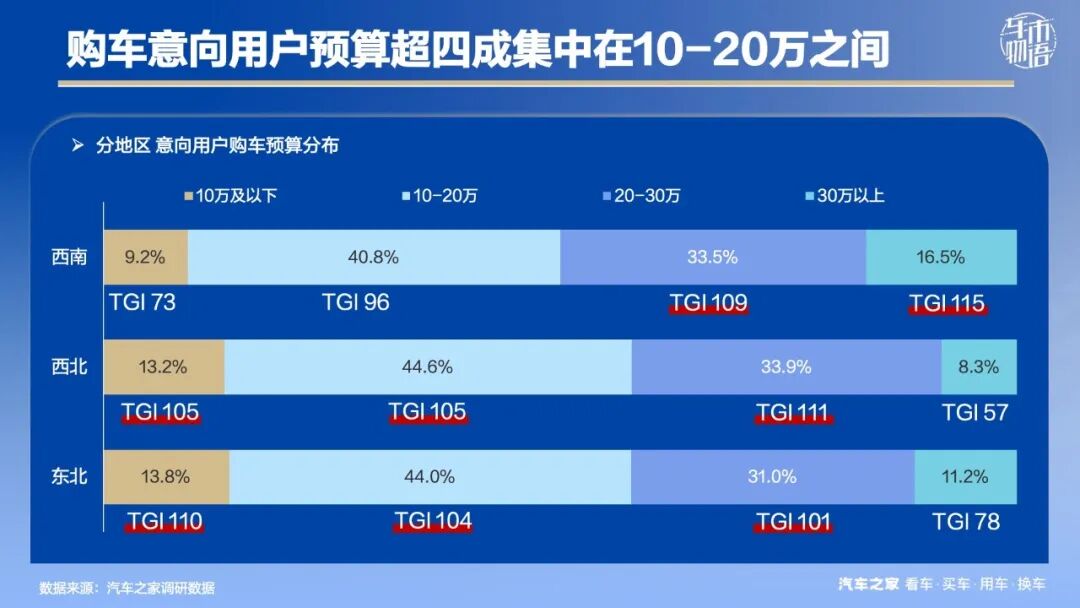
"When the potential customer base is large enough, even a low conversion rate will result in a considerable number," said a senior industry insider. Therefore, first of all, it is necessary to understand the basic car - buying needs of users to attract more attention. According to research data from Autohome, the main budget range for car buyers in these three regions is between 100,000 and 200,000 yuan, accounting for over 40% in each region. The next range is between 200,000 and 300,000 yuan, and the combined proportion of these two ranges exceeds 70%.
In the sub - markets, the proportion of high - budget users in the Southwest region is relatively higher, with a TGI of 115 for budgets over 300,000 yuan; in the Northwest and Northeast regions, the budget range below 200,000 yuan is more prominent. In the Northeast region, the budget of 100,000 yuan or less is even more significant, with a TGI of 110, the highest among the three regions.
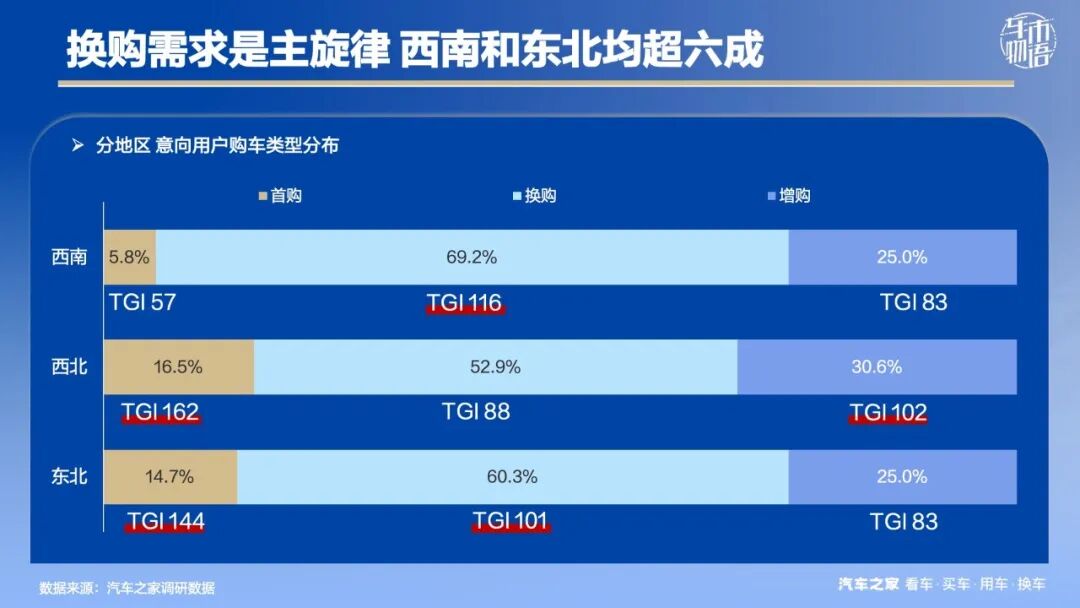
In terms of car - buying types, replacement demand is the main trend. The proportion in the Southwest region is the highest, reaching 69.2%, and even in the relatively lower - proportion Northwest region, it still exceeds half.
Looking at different regions in detail, the proportion of first - time car buyers in the Northwest and Northeast regions is relatively higher, with TGI values of 162 and 144 respectively compared with the overall users. Therefore, for potential buyers in these three regions, financial policies and replacement programs are particularly important and will be one of the key points to promote sales.
However, these are obviously not enough. For users in these regions, the main reason for their refusal to buy new energy vehicles is not the lack of "benefits" but too many concerns.
Range degradation is the biggest concern for users,
and free value - added services can effectively increase consumption willingness
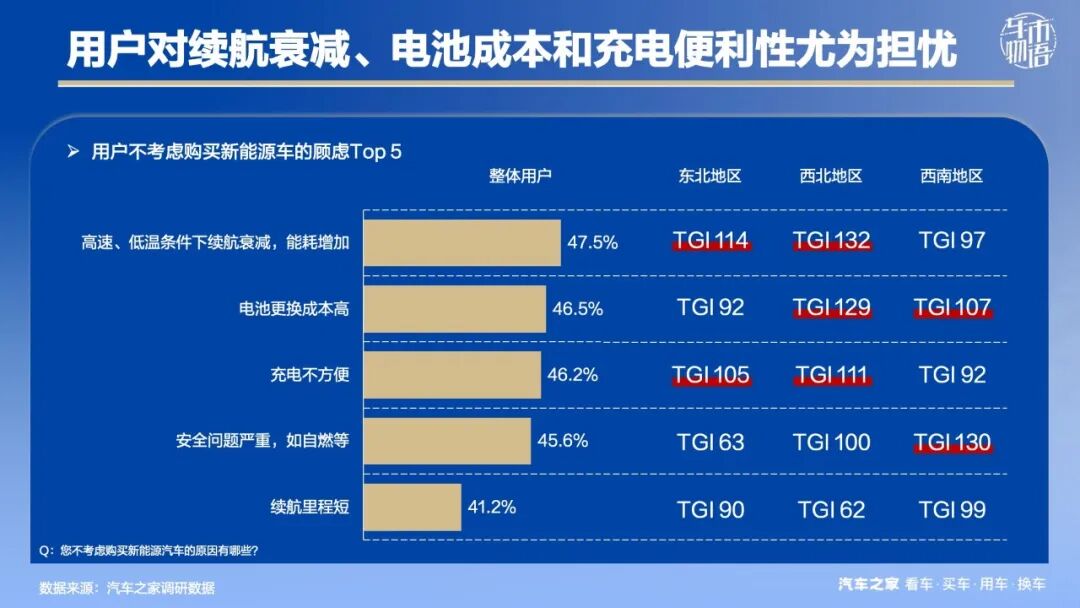
Among the top five concerns of users when considering not buying new energy vehicles, users in the three regions show stronger emotions towards the top four concerns. In the Northeast and Northwest regions, due to the relatively lower temperatures, users are more worried about range degradation and increased energy consumption under high - speed and low - temperature conditions, with TGI values of 114 and 132 respectively compared with the overall users. At the same time, inconvenient charging is also a problem for users in these two regions, with TGI values of 105 and 111 respectively. If brands can set up more and denser charging stations or give users stronger commitments regarding range degradation, it will help boost consumer confidence.
High battery replacement costs worry users in the Northwest and Southwest regions more, with TGI values reaching 129 and 107 respectively. While strengthening the promotion of battery durability, brands can provide more preferential policies for battery replacement to eliminate users' concerns.
Nowadays, with the continuous development of new energy vehicle technology, although users still have concerns about the safety of new energy vehicles, this concern has dropped to the fourth place. However, for users in the Southwest region, safety is the top - priority issue, with a TGI as high as 130. Brand commitments will help relieve their anxiety. For example, GAC Toyota has proposed that "the manufacturer will directly bear the liability for electric vehicle spontaneous combustion, and both new and old users (limited to the first - owner) can enjoy lifetime benefits regardless of whether they are within the vehicle warranty period."
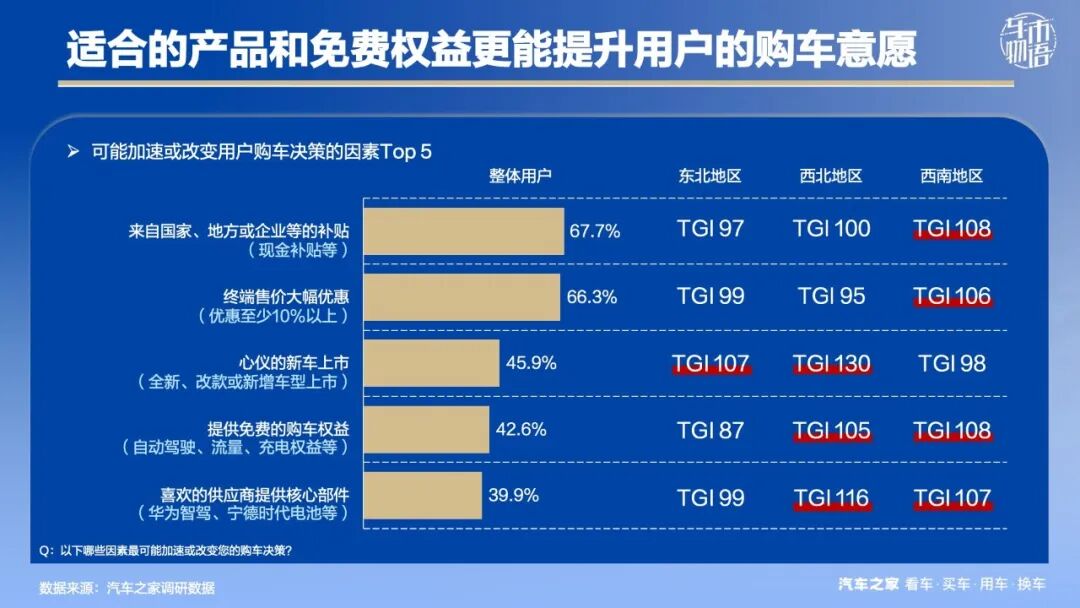
After removing the "veto power" of users, there is hope for a deal. How can users be encouraged to make up their minds to buy new energy vehicles? Research data shows that the top five factors that can accelerate or change users' car - buying decisions are various subsidies, price cuts, new products, free benefits, and the brand effect of suppliers.
Among them, users in the Northeast region pay more attention to new products, with a TGI of 107; in addition to new products, users in the Northwest region are also more attracted by free car - buying benefits and the brand effect of suppliers, with TGI values of 105 and 116 respectively; users in the Southwest region pay relatively less attention to new products, but they care more about the other four factors.
In terms of price cuts, new energy vehicles are obviously not as "aggressive" as fuel - powered vehicles, but in terms of innovative services, new energy vehicles have an edge and more competitive advantages.
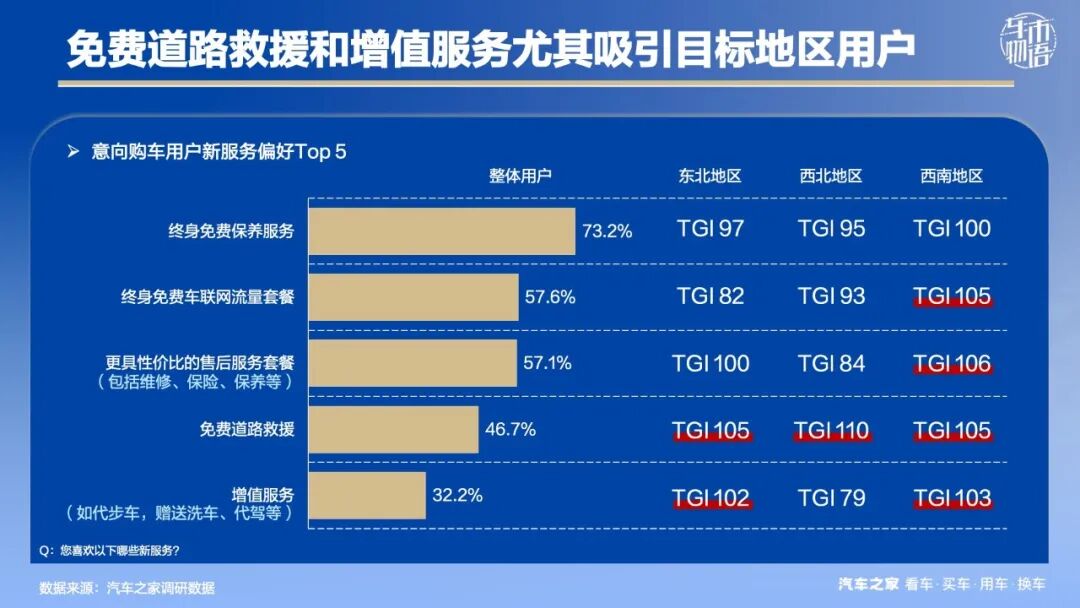
Compared with fuel - powered vehicle brands, new energy vehicle brands are more open and offer a variety of new services innovatively. Among the many types of new services, the top five services that users are most concerned about are free maintenance, free data packages, cost - effective after - sales services, free rescue services, and various value - added services.
Among them, users in the Southwest region have a relatively higher acceptance of new services and pay more attention to the other four new services except for free maintenance.
Users in the Northeast region pay more attention to free rescue services and value - added services, while users in the Northwest region are only more interested in free rescue services, with a TGI of 110, significantly higher than that in other regions.
By 2025, the new energy vehicle market in China has entered a stage of stable development. In the future, although the penetration rate will continue to rise, compared with the previous rapid expansion, the growth rate will further slow down, and the overall market will enter a relatively high - quality development stage.
In terms of regional markets, the East China region, which accounts for over 30% of the sales volume, is definitely a battleground for all players. After all, the market is large enough, but the competition is also very fierce. Although the total market share of the Southwest, Northwest, and Northeast regions is only 24%, the penetration rate of new energy vehicles in these regions has not exceeded 50%, leaving much room for improvement.
Nowadays, with the continuous improvement of new energy vehicle technology, the range of new products is sufficient for daily use, and the development of battery technology has also gradually improved the problem of range degradation. Coupled with the intelligent advantages of new energy vehicles, more and more users will pay attention to and consider buying new energy vehicles. However, the environment is an objective factor that cannot be changed. Therefore, compared with pure - electric vehicles, launching more plug - in hybrid and range - extended new models and widely promoting and popularizing new technologies will be the key to breaking through the growth bottleneck of market penetration.
This article is from the WeChat public account "Autostinger" (ID: autostinger), author: Sun Ying. It is published by 36Kr with authorization.