Is AI glasses with a return rate of up to 40% still a good business?
From the ups and downs of VR headsets to the new battlefront of AI glasses, every technological iteration in the smart glasses track has been accompanied by a brutal industry reshuffle.
At the end of 2025, the AI glasses track witnessed a fierce battle.
Riding on the wave of the Double 11 shopping festival, multiple AI glasses products chose this time point to be launched, vying for traffic. On November 9th, Lenovo's AI Glasses V1, priced at 3,999 yuan, went on sale. Subsequently, Baidu's Xiaodu AI Glasses Pro (priced at 2,299 yuan), the new - generation AI glasses jointly developed by Rokid and BOLON, and Thunderobot's first AI audio glasses, the AURA Enjoy Edition, were released. By November 27th, Alibaba's Quark AI Glasses S1 and G1, priced at 3,999 yuan and 1,899 yuan respectively, started selling.
Meanwhile, Li Xiang, the founder of Li Auto, announced his entry into the AI glasses market this month. From major mobile phone manufacturers to internet giants, from AR startups to cross - border players, all parties are engaging in all - around competition in terms of price, ecosystem, and technology.
The industry competition is intensifying. While the market is expanding, the competitive landscape is also changing at any time. JD.com data shows that during the Double 11 period, the sales growth rate of smart glasses reached 346%. Brands such as Xiaomi, INMO, Rokid, and TCL Thunderbird led the sales rankings.
Even though the sales were good during this Double 11, AI glasses manufacturers, who are currently burning money to capture the market, are not out of the woods. The "high return rate" problem looms large, behind which are the double questions from users' real needs and technological bottlenecks.
Although it's still unknown who will emerge victorious in the end, companies that can't keep up will quickly fall behind.
01
The Battle of a Hundred Glasses: Head - to - Head Competition
AI glasses are still in the stage of large - scale investment, which is first reflected in the rapid product iteration and the continuous decline in prices.
In the ongoing "Battle of a Hundred Glasses" that has lasted for over a year, VR/AR glasses manufacturers, major mobile phone and internet companies, and even myopia glasses brands have all entered the market. Players with different backgrounds have adopted different strategies.
AR glasses manufacturers emphasize the combination of AI and AR, while major mobile phone and internet companies stress the integration with their existing software and hardware ecosystems. For example, Xiaomi glasses support the control of Xiaomi smart home devices; Alibaba's Quark glasses support Alipay; and Huawei glasses (expected to be released in Q4 2025) focus more on the linkage with intelligent driving systems.
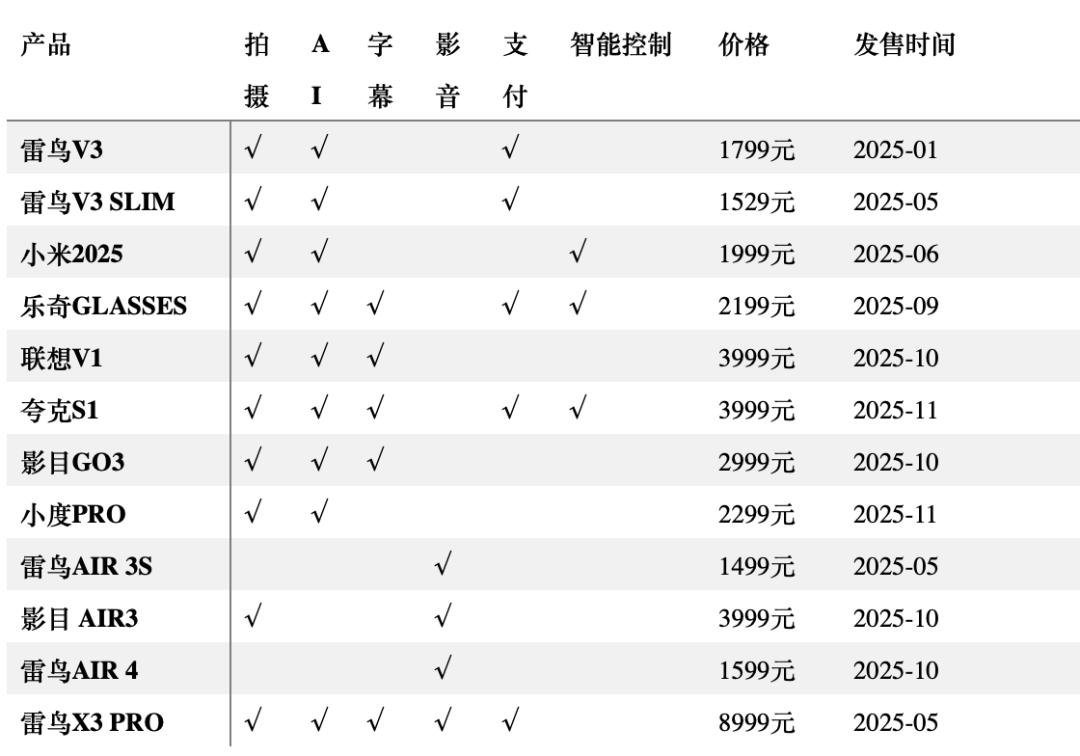
Incomplete statistics of smart glasses launched in 2025
Fierce market competition, along with scale - up and user subsidies, has led to the price of mainstream AI and AR glasses dropping from over 2,000 yuan in 2024 to around 1,500 yuan. Some brands have further lowered the threshold by "simplifying configurations" or launching lightweight versions.
Take Thunderbird's new AI glasses, the V3 Slim, for example. Its price is 270 yuan lower than the version launched at the beginning of the year. The AR glasses, the Air 3s, have seen their price drop from 2,000 - 3,000 yuan in 2024 to 1,499 yuan.
Recently, Alibaba's Quark released two series of AI glasses. The G1 series doesn't have a display function, but its hardware configurations such as the chip and camera are the same as those of the S1 series. However, it is 1,900 yuan cheaper than the S1 series.
Meanwhile, AI glasses are still in the user education stage, and marketing investment has become a focus of competition. Brands have adopted diverse and practical strategies in choosing "endorsements" or promotion methods.
To reach specific interest groups, startup Rokid adopted a "top - tier tech KOL" strategy. Well - known tech blogger "FilmoraTim" became the brand's spokesperson and made an appearance at the joint product launch event of Rokid and BOLON in mid - November.
Behind the cooperation with BOLON is Rokid's emphasis on offline channels. Currently, Rokid has also partnered with large - scale eyewear chain brands such as Dr. Glasses and entered their offline networks.
To control costs or shape a "technology - driven" brand image, some AI glasses brands have chosen their founders or senior executives to be the core figures in brand communication.
For example, Lei Jun, the founder of Xiaomi, will casually showcase Xiaomi's AI glasses at some public events.
Li Hongwei, the CEO of Thunderbird Innovation, frequently appeared on podcasts, social media, and industry exhibitions in 2025, personally explaining the product concept. He admitted that this was a "collective decision by senior management," which not only saved high endorsement fees but also avoided potential public opinion risks associated with celebrity endorsements. At the same time, it can more directly convey the startup's vision and technological thinking.
Many brands also convert early users into brand promoters through various means, emphasizing real experiences and a sense of participation.
For example, when Thunderbird was soliciting Chinese themes for its new V3 glasses, it launched a user creativity activity and gave away products as rewards. This method is relatively low - cost, can enhance the sense of belonging of core users, and generate promotional content that is closer to real needs.
In the AI Battle of a Hundred Glasses, products backed by large companies have ecosystem advantages and can afford to burn money. For startups, financing ability directly affects their competitive endurance.
Relevant industry data shows that from January to October 2025, the investment and financing amount related to the Chinese smart glasses industry reached 3.02 billion yuan, involving 15 financing rounds. More importantly, funds are beginning to concentrate on leading startups with technological advantages and market positions.
In November 2025, three subsidiaries under CITIC Securities participated in Thunderbird Innovation's new round of financing, with a financing scale of about 800 million yuan, setting a record for a single - round financing in the smart glasses industry. If we also count the company established by TCL Capital, this is already Thunderbird's ninth round of financing.
In addition, INMO completed a Series B2 financing of over 150 million yuan in July 2025. As a core optical manufacturer for AR glasses, Zhige Technology completed another billion - level financing in August 2025.
These funds are mainly used for the research and development of next - generation products, breakthroughs in core AI and optical technologies, the construction of supply chains and production capacities, as well as the expansion of offline channels and ecosystems.
02
"Completed but Imperfect": A Gap in User Experience
Although current manufacturers regard AI glasses as the next "super - entry point" for human - machine interaction, there is still a certain gap between the actual user experience and expectations.
"I bought Thunderbird's V3 because I wanted to capture the moment my son was born, and it's inconvenient to use a phone at that time," Mr. Wang, who works in a tech company, told "Bao Bian."
Most users choose smart glasses mainly for convenient shooting, especially in situations where they don't have time or it's inconvenient to take out their phones. Wearing glasses not only achieves the purpose of shooting but also reduces the distortion of the usage scenario caused by holding a device.
When Mr. Wang made his purchase, the main products with shooting functions on the market were Thunderbird's V3 and Xiaomi's glasses.
"I don't have a Xiaomi phone, so I can't enjoy the ecosystem. Thunderbird's product has a decent shooting effect, its APP has a high - end UI, and its design is cooler," he said.
Mr. Wang tested the anti - shake performance of the glasses while playing football in daily life. However, the product still has problems such as insufficient battery life, useless AI features, and unstable connections for charging and internet access. Currently, most Android phones have voice - activated AI assistants, which means the AI in the glasses has limited improvement in terms of convenience. The battery life is about 90 minutes for calls and 30 minutes for shooting, which is difficult to meet the needs of long - term wearing. The main problems with the network and charging are poor contact, and the quality control needs to be improved.
Among these issues, battery life is the most criticized aspect of many AI glasses. Different from smartphones, AI glasses need to be assembled in a very limited space, making it difficult to achieve a perfect balance among battery life, performance, and lightweight design.
If his child had been born a few months later, Mr. Wang said he might have chosen products with lens display functions, such as Rokid Glasses, INMO GO3, or Quark S1.
The lens display function uses waveguide technology to directly display information on the lens. This is not a cutting - edge technology. In 2023, Meizu launched the first pair of glasses with waveguide technology but without a shooting function on the market. Later, due to an acquisition, it changed its business direction.
The problem with this technology is that it can only form an image on a flat mirror. Myopic people need to add an additional concave mirror, which increases the weight of the product. For people with normal vision, "wearing glasses" is something that requires additional getting used to.
Another problem is the position of the camera. To make smart glasses look more like ordinary glasses, the camera and shooting components are placed on one side of the glasses, which means users need to adjust their head angles when shooting.
On social platforms, many users complain that they need to get used to their AI glasses, which also implies that the products still need to be refined.
"One of the uses of glasses is for 'inconvenient' shooting scenarios. Thunderbird can continue shooting when the camera indicator light is covered, while some other products can't. But it's hard to say whether the ability to shoot secretly is an advantage," Mr. Wang said.
This means that some AI glasses can actually achieve "secret shooting." Besides being more convenient, there may also be potential social and ethical issues.
Currently, many functions of AI glasses cannot provide an experience that surpasses that of mobile phones. Behind the Battle of a Hundred Glasses, the increase in sales is accompanied by a high return rate.
According to statistics from industry media XR Vision, the return rate of AI glasses on platforms such as JD.com and Tmall is about 30%, and it is as high as 40% - 50% on Douyin.
03
Advancement and Retreat in the Technological Wave
From the ups and downs of VR headsets to the new battlefront of AI glasses, every technological iteration in the smart glasses track is accompanied by a brutal industry reshuffle. The ebb and flow of companies entering and exiting the market outline the real survival picture of this high - potential track.
The modern narrative of smart glasses began in 2012. In this year, VR leader Oculus (later acquired by Meta) was established, and the first AR glasses, Google Glass, were released. After that, the VR market started to rise. The year 2016 was known as the "Year of Virtual Reality." Around this time, companies such as HTC, Sony, Samsung, and Google all released their VR products.
After several years of prosperity, the VR market briefly hit a bottleneck from 2017 to 2018. High costs and inconvenient products limited the development space of the devices. At this time, venture capital in the relevant field decreased sharply, and some companies were no longer willing to invest in device research and development. Intel disbanded its smart glasses and wearable device team in this year and announced its withdrawal from the AR/VR track. IMAX closed all its offline experience stores, and the VR departments of companies such as CCP Games and Hardlight VR were either acquired or disbanded.
With the mass production of all - in - one VR devices such as those from Meta and Pico, the market returned to prosperity. Meta's Quest 2, released in Q4 2020, led the market and significantly boosted overall sales. In 2021, the global shipment of XR devices exceeded 10 million.
But soon, the industry entered a cold winter with the macro - economic recession and the ebb of the metaverse concept. Microsoft exited the consumer - grade VR social business, and large companies such as Tencent and Baidu scaled back their VR operations. ByteDance canceled the launch plan of Pico 5.
Meanwhile, the AR glasses market was in a stable development state. Vuzix, INMO, and Thunderbird each released their first consumer - grade AR glasses products in 2021. Later, XREAL, Lenovo, Meizu, etc. also joined the battle.
After 2023, the development of AI made its combination with smart devices a market full of imagination. AI smart glasses have become a hot business concept. In addition to Meta, which has always been at the forefront of the market, hardware manufacturers and internet giants have also entered the manufacturing of relevant products at this time. INMO and Rokid are among the earliest domestic manufacturers to add AI functions to glasses.
Of course, during this period, some companies have continuously exited the industry: In 2023, industry pioneer Google's smart glasses were finally discontinued. In China, Flash Speed Technology, which claimed to be the first to mass - produce AI glasses, was in an embarrassing situation of collective refunds due to supply chain problems that prevented it from delivering products on time.
However, recently, some media reported that Google launched two AI glasses projects at the end of 2024. Currently, these two projects have entered the POC (Proof of Concept) stage, and the selection and ID design are being intensively promoted.
The market generally believes that AI glasses are just a transitional stage for AR glasses. This reveals the deep - seated logic of the development of smart glasses, which is a gradual revolution from "interaction intelligence" to "visual intelligence."
What the industry is experiencing now is just a brutal "qualifying round." Companies that perform well in financing, product iteration, ecosystem cooperation, and user feedback loops are not only competing for the market share of AI glasses but also accumulating the key tickets to enter the AR era.
Whether it's Xiaomi, Quark, or players like Rokid and Thunderbird, they all need to continuously respond to real needs while accelerating their pace to gain an advantage in the upcoming industry integration.
This article is from the WeChat official account "Bao Bian" (ID: baobiannews). Author: Zhang Jingwei, Editor: Xing Yun. Republished by 36Kr with permission.