Countdown to 30 days: Which new car manufacturers will achieve their goals at the end of 2025?
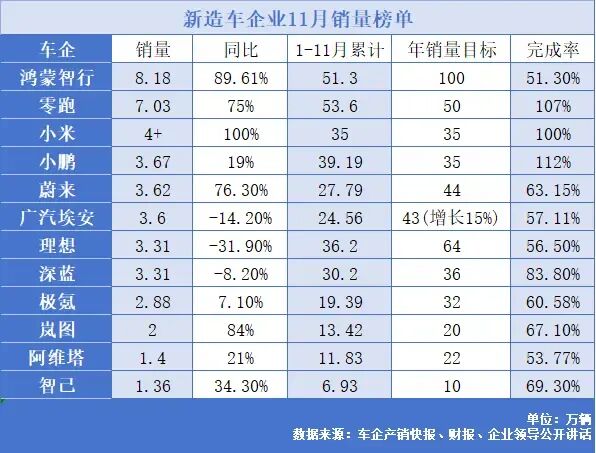
With 30 days to go, the engine roars of the 2025 auto market's final sprint are ringing out, and the sales report card for November is beginning to take shape.
According to the data released by various automakers, in November, Leapmotor, which has firmly held the title of "sales champion" among new forces, continued to exceed the 70,000 - unit mark, continuously refreshing its monthly sales record. It achieved its 2025 annual sales target of 500,000 units 45 days ahead of schedule and is marching towards the one - million - unit goal for next year.
Behind Leapmotor, the three new - energy vehicle startups "NIO, XPeng, and Li Auto", each delivering around 30,000 vehicles per month, are in hot pursuit and making a final sprint. XPeng Motors crossed the finish line ahead of schedule. NIO's sales have recovered, but it still falls short of its annual target. Li Auto, last year's "sales champion", continued to rank at the bottom among new forces in November and is still far from its revised annual sales target.
The "star" effect of the "cross - border players" Huawei and Xiaomi has continuously radiated to larger scales. With the combination of the "Five Worlds", Hongmeng Zhixing's sales exceeded 80,000 units in November, firmly holding the leading position among new automakers. However, it is far from achieving its ambitious goal of delivering one million units at the beginning of the year. Xiaomi's sales reached 40,000 units in November. While it completed its annual target ahead of schedule, its cumulative sales have exceeded 500,000 units, showing rapid growth.
The growth of the "second - generation automakers" is limited. Caught between the new - energy vehicle startups and the technology giants' cross - border competition, their overall annual target completion rate hovers around 60%. They are likely to miss their annual sales targets and fail to fulfill the lofty ambitions set at the beginning of the year.
Entering the next cycle, after the subsidy withdrawal, the auto market has become even more intense. Consumers are no longer sensitive to price fluctuations and are more rational in comparing various factors such as power, intelligent driving, and cost - effectiveness. They are taking longer to make decisions, which tests the patience and capabilities of automakers.
Leapmotor Leads by a Wide Margin, and the Ranking of "NIO, XPeng, and Li Auto" Changes
In November, Leapmotor's total deliveries reached a new high of 70,327 units, a year - on - year increase of over 75%. This is the second time that Leapmotor's monthly deliveries have exceeded 70,000 units, continuously refreshing its monthly sales record.
With nine consecutive months of strong growth, Leapmotor also achieved its annual sales target of 500,000 units last month, reaching its 2025 annual sales target 45 days ahead of schedule. With an upward growth trend throughout the year, Zhu Jiangming, the founder, chairman, and CEO of Leapmotor, has also set a goal of selling one million units in 2026 for the brand.

Firmly holding the sales championship among new forces, since the beginning of this year, the gap between Leapmotor and the three new - energy vehicle startups "NIO, XPeng, and Li Auto" has been widening. The former has achieved a monthly sales scale of 70,000 units, while the latter three are still hovering around 30,000 units.
XPeng delivered 36,728 vehicles in November, a year - on - year increase of 19% but a month - on - month decrease of 12.6%. From January to November this year, XPeng Motors' cumulative deliveries reached 392,000 units, a year - on - year increase of 156%. Looking back at the whole year, like Leapmotor, XPeng also completed its annual sales target of 350,000 units in October.
NIO delivered 36,275 new vehicles in November, a year - on - year increase of 76.3% but a month - on - month decrease of 10%. Among them, the NIO brand delivered 18,393 new vehicles, the LeDao brand delivered 11,794 new vehicles, and the Firefly brand delivered 6,088 new vehicles.
Benefiting from the continuous and stable growth of new orders for the new ES8, NIO's sales have gradually recovered, and the brand's delivery volume has increased for four consecutive months.
However, in terms of its annual target (440,000 units), NIO's sales in the first eleven months have just crossed the "passing line", with a completion rate of 63.15%. Although NIO said that "the production and delivery of the new ES8 will accelerate significantly in December", it is still likely to miss its annual target.
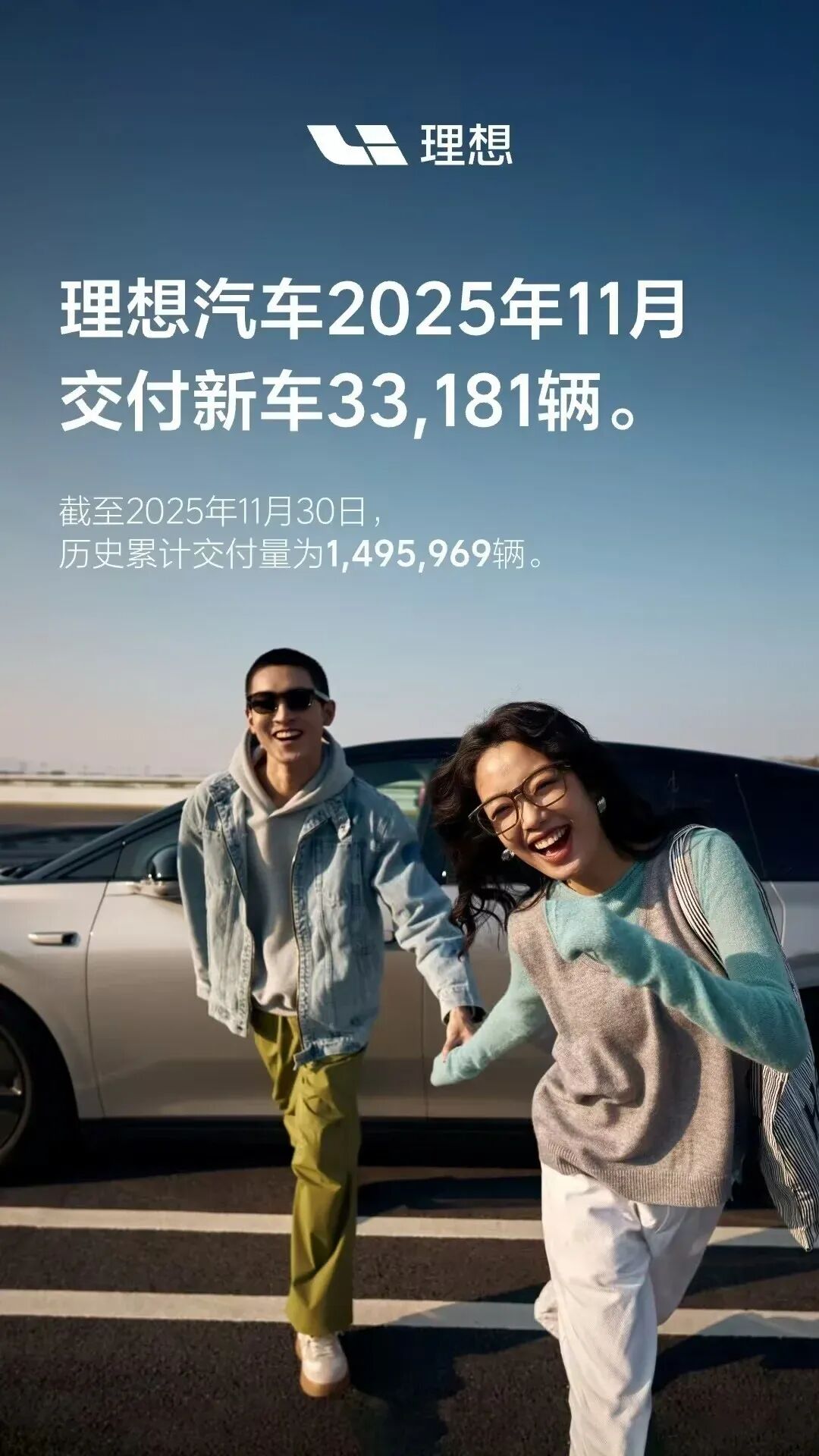
Entering a "decline period", Li Auto's delivery volume in November was 33,181 units, a year - on - year decrease of 31.9%. The former "sales champion" among new - energy vehicle startups has fallen to the bottom.
Repeatedly failing in its pure - electric strategy, as CEO Li Xiang said, in 2025, the brand encountered "various challenges brought about by the product cycle, public relations and public opinion, supply - chain acceleration, and policy changes", which affected the brand's delivery and operations. Previously, Li Auto had revised its 2025 sales target down to 640,000 units.
However, as of November, Li Auto's cumulative deliveries this year reached 362,000 units, and the completion rate of its annual target is less than 60%. In the face of the sales dilemma, it is difficult for Li Auto to achieve its annual target.
Leapmotor is running fast, and its leading advantage is getting bigger. The ranking of "NIO, XPeng, and Li Auto" has changed to "XPeng, NIO, and Li Auto". The sales landscape has been reshuffled, and the new - energy vehicle startups are accelerating their re - ranking.
Hongmeng Zhixing's Monthly Sales Exceed 80,000 for the First Time, and Xiaomi's Cumulative Deliveries Exceed 500,000
In November, Hongmeng Zhixing's total deliveries exceeded 80,000 units, a year - on - year increase of 89.61%, setting a new monthly delivery record. However, the specific sales of Wenjie, Zhijie, Xiangjie, Zunjie, and Shangjie were not announced. Despite the different scales within the group, the product family composed of the "Five Worlds" has still helped Huawei, which does not manufacture cars itself, reach the leading position in the industry.
The combination of the "Five Worlds" exceeding the 80,000 - unit mark has continuously reshaped the competitive landscape. In October, Hongmeng Zhixing's cumulative deliveries exceeded one million units, making it one of the fastest - growing brands in the Chinese new - energy vehicle industry.

However, for Hongmeng Zhixing itself, its self - expectation is obviously higher. In 2025, Hongmeng Zhixing set an annual delivery target of one million units for itself. With the efforts of the "Five Worlds", its cumulative deliveries in the first 11 months of this year reached 513,000 units. The completion rate of the annual delivery target of one million units is only over half. Although there is still one month left for a final sprint, the gap of about 500,000 units is obviously difficult to make up.
For the whole year of 2026, on one hand, there is a large gap between the achieved delivery volume and the one - million - unit target of the previous year. On the other hand, the new products of the "Five Worlds" brands are accelerating their iterations. It is worth looking forward to how Hongmeng Zhixing will plan for its 2026.
In November, Xiaomi Auto's cumulative deliveries exceeded 40,000 units, ranking among the top in the new - energy vehicle market. Achieving this result with only two models on sale, the Xiaomi SU7 and Xiaomi YU7, is really not easy. Xiaomi Auto has exceeded its annual target of 350,000 units set at the beginning of 2025.
Since "crossing over" into the auto - manufacturing industry on April 3, 2024, the "star" effect of Xiaomi in the auto circle has been continuously reflected in its sales scale. On December 2, 2025, Xiaomi Auto announced that its cumulative deliveries had exceeded 500,000 units, showing a fast - paced growth.

After the November sales results were announced, Xiaomi Auto announced a new car - purchasing model - "in - stock car selection". Xiaomi said that all in - stock cars have passed strict quality inspections. Some models have been repaired by the official and are all unregistered vehicles. Buying an in - stock car, customers can enjoy fast vehicle pick - up, complete original factory warranty, and after - sales service. Some models can enjoy discounts. Even if customers place an order before 24:00 on December 26, 2025, they are expected to pick up the car before the end of 2025.
It is reported that this is related to the frequent safety accidents and public opinions of Xiaomi this year. Under the public's doubts about its product performance and even its auto - manufacturing concept, combined with the one - year waiting period after the "explosive orders" and crazy rush to buy its products, Xiaomi's user stickiness has begun to decline, and a "cancellation wave" has emerged. The offline cars are waiting to be sold.
To some extent, Xiaomi's "in - stock car selection" model is also a signal of its declining orders. As the fastest - growing "star" in the auto circle, Xiaomi, which has exceeded its 2025 sales target, will face a more critical growth and stability period next year.
The "Second - Generation Automakers" May Miss Their Annual Sales Targets Collectively
Different from the "reshuffle" of new - energy vehicle startups and the rapid growth of the "cross - border players" Xiaomi and Huawei, the sales performance of the "second - generation automakers" in 2025 has collectively fallen short of their self - expectations, and their overall annual sales target completion rate hovers around 60%.
GAC Aion, which used to be in the "first echelon" with Hongmeng Zhixing and Li Auto, has been in a continuous decline in 2025. Its sales in November were 36,288 units, a year - on - year decrease of 14.2%. At the group level, GAC Group is undergoing an extreme transformation from organization to strategy. A series of changes after entering the "wartime state" still failed to help its self - developed "ace" - GAC Aion recover.
In the first eleven months of this year, GAC Aion's cumulative deliveries reached 245,600 units. Based on GAC Group's goal of a 15% growth in 2025, GAC Aion's annual sales should reach 430,000 units. As of November, the completion rate is only 57%.
Deepal, which is on the 30,000 - unit delivery line, had strong momentum in 2024 but has fluctuated this year. In November this year, Deepal's global sales were 33,060 units, remaining above the 30,000 - unit mark for three consecutive months. From January to November, its cumulative year - on - year growth was 45.7%. Although the scale of 300,000 units is still some distance from the annual target of 360,000 units set at the beginning of the year, it has ranked at the forefront among the "second - generation automakers".
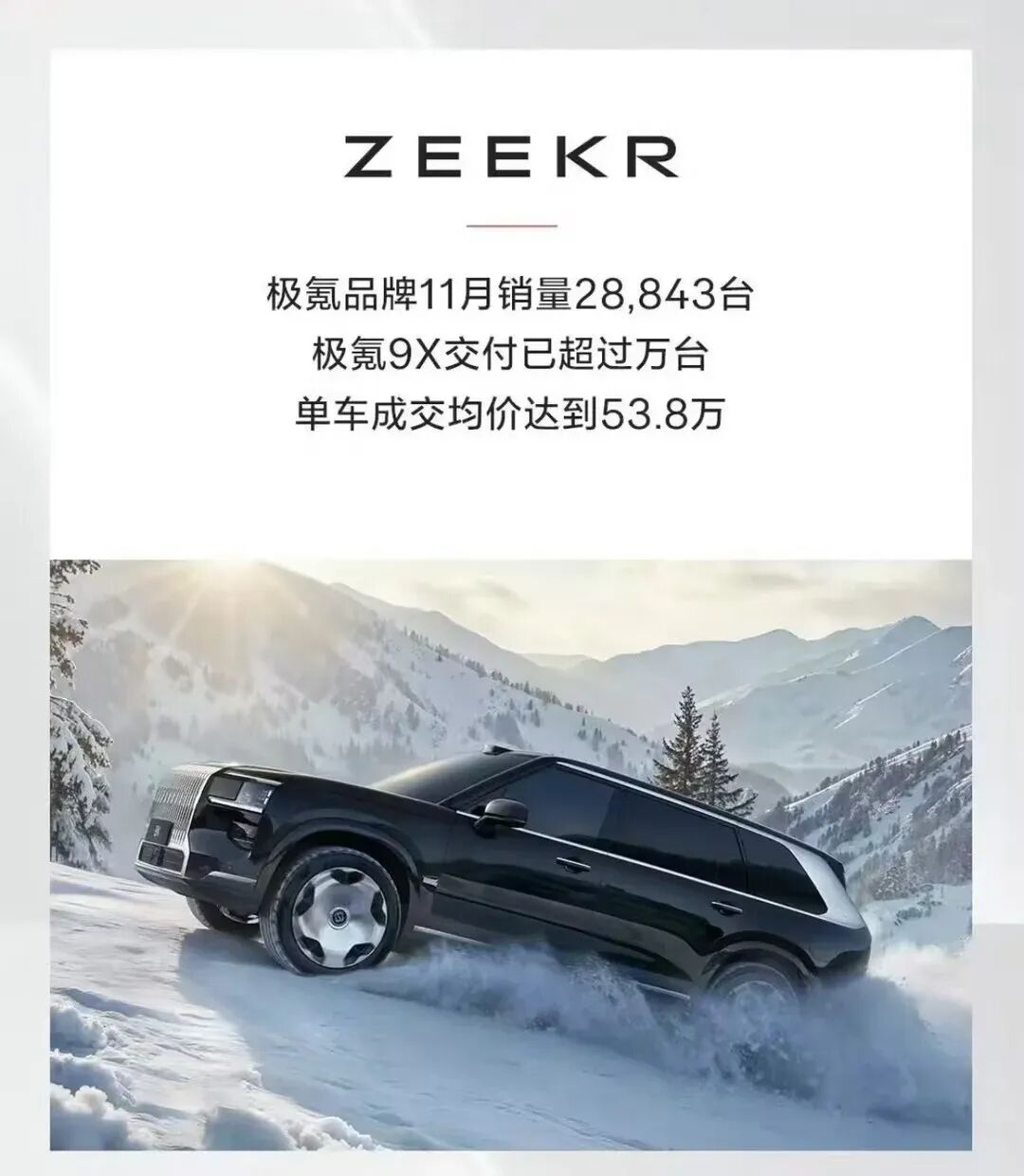
ZEEKR delivered 28,800 vehicles in November, a year - on - year increase of 7%. Its cumulative deliveries in the first 11 months reached 193,900 units. Compared with the annual delivery target of 320,000 units set at the beginning of the year, the completion rate is 60%.
As a new - energy vehicle brand under a central state - owned enterprise, Voyah's delivery volume exceeded 20,000 units for the first time in November, reaching 20,005 units, a year - on - year increase of 84% and a month - on - month increase for 10 consecutive months. Since the beginning of this year, Voyah's cumulative deliveries have reached 134,000 units. According to the annual target of 200,000 units, the completion rate is 67%. The Avita brand under Changan Automobile delivered 14,000 vehicles in November. Its cumulative deliveries in the first 11 months of this year reached 118,300 units. Compared with the annual delivery target of 220,000 units, Avita has completed 53.77%.
As the brand with the lowest sales, IM Motors under SAIC Group delivered 13,600 vehicles in November, ranking at the bottom. In the first 11 months of this year, IM Motors' cumulative deliveries reached 69,300 units, and the completion rate of its annual target is 69.3%.
Caught between the new - energy vehicle startups and the technology giants' cross - border competition, the growth of the "second - generation automakers" is limited, and the market share they can obtain in the limited market is even more limited. They are likely to miss their annual sales targets collectively. Obviously, these new - energy vehicle brands incubated by traditional automakers in 2025 have