Consumer Transformation: Inheritance and Innovation | 36Kr WISE2025 King of Business Conference
From November 27th to 28th, the 36Kr WISE 2025 Business King Conference, hailed as the "annual barometer of technology and business," was held at the Conduction Space in the 798 Art District in Beijing.
This year's WISE is no longer a traditional industry summit but an immersive experience centered around the theme of "technology-infused short dramas." From AI reshaping the boundaries of hardware to embodied intelligence opening the door to the real world; from the globalization of brands in the wave of going overseas to traditional industries embracing digital transformation—what we present here is not just trends but also the insights gained from numerous business practices.
In the following content, we will dissect the real logic behind these "exciting dramas" frame by frame and explore the unique business landscape of 2025.
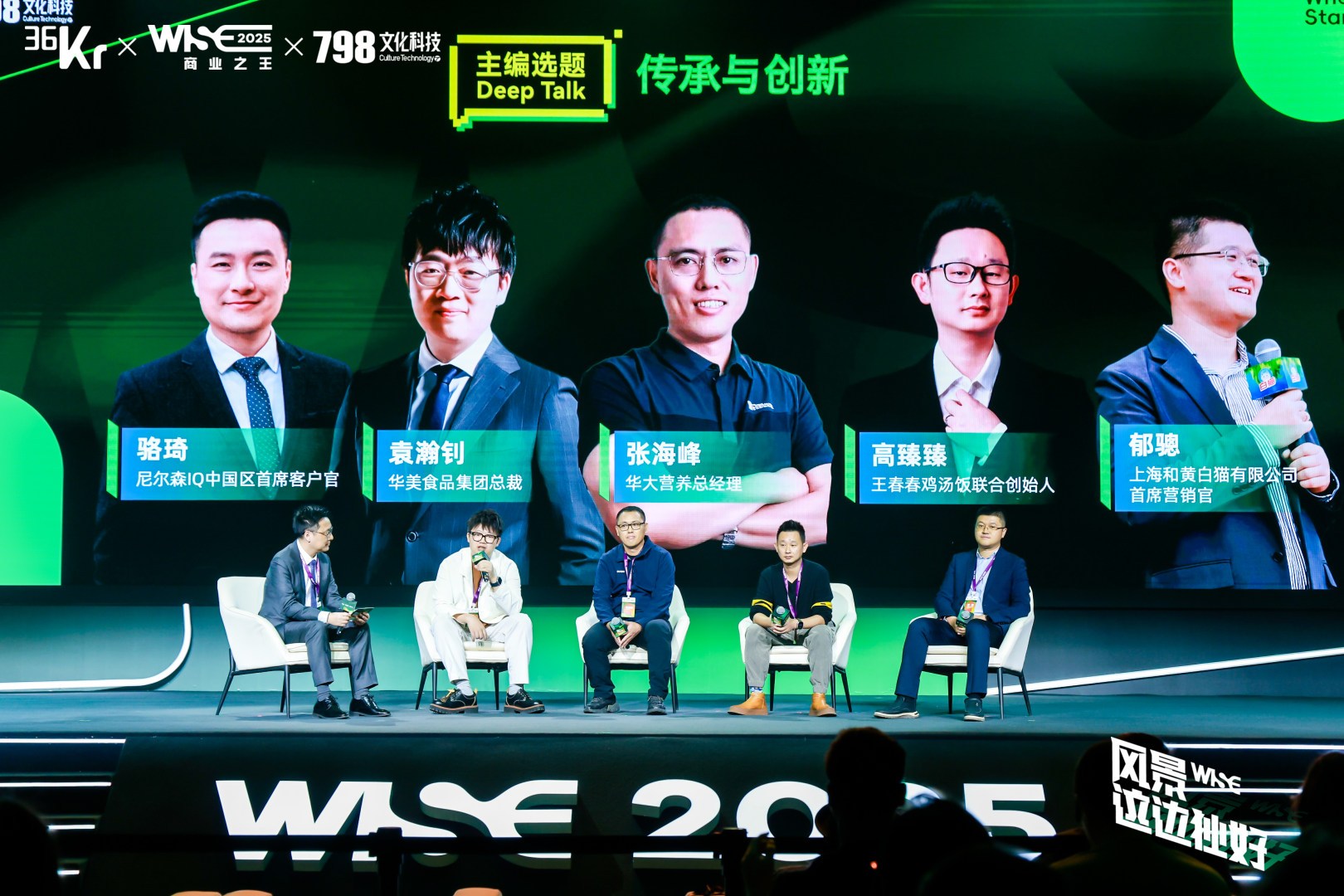
Roundtable on Consumption Transformation: Inheritance and Innovation
The following is the content of the roundtable discussion, edited by 36Kr:
Luo Qi | Chief Client Officer of Nielsen IQ China (Host)
Yuan Hanzhao | President of Huamei Food Group
Zhang Haifeng | General Manager of BGI Nutrition
Gao Zhenzhen | Co-founder of Wang Chunchun Chicken Soup Rice
Yu Cong | Chief Marketing Officer of Shanghai Hutchison White Cat Co., Ltd.
Luo Qi: Good morning, dear guests and friends! I believe you've gained a lot of new knowledge after listening to the insightful speeches this morning. Especially in the previous roundtable, we discussed how technology drives innovation. Now, what are we going to talk about in this session? As you can see, we have representatives from many traditional enterprises here, including myself. We're going to discuss how traditional enterprises can innovate in this era of rapid change.
First, let me introduce myself. I'm Luo Qi from Nielsen IQ. Nielsen IQ is a 102-year-old company, and we're always concerned about how to innovate continuously to better serve the current era.
Next, I'd like to give the floor to our guests. Could you briefly introduce yourself and your company to our audience in one or two minutes? Let's start with Mr. Yuan.
Yuan Hanzhao: Good morning, everyone! I'm Yuan Hanzhao from Huamei Food. I'm currently the president of Huamei Food, and I'm also the inheritor of the intangible cultural heritage of Cantonese mooncake-making skills. Although the mooncake industry may seem traditional, Huamei is doing something new. We started to build a new model of "culture + industry" a few years ago and used cultural empowerment to promote our traditional products to new consumers. In this process, we established the first mooncake museum in China. Through product innovation and a social responsibility system, we've upgraded our products and presented the traditional industry in a new light to the market.
Today's theme is inheritance and innovation. I believe true inheritance means turning tradition into a trend.
Luo Qi: Thank you, Mr. Yuan. Next, Mr. Zhang?
Zhang Haifeng: Hello, everyone! I'm Zhang Haifeng from BGI Nutrition.
BGI Nutrition began researching the human gut microbiota globally in 2008. With 17 years of history, we've published over a hundred high-level scientific research papers and built a strain library of over 60,000 gut bacteria from healthy Chinese people. We hope to continuously screen comprehensive gut health solutions more suitable for the Chinese population through scientific research and practice.
Gao Zhenzhen: Hello! I'm Gao Zhenzhen, the co-founder of Wang Chunchun Chicken Soup Rice. We're in the healthy fast-food business, with over 200 franchise stores. More than 200,000 people visit our restaurants every month.
Yu Cong: Hello, everyone! I'm Yu Cong, the Chief Marketing Officer of Shanghai Hutchison White Cat. White Cat is a well-established brand in Shanghai, mainly producing daily chemical cleaning products like dishwashing liquid and laundry powder. So, we're a typical traditional enterprise with a long history.
Our company was founded in 1948 and was the first daily chemical factory in China. Our brand was launched in 1963 and has a history of 60 to 70 years. In the development of the domestic daily chemical industry, White Cat was the first to produce and launch dishwashing liquid and laundry powder in China, witnessing the development of the domestic daily chemical cleaning industry. Maybe because our brand is named after a cat, and it's said that a cat has nine lives, we've managed to survive for a long time.
We're very glad to have the opportunity to participate in this event. We hope to find new directions in the increasingly complex competitive environment and continue to thrive for the next 70 years.
Luo Qi: Today, we have representatives from different industries, such as the daily chemical and catering industries, sitting at this roundtable. I believe that all of you have inherited a lot of valuable traditions over the years. So, my first question for you is: what do you think is the most important thing to inherit in your respective industries, and what was your latest innovation? Let's start with Mr. Yuan.
Yuan Hanzhao: Well, regarding inheritance and innovation, my understanding is that it's about making "unchanging" choices for the brand in an uncertain market environment. For Huamei, the first unchanging aspect is inheritance. Quality comes first, which is the foundation of the food industry and the guarantee of food safety and quality. As we all know, after the pandemic, the market environment has changed significantly. Many business owners may be pessimistic and trapped in the information cocoon of "consumption downgrade" and "economic downturn" on social media. They may choose to launch lower-priced products or even reduce the quality and configuration. However, Huamei believes that brand stability, brand commitment, and brand guarantee become more valuable when the market environment is uncertain or volatile. This is our first unchanging principle.
The second unchanging aspect is that we've separated our low-priced products and placed them under our sub-brands. Huamei focuses on its mainstream price range because we believe that in the current market environment, we need to give consumers a clearer signal and more certainty from the brand. We're moving from a "big and comprehensive" brand strategy to a more focused one.
After listening to the sharing of Mr. Wang Fei from Nielsen, I agree that cultural resonance will be a crucial factor, which is our third unchanging principle. The mooncake industry is a traditional one with rich cultural and historical connotations. We need to find Huamei's unique position in this cultural context and tell our brand story within this large cultural system. This is what we think should be inherited and what our team will continue to work on in the next 5 to 10 years.
In terms of innovation, our biggest innovation this year is our cultural empowerment strategy. We attach great importance to culture and are developing both the cultural and business aspects simultaneously. This year, we established the first mooncake-themed museum in China, which offers a variety of experiences, including research and study programs, DIY activities, industrial tourism, and a super bakery. It's a comprehensive complex.
We also launched an initiative to support China's application for the inclusion of the Mid-Autumn Festival in the World Intangible Cultural Heritage List. As a leading enterprise in the industry, we believe that our innovation efforts should focus on promoting the development of the entire industry and elevating the Mid-Autumn Festival culture to a new level. Instead of getting involved in the intense competition, we want to expand the market and create a better future for the industry.
That's our answer.
Luo Qi: Thank you, Mr. Yuan. Your answer is very insightful. In summary, I think traditional industries need to first identify their core values and stick to them without being influenced by market trends. At the same time, an important aspect of innovation is to bring out our culture and resonate with today's consumers. This is a way for traditional enterprises to find new growth points and breakthroughs.
Thank you, Mr. Yuan!
Next, I'd like to ask Mr. Zhang. How do you view the relationship between change and constancy?
Zhang Haifeng: BGI Nutrition is a subsidiary of BGI Group, a globally renowned life science research, education, and industrial institution with a 26-year history. In the 2025 global industrial technology strength ranking, BGI Group has risen to the second place in the world and has been the first in the Asia-Pacific region for ten consecutive years. Therefore, we have an inherent scientific research gene. The first thing we inherit is BGI's scientific spirit of "seeking truth from facts," always adhering to evidence-based practice.
In the field of nutrition and health, all nutrition solutions should be based on solid evidence rather than empty concepts. We've always been committed to applying scientific spirit to the industry and transforming cutting-edge life science research results into tangible and verifiable solutions.
The second thing we inherit is the respect for individuals. We use data to understand each person, respecting the complexity and uniqueness of life. Relying on BGI's unique population cohort and AI platform, we can unlock the health secrets of each individual, moving nutrition from experience-driven to data-driven and providing long-term value for every life.
The third thing is the long-term perspective of "looking at the long term." We refuse short-sighted speculation and choose to be friends with time. We adhere to science, safety, and effectiveness as our unwavering bottom line, respecting business rules and ethics. We aim to create products and services that can stand the test of time and grow steadily with our users in the future.
Regarding innovation, our most significant breakthrough in 2025 was the upgrade of the probiotic gut health solution from a general and vague supplement to a personalized and precise intervention system based on individual gut microbiota data. This redefines the value logic of gut microbiota health management. It's not only a product innovation but also a complete paradigm shift. Starting from gut microbiota testing, combined with AI formulation and full-process health management, we've achieved a closed-loop from testing to intervention to health guidance. This not only expands the application scenarios and effectiveness of probiotics but also promotes the transformation of nutrition and health from a population-based average to individual precision, setting a new benchmark for the industry with data and evidence at its core.
Luo Qi: Thank you, Mr. Zhang. When you talked about constancy, you mentioned the scientific spirit, data-driven decision-making, and long-term perspective. These are simple yet profound principles, but it's the most difficult to adhere to them through all the challenges. I think we should give a round of applause to traditional enterprises for their perseverance in this regard.
In addition, when you talked about innovation, our research at Nielsen also shows that in the current market, consumers are moving from simply having products to demanding high-quality and personalized ones. However, there are some contradictions. Customization may lead to higher prices and a lack of economies of scale for manufacturers. I'd like to ask you, Mr. Zhang, how does BGI view this future trend?
Zhang Haifeng: There are two aspects to this. First, we've developed a standardized probiotic product matrix for the general public, such as the Youmeida series of BGI Nutrition. We've formulated different products to meet the specific health needs of different groups. For example, Yichang is designed for people with bowel and digestion problems, and Yixiu is for those with sleep and stress management issues. In addition, we have product lines for blood sugar management, weight control, and female intimate care. We'll continue to provide consumers with a wide range of options to choose the most suitable products for themselves. As a result, BGI Nutrition probiotics have ranked first in domestic probiotic sales for three consecutive years.
Second, since each person is unique, and their genetic background and diet determine their unique gut microbiota composition, just like fingerprints, we customize personalized probiotic formulas based on individual gut microbiota data. We then adjust the formulas dynamically to achieve a complete closed-loop of "testing - intervention - guidance," providing more precise solutions for comprehensive health needs.
However, the essence of this solution lies in having a large population cohort, data support, and a strain library with a wide range of functions. From this strain library, we can continuously screen for strains that can improve health. With the development of science and technology, gut health management will become a more accessible and effective solution for everyone.
Luo Qi: Thank you, Mr. Zhang. After your introduction, I have a more concrete understanding of the future development. Maybe one day, we can also customize mooncakes for individuals based on their health data, such as for people with diabetes, and add their names to make gift-giving more meaningful. Thank you, Mr. Zhang. It's very interesting!
Next, I'd like to ask Mr. Gao. How do you view the relationship between change and constancy?
Gao Zhenzhen: Well, regarding the first question, what have we inherited? We have two intangible cultural heritages, but I don't want to talk about them. Instead, I want to ask you a question. A foreigner asked me some time ago, "What is Chinese cuisine?" It's not easy to answer. Is it a variety of dishes? No. I thought about it for a long time but couldn't find an answer. Then an old Chinese doctor beside me told me that Chinese cuisine is about eating according to the season, the region, and the individual. So, what have we inherited in the catering industry? We've inherited the ancient Chinese philosophy of "going with the flow."
Now, let's talk about what we've specifically inherited in the Wang Chunchun Chicken Soup Rice project. First, do you know when the earliest record of chicken soup was? I was shocked to find out that it was during the time of Emperor Yao in the era of Yao, Shun, and Yu, about 4300 years ago. Peng Zu gave Emperor Yao a bowl of chicken soup when he was ill, and the emperor recovered and granted Peng Zu a fief. This is the earliest record. Throughout history, nine emperors and 18 historical figures, such as Li Bai and Lu You, have expressed their love for chicken soup in their poems and writings. So, we're inheriting a long history and cultural tradition, passing on the baton of history. This is the first aspect.
Second, what else have we inherited? You may be surprised to know that although Wang Chunchun Chicken Soup Rice has a relatively light taste, it's very popular in Chongqing, a place known for its spicy food and hot pot. I realized that this implies the principle of yin and yang. As people in Chongqing consume more spicy and stimulating food, there's a growing demand for light and healthy food among young people. That's why our business is booming. By going with the flow, we've found our place in the market, with over 200,000 people visiting our restaurants every day.
Third, as China becomes more powerful and confident, and with the revival of Chinese culture, we're a brand that grows along with the country's development. In the future, after establishing a solid foundation in the domestic market, we hope to become a "Confucius Institute" in the catering industry in three years and promote Chinese cuisine globally through cultural diplomacy.
That's what we've inherited.
Now, let's talk about innovation. Although we're in the fast-food business, we also adhere to some traditional Chinese medicine concepts, but not too strictly. We also pay attention to the five flavors of sour, bitter, sweet, spicy, and salty. However, we're more focused on meeting the needs of current consumers. For example, young people, especially girls, are concerned about insomnia, hair loss, and menstrual pain. So, we've developed different products for different scenarios. Instead of just offering a simple bowl of chicken soup, our products are more targeted. For example, we have a flower glue beauty chicken soup for women who want to improve their skin, which is like a "drinkable skin booster." And for women with menstrual pain, we have an angelica and red date warm palace soup, which is like a "portable warm baby" in winter. These are our innovations. We're also working on obtaining low-GI and low-purine certifications to make our food healthier.
In summary, we've created a new category called "nourishing fast food." There are many businesses focusing on health and many fast-food brands, but combining the two is not easy. We're a unique player in the catering industry.
Thank you!
Luo Qi: Thank you, Mr. Gao. Your speech is very inspiring, and I really resonate with it. As you mentioned, chicken soup has a history of thousands of years, and we all know its benefits. Your innovation not only lies in the nourishing aspect but also in the concept of scenario marketing. People know the benefits of these ingredients but don't have the time to cook them at home. By offering a variety of options in our restaurants, we can meet the different needs of consumers in different scenarios, giving new life to the traditional chicken soup.
Speaking of innovation, I'd like to ask you another question. In the catering industry, many innovations are related to pre-packaged food, especially in fast-food restaurants. Pre-packaged food can ensure product safety and improve supply chain efficiency, which is beneficial to the industry. However, there are also some opposing voices, advocating for freshly cooked food. We know that Wang Chunchun Chicken Soup Rice is still freshly cooked every day. Won't this increase your cost? How do you consider this issue when making innovation decisions?
Gao Zhenzhen: Well, I'd like to say that all great brands are built on persistent efforts. We have two "stub